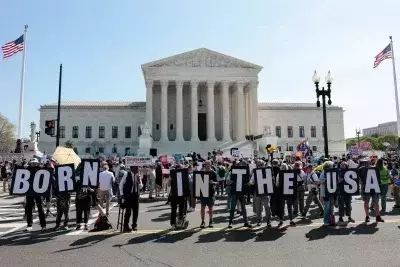
The United States Supreme Court recently deliberated on a highly contested legal matter concerning birthright citizenship, a case brought forward by the Trump administration. This legal challenge, which questions the automatic citizenship of children born in the U.S. to undocumented immigrants, has ignited fervent discussions both within the judiciary and among the public. The presence of former President Trump at the oral arguments, a rare occurrence for a sitting or former president, highlighted the political gravity of the proceedings. Outside the courthouse, impassioned demonstrators gathered, advocating for the preservation of the current interpretation of the 14th Amendment, which underpins birthright citizenship. The eventual ruling on this case is anticipated to have profound implications for immigration policy and the definition of citizenship in the U.S.
A Nation's Identity: The Birthright Citizenship Debate at the Forefront of Justice
Judicial Scrutiny: Justices Challenge Administration's Stance on Birthright Citizenship
During the Supreme Court's session, a significant number of justices, including prominent conservative figures such as Chief Justice John Roberts and Justices Neil Gorsuch, Brett Kavanaugh, and Amy Coney Barrett, expressed considerable skepticism regarding the Trump administration's legal position. The administration, represented by Solicitor General D. John Sauer, argued that birthright citizenship, as currently understood, should not extend to children born within U.S. borders to parents who are undocumented immigrants. The justices' intense questioning suggested a deep dive into the historical and legal underpinnings of the 14th Amendment.
Ambiguity and Intent: A Deep Dive into the 14th Amendment's Language
The core of the legal debate centered on the precise wording and original intent of the 14th Amendment, particularly its citizenship clause. Justice Gorsuch, for instance, pressed Solicitor General Sauer on the historical context of immigration laws in 1868, contrasting them with the modern interpretation. The discussion also revisited the landmark case of Wong Kim Ark, a precedent frequently cited in support of universal birthright citizenship, with Justice Gorsuch playfully suggesting caution in its application. Justice Kavanaugh further questioned why the language of the 14th Amendment differed from the Civil Rights Act of 1866, particularly regarding the phrase "not subject to any foreign power."
Puzzling Arguments and International Comparisons in Citizenship Debates
Justice Kavanaugh also dismissed the relevance of international citizenship laws in the U.S. legal context, emphasizing that legal interpretation should not be swayed by practices in other countries. Justice Barrett found certain aspects of Sauer's arguments "puzzling," particularly his attempt to understand why the framers did not explicitly tie citizenship to bloodline (jus sanguinis) rather than soil (jus soli). This line of questioning underscored the complexities in interpreting the original intent behind the constitutional provision.
Clashing Interpretations: Alito Versus Wang on the 14th Amendment's Meaning
Cecillia Wang, representing the American Civil Liberties Union, faced rigorous questioning, particularly from conservative Justice Samuel Alito. Alito challenged Wang on her interpretation of the 14th Amendment's intent. While Wang conceded that the general spirit of both the 1866 Civil Rights Act and the 14th Amendment might have been similar, she highlighted that the Wong Kim Ark ruling served to clarify any existing ambiguities in the amendment's application. Wang further clarified that the phrase "foreign powers" within the legal framework specifically refers to diplomatic immunity, exempting children of ambassadors from automatic citizenship.
Public Outcry: Advocates Rally Outside the Supreme Court for Birthright Citizenship
Outside the Supreme Court building, a vibrant demonstration unfolded, with numerous individuals gathering to voice their support for birthright citizenship. Organizations such as the ACLU, CASA, and the League of United Latin American Citizens distributed literature championing the 14th Amendment and its guarantee of citizenship. Participants, many of whom were birthright citizens themselves, shared personal stories, emphasizing the profound impact of this constitutional right on their lives and their sense of belonging to the United States. The rallies underscored the strong public sentiment surrounding this pivotal issue.
Confident Voices: ACLU Leaders Express Optimism Following Oral Arguments
Following the conclusion of the oral arguments, ACLU Executive Director Anthony Romero conveyed a sense of confidence in the outcome. Addressing the gathered crowd, Romero framed the fight for birthright citizenship as a battle for the core values and future identity of the nation. He emphasized that the issue extends beyond historical precedent, touching upon the lives of families and communities across the country, reiterating a commitment to justice and fundamental rights. The unprecedented attendance of former President Trump at the proceedings further amplified the high stakes of this judicial review.
