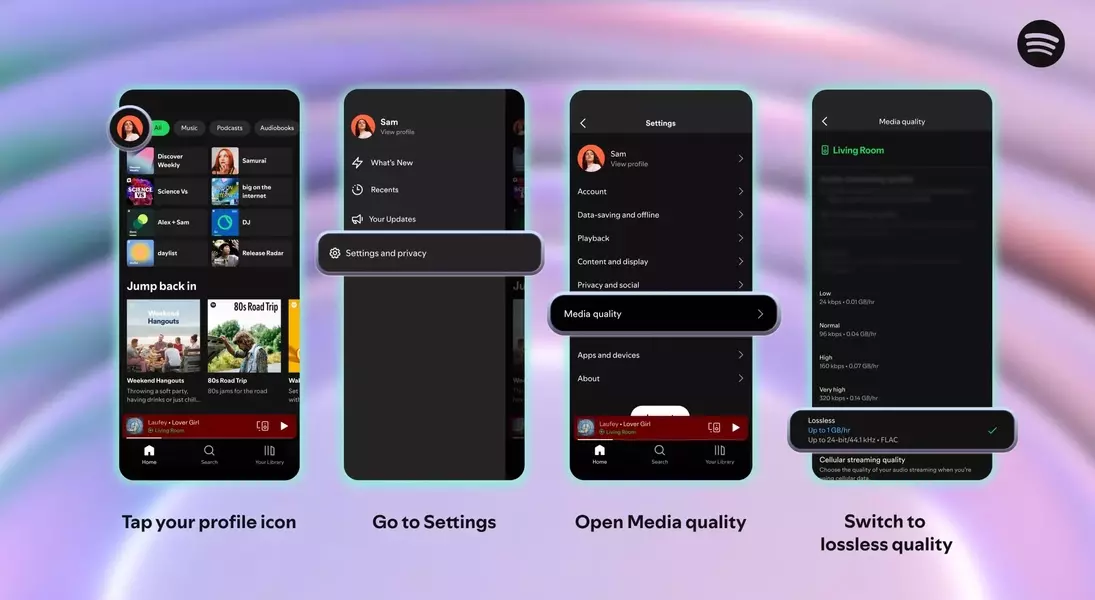

For many years, high-quality audio has been a much-discussed topic among music streaming enthusiasts. Spotify, a leading name in the industry, has now answered this call by officially launching lossless audio. This enhancement, eight years in the making, promises an elevated listening experience for its dedicated Premium user base. Unlike some competitors, Spotify is integrating this feature into existing Premium subscriptions, avoiding additional charges or new tiered memberships.
Spotify's High-Fidelity Audio Arrives After Long Anticipation
Spotify, the popular music streaming service, has officially rolled out its lossless audio feature, fulfilling a promise that has been teased for nearly a decade. On September 10, 2025, the company began implementing 24-bit/44.1 kHz FLAC quality streaming for its Premium subscribers. This move comes after years of speculation and various rumors, dating back to 2017 when early whispers of a "HiFi" offering first emerged. In 2021, Spotify explicitly stated that a high-fidelity option would arrive that year, yet it remained elusive until now. By May 2024, leaks suggested the feature was "almost ready," leading to renewed skepticism when further rumors surfaced in June 2025.
Contrary to previous speculation about new, higher-priced subscription tiers like "Spotify HiFi" or "Music Pro," lossless audio will be included as part of the existing Premium plan. This inclusive approach sets Spotify apart from some rivals and is a welcome development for subscribers. The rollout will occur over the next two months, starting with 12 key markets: Australia, Austria, Czechia, Denmark, Germany, Japan, New Zealand, the Netherlands, Portugal, Sweden, the United States, and the United Kingdom.
Subscribers will be notified directly within the Spotify app once lossless audio becomes available for their account. They can then activate the feature through the media quality settings. When actively streaming in lossless quality, a visual indicator will appear in the Now Playing bar and via the Connect Picker for compatible devices. Initially, this compatibility extends to hardware from major brands such as Sony, Bose, Samsung, and Sennheiser. Support for Sonos and Amazon devices is anticipated to follow in October 2025.
While Spotify's lossless offering at 24-bit/44.1 kHz FLAC is a significant upgrade, it's worth noting that competitors like Apple Music, Tidal, and Qobuz provide higher-resolution FLAC streams, reaching up to 24-bit/192 kHz. For the average listener, distinguishing between these higher bitrates may prove challenging without high-end audio equipment. However, this distinction does leave open the possibility for Spotify to introduce a "deluxe" tier in the future, should it choose to cater to the most discerning audiophiles and generate additional revenue. With this launch, YouTube remains one of the few major music streaming services that does not support lossless audio, with no immediate plans for its inclusion.
This long-awaited upgrade from Spotify marks a significant moment for both the platform and its users. It highlights the evolving landscape of music streaming, where audio quality is increasingly becoming a key differentiator. The decision to include lossless streaming within the existing Premium plan demonstrates a commitment to enhancing user experience without imposing extra costs, fostering greater loyalty among its subscriber base. This move also puts pressure on competitors, particularly those who have yet to embrace high-fidelity options, to adapt to the growing demand for superior sound quality.
