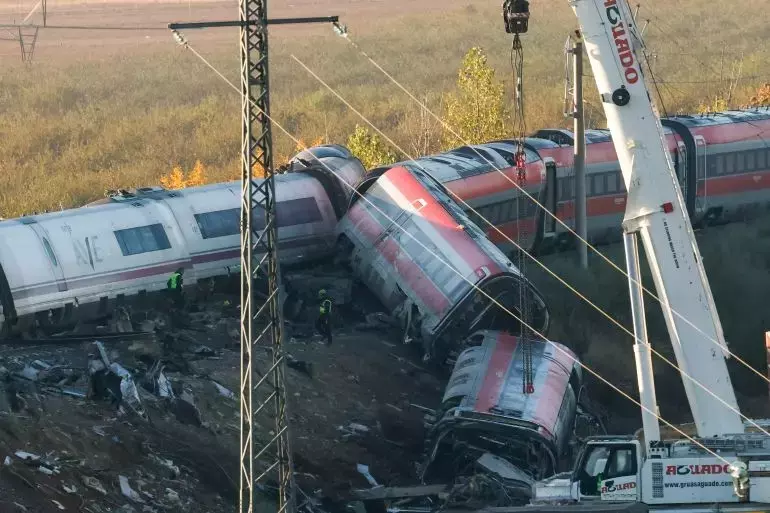
Emergency responders in Spain are currently engaged in a meticulous search for victims and potential survivors, following a devastating high-speed train collision that occurred a day prior. The incident, which took place in Toledo province, has tragically resulted in 68 fatalities, marking the second such catastrophic event on the nation's rail lines within the current year.
On Thursday morning, a day after the rear-end collision, specialized rescue units, accompanied by canine teams trained to locate human remains, persisted in their efforts to navigate through the mangled wreckage. Heavy lifting equipment, including cranes, has been deployed to assist in moving the collapsed train carriages, as police and military personnel meticulously sift through the debris scattered across the gravel embankment where at least three carriages veered off track due to the force of the impact.
Esther Padilla, a spokesperson for the regional government of Castilla-La Mancha, emphasized the cautious nature of the ongoing operation during an interview with TVE. She stated that teams are proceeding with extreme care, as there is no absolute certainty that additional victims are not still trapped within the deformed metal. Padilla also confirmed that a canine unit, initially deployed on Wednesday, would be re-engaged to ensure no individuals are overlooked in the wreckage. As of now, 53 individuals remain hospitalized, with 15 listed in critical condition. In solemn remembrance of those who perished, the authorities have declared a three-day period of national mourning.
This latest accident eerily mirrors a previous fatal collision earlier this year, involving the same railway operators and occurring on the identical route. In January, 46 people lost their lives when a train derailed and collided with another traveling in the opposite direction in the southern region of Spain. The recurrence of such devastating events has reignited a national discourse regarding the robustness and safety standards of Spain's high-speed rail network. This network, recognized as the most extensive in Europe, had previously been a source of national pride until these recent tragedies cast a shadow of doubt.
Transport Minister Oscar Puente disclosed that the recent crash was precipitated by several trains automatically halting due to a signal malfunction. Subsequently, a state-operated Renfe train was granted clearance to proceed at its regular speed, despite the presence of a stationary Iryo-operated train ahead on the track. In response to the crisis, Prime Minister Pedro Sanchez visited the crash site on Wednesday, vowing to launch a thorough investigation into the collision. He also committed to implementing significant safety enhancements to prevent any future recurrences, aiming to restore public trust in a rail system that transported 45 million passengers last year, including millions of international visitors. Sanchez unequivocally stated that it is unacceptable for a nation like Spain to experience two high-speed train accidents in a single year, underscoring the urgency of the situation.
The Spanish train drivers' union, SEMAF, has refrained from speculating on the precise cause of the accident, advocating for prudence until a detailed understanding of the events can be established. Meanwhile, SEMAF confirmed that its members have proceeded with a previously scheduled strike, initiated to advocate for improved railway safety measures and structural reforms within the system.
The recent train disaster in Toledo province, resulting in a significant loss of life and numerous injuries, underscores pressing concerns regarding the safety and operational protocols of Spain's high-speed rail network. With investigations underway and a commitment from government officials to enhance safety, the nation faces the critical task of rebuilding confidence in its advanced railway system while addressing the underlying issues that led to these tragic incidents.
