
Discover Snowflake's transformative journey in the data landscape, from revolutionizing data unification across disparate cloud environments to pioneering advanced artificial intelligence development. This article delves into the company's recent financial achievements, highlighting its accelerated revenue growth and strategic AI innovations, while also addressing critical considerations regarding its current valuation and profitability challenges.
Unlocking Data's Potential: Snowflake's Vision for the Future
Bridging Cloud Silos: The Genesis of Snowflake's Data Cloud
In today's complex digital ecosystem, major organizations often utilize multiple cloud service providers, such as Microsoft Azure and Amazon Web Services, for their operational needs. This distributed infrastructure frequently results in fragmented data, making it challenging to consolidate and analyze crucial information stored across different platforms. Snowflake emerged to address this very issue, introducing its pioneering Data Cloud. This innovative solution operates above existing cloud infrastructures, allowing enterprises to centralize their dispersed data. By integrating diverse data sources into a single, accessible repository, businesses can extract more precise and actionable insights, fundamentally transforming their analytical capabilities.
Empowering AI Development: Snowflake's Expanding Toolkit
Snowflake's strategic positioning extends deeply into the artificial intelligence domain. Recognizing the critical need for seamless data access in AI model development, the company has significantly enhanced its product portfolio. The introduction of Cortex AI in 2023 provides businesses with direct access to sophisticated large language models (LLMs) from leading industry players, including OpenAI's latest GPT-5. Through Cortex, organizations can integrate their proprietary data with these advanced models to create tailored AI applications. Furthermore, tools like Document AI streamline data extraction from unstructured documents, while Cortex Agents can be trained for autonomous task execution, such as analyzing sales interactions to identify revenue-generating opportunities. The forthcoming Snowflake Intelligence platform, currently in public testing, promises to democratize data interaction by enabling natural language queries, empowering even non-technical personnel to derive valuable insights effortlessly. As of the fiscal 2026 second quarter, over 6,100 of Snowflake's 12,062 customers were actively leveraging its AI products weekly, underscoring the growing adoption of these solutions.
Financial Momentum and Valuation Nuances
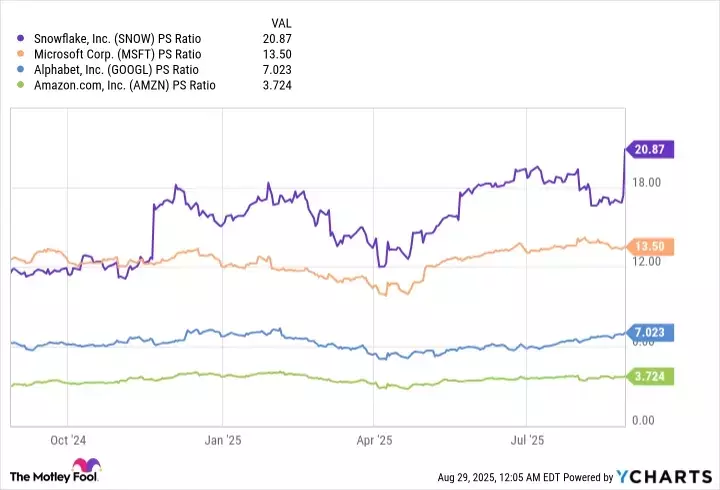
Snowflake's recent financial disclosures for its fiscal 2026 second quarter (ending July 31) showcased impressive growth, with product revenue reaching $1.09 billion, comfortably surpassing management's projections. This figure represents a robust 32% increase year-over-year, marking a notable acceleration from the 26% growth observed in the prior quarter and reversing a trend of decelerating revenue growth. The company's net revenue retention rate also saw a sequential improvement, indicating that existing customers are increasing their spending, partly attributable to the successful uptake of new AI products. Furthermore, remaining performance obligations (RPOs), a key indicator of future demand, surged by 33% annually to a record $6.9 billion. However, the financial narrative isn't without complexities. Snowflake reported a GAAP net loss of $298 million for the quarter, contributing to a staggering $728 million loss for the first half of fiscal 2026. While non-GAAP metrics present a more favorable picture by excluding substantial stock-based compensation, the dilutionary impact of such expenses on existing shareholder value remains a concern. The company's current valuation, with a price-to-sales (P/S) ratio of 20.8, is at a one-year high and significantly exceeds those of major cloud providers, suggesting that despite its operational strengths, the stock's near-term upside may be constrained. Investors considering Snowflake stock might need to adopt a long-term perspective, potentially five years or more, to fully realize their investment's potential.
