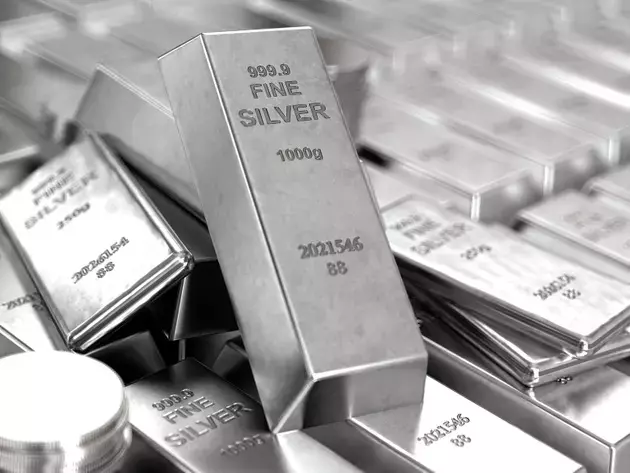
This article presents a detailed analysis of silver's recent performance in the financial markets, focusing on its price movements, technical indicators, and the broader macroeconomic factors influencing its valuation. It provides insights into potential support and resistance levels, offering a comprehensive view for traders and investors.
Navigating Silver's Volatility: Understanding Key Market Signals
Decoding Silver's Recent Price Action
On February 16, the spot price of silver (XAG/USD) experienced a downturn, settling around $76.10, a decline from its opening position near $76.36. This movement occurred within a substantial intraday range, spanning from $74.78 to $77.49. Such a wide fluctuation within a single day is particularly noteworthy, especially considering that the average true range (ATR) for the past 14 days typically indicates less volatility. This extended range underscores the impact of reduced market liquidity, a common characteristic of holiday trading periods, which can amplify intraday price swings and lead to exaggerated probes into new price territories.
Technical Indicators Pointing to a Bearish Bias
Several technical indicators suggest a prevailing bearish sentiment in the silver market. The Relative Strength Index (RSI) for a 14-period setting was observed near 44.5, signaling that momentum leans towards the downside. Concurrently, the Moving Average Convergence Divergence (MACD) was marginally negative, further reinforcing the bearish outlook. Additionally, key moving averages were positioned above the spot price, indicating that silver was trading below these significant technical benchmarks. These combined signals imply that the immediate market sentiment for silver is cautious, with a tendency towards further price weakness unless fundamental shifts occur.
Crucial Support and Resistance Levels for Future Movements
For traders and investors, understanding the critical technical levels is paramount. The pivot point for silver is identified at $76.29. Above this, resistance levels are found at $76.58, and a clustered zone between $77.04 and $77.33. Conversely, immediate support levels are located at $75.83, $75.54, and $75.08. A particularly critical downside zone for silver is between $74.66 and $74.78. These levels will serve as important benchmarks for monitoring silver's price action and identifying potential turning points in its trajectory.
Macroeconomic Headwinds and Market Sensitivity
The broader macroeconomic landscape is currently presenting significant challenges for silver. Factors such as limited market liquidity, a strengthening U.S. dollar, and elevated Treasury yields are acting as headwinds. These elements collectively contribute to a defensive trading environment, characterized by range-bound price movements. In such conditions, silver becomes highly sensitive to technical levels, with external macroeconomic pressures dictating much of its short-term behavior. The interplay of these forces magnifies the importance of technical analysis in predicting silver's immediate future.
Conditions for a Potential Bullish Reversal
Despite the current bearish bias, there are specific conditions that could catalyze a shift towards a more bullish scenario for silver. A sustained breach above the $76.29 pivot point, coupled with a decisive move above the 20-day Simple Moving Average (SMA), which is approximately at $76.61, would be a strong indicator of a potential reversal. Furthermore, if the RSI were to climb above the 50-level, it would confirm an improving momentum profile. Should these technical conditions materialize, the probability of a bullish extension towards the identified clustered resistance levels would significantly increase, offering renewed opportunities for buyers in the market.
