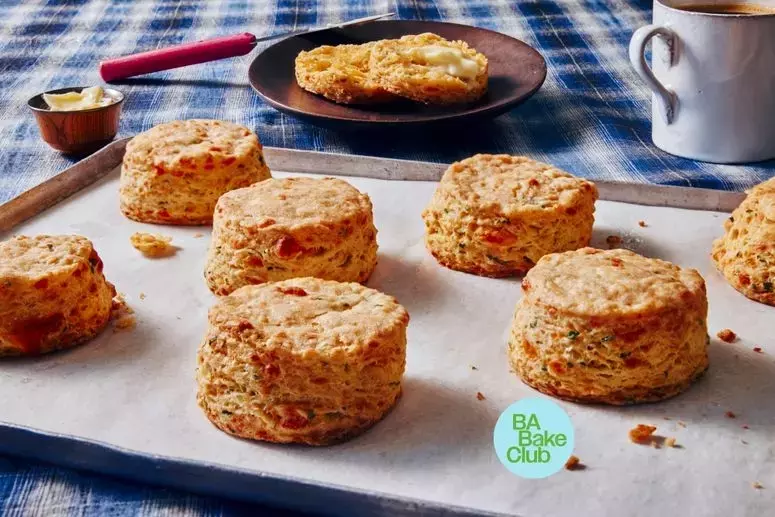
Welcome to the Bon Appétit Bake Club, a hub for passionate bakers where senior Test Kitchen editors Jesse Szewczyk and Shilpa Uskokovic unveil monthly must-make recipes and delve into the science behind their success. This month, the focus is on mastering the art of flaky biscuits, a seemingly complex task made accessible to all. The core principle lies in a simple yet effective folding technique, akin to preparing croissants or puff pastry, which creates distinct layers of butter within the dough, ultimately leading to a light and airy texture. This guide aims to demystify the process, empowering home bakers to achieve professional-level results with confidence.
Biscuits manifest in various forms, from the rustic drop biscuits to the indulgent butterswim, and the delicate angel biscuits. However, the true connoisseur often seeks the exquisitely flaky variety—those that yield themselves layer by delicate layer, much like the turning pages of a beloved book. This coveted characteristic is the very essence of the February Bake Club recipe. While it might appear to be a culinary feat reserved for seasoned pastry chefs, this notion is far from the truth. With the right approach, anyone, regardless of their baking experience, can produce these exquisite pastries, even today.
The technique that produces these desired layers is aptly named 'folding,' as it literally involves folding the dough, much like a sentimental letter. This method is not exclusive to biscuits; it's a cornerstone in the creation of other layered delights such as croissants, puff pastry, and even pie crusts. The fundamental objective remains consistent: to meticulously create parallel strata of butter, encapsulated within the dough. When this prepared dough encounters the heat of the oven, the butter begins its transformation. It melts, and the water content within it rapidly converts into steam, causing the surrounding dough to expand, puffing up like countless miniature balloons, thereby forming the distinct, airy layers we cherish.
For more intricate pastries like croissants and puff pastry, the process is notoriously precise, often necessitating a 'butter block'—a large, rectangular mass of butter—and specialized equipment like a sheeter, a machine designed solely to progressively thin the dough and butter block into an almost infinite number of layers. Such a demanding process explains why many opt to purchase these items from a bakery rather than attempting them from scratch. However, biscuits, fortunately, are far less stringent in their demands. A more relaxed application of this folding action is more than sufficient to achieve remarkable results. You’ll incorporate butter into flour, either by hand or with a food processor, creating haphazard chunks. Then, with the aid of a rolling pin, a bench scraper, and your own hands, you’ll shape and fold the dough. The outcome? Biscuits so exceptionally lofty and beautifully laminated that they are guaranteed to elicit admiration from anyone who tastes them.
A particularly effective method involves folding the dough into thirds, much like a standard sheet of printer paper. This approach strikes a perfect balance, rapidly building layers without making the dough unmanageable. Folding the dough in half often proves insufficient, potentially leading to overworking the dough before the desired layers are established. Conversely, folding it into quarters can render the dough cumbersome and difficult to handle. Thus, three is the optimal number for folds. It is recommended to fold and roll the dough a minimum of two times, but no more than three. Exceeding this limit can result in a homogenous, dense mass, completely counteracting the goal of producing a light and flaky biscuit. All these precise instructions are thoroughly detailed within the provided recipe, ensuring your success. Therefore, do not hesitate; embark on your baking journey with confidence and embrace the art of folding!
The journey to crafting perfect flaky biscuits is not as daunting as it may seem. By embracing the simple yet transformative technique of folding, home bakers can elevate their culinary skills and produce results that rival those of professional pastry chefs. The key lies in understanding the interplay between butter, dough, and heat, and applying a methodical approach to layering. With each fold, you are building the foundation for a biscuit that is light, airy, and rich in texture, a true testament to the magic of baking. So gather your ingredients, follow the steps, and prepare to delight in the triumph of your own homemade, wonderfully flaky biscuits.
