
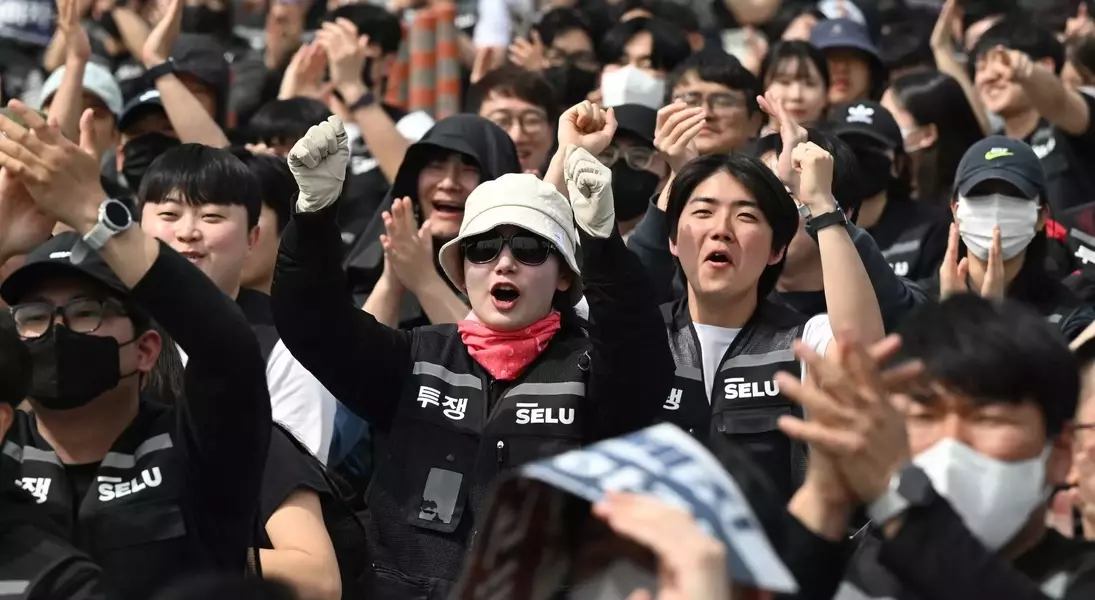
In a significant victory for labor rights and collective action, Samsung Electronics workers have overwhelmingly approved a new profit-sharing agreement. This landmark deal not only averts a potential strike but also promises substantial financial benefits for employees, highlighting the increasing influence of unions in the technology sector, especially within industries crucial to artificial intelligence.
Samsung Employees Secure Historic Profit-Sharing Agreement Following Union Vote
Last week, Samsung Electronics successfully sidestepped an impending factory strike in South Korea through a last-minute accord. The workers' union had consented to postpone the strike, initially slated for May 21, to allow for an internal vote on a new proposal. The outcome of this crucial vote has since been revealed: a decisive 74% of union members voted in favor of a profit-sharing arrangement. This agreement could see individual employees receive an average of $340,000 in bonuses, a testament to the efficacy of collective bargaining power. This is particularly impactful in the semiconductor industry, which has become indispensable to the burgeoning field of AI.
The newly ratified agreement dictates that approximately 78,000 semiconductor workers will collectively receive 10.5% of Samsung’s operational profits. Financial analysts project this bonus pool to reach an impressive total of $22.6 billion, equivalent to 34 trillion South Korean Won. Given Samsung's status as a trillion-dollar market capitalization entity, sharing a portion of these profits with its workforce is seen as a fair and equitable move.
Under the terms of the deal, 40% of the bonus fund will be distributed equally among employees, with the remaining portion allocated based on departmental performance. Memory chip workers, in particular, are anticipated to receive a bonus estimated at around $400,400. This structure mirrors a similar profit-sharing deal forged by SK Hynix with its own employees last year, which committed 10% of operating profits for the next decade. Interestingly, this "bonus bonanza" at SK Hynix reportedly elevated its employees to a social standing akin to that of doctors and lawyers within the South Korean marriage market.
Despite this positive development, Samsung still faces the challenge of retaining talent, as some workers had previously left for more lucrative opportunities at rival companies like SK Hynix. The finalized compensation package for Samsung's employees, while generous, remains slightly less than what SK Hynix offered per individual, posing a continued risk of employee migration.
This outcome underscores the growing importance of unions across the broader tech and gaming landscapes. Even if not all unions can secure such substantial profit-sharing deals as those at Samsung or SK Hynix, their role in advocating for workers' rights and fair compensation is becoming increasingly vital. Recent events, such as the legal action faced by Rockstar Games after laying off over 30 employees last year, and Hasbro and Wizards of the Coast's efforts to dissuade unionization among their remaining staff after mass layoffs, highlight a broader trend. These instances, among many others, demonstrate why game development union members marched at this year's GDC to propose a 'Game Workers' Bill of Rights.' These collective efforts suggest that a more equitable and prosperous future is attainable, not only for tech and game industry professionals but for workers across all sectors.
