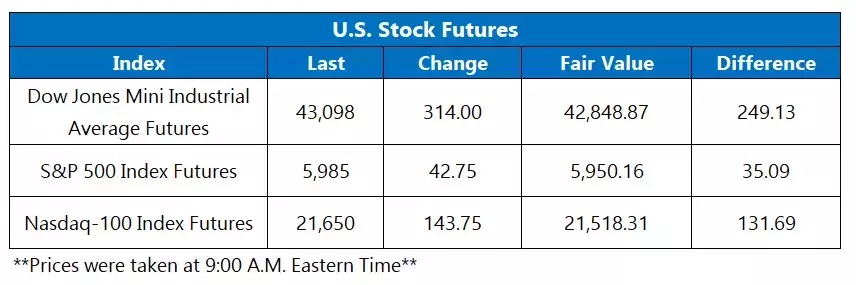
Stock futures are on the path to rebound after yesterday's market meltdown. The Federal Reserve's forecast of fewer-than-expected rate cuts in 2025 set the stage for this potential recovery. The Dow Jones Industrial Average (DJIA) futures are up over 300 points, with the blue-chip index having just experienced its historic 10th-straight loss and its worst day since 2022. Nasdaq-100 Index (NDX) and S&P 500 Index (SPX) futures are also showing signs of improvement, with the former eyeing a significant triple-digit pop.
Unraveling the Market's Path to Recovery
Stock Futures and the Federal Reserve's Impact
Stock futures are highly sensitive to the actions and forecasts of the Federal Reserve. Yesterday's forecast of fewer rate cuts in 2025 sent shockwaves through the market, leading to steep losses. However, today, there is a glimmer of hope as futures look to recoup those losses. The Dow Jones Industrial Average futures, in particular, have shown a remarkable upward trend, with a gain of over 300 points. This indicates that investors are hopeful that the market will stabilize and start to recover. The Nasdaq-100 Index and S&P 500 Index futures also follow suit, with the former aiming for a triple-digit pop. This shows that the market is not giving up easily and is looking to bounce back from yesterday's turmoil.The Federal Reserve's decisions have a profound impact on the stock market. When the Fed signals a change in its monetary policy, it can lead to significant fluctuations in stock prices. In this case, the forecast of fewer rate cuts has initially caused panic among investors, but now they are waiting to see how the market will react in the coming days. If the Fed follows through with its forecast and keeps rates steady or even cuts them further, it could provide a much-needed boost to the stock market.I.T. Services Firm Accenture's Performance
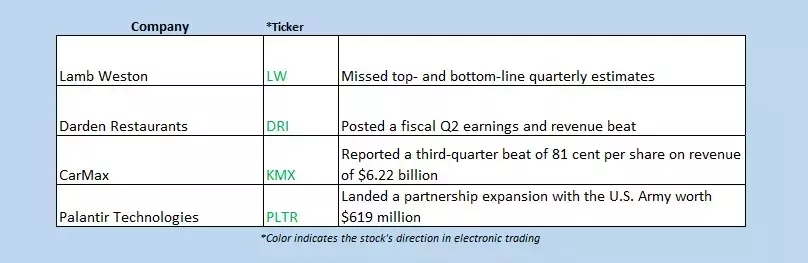
I.T. services firm Accenture Plc (NYSE:ACN) has announced better-than-expected fiscal first-quarter revenue and lifted its full-year outlook. This news has had a positive impact on the company's stock, which is up 5.7% before the bell. In the last six months, Accenture stock has added 21.8%, demonstrating the company's strong performance and growth potential. Accenture's success can be attributed to its ability to adapt to the changing technological landscape and provide innovative solutions to its clients. The company's focus on digital transformation and cloud computing has paid off, as it has been able to attract new clients and increase its revenue. This is a great example of how a well-managed company can thrive in a challenging market environment.Lennar Corp's Q1 Performance and Stock Movement
Lennar Corp (NYSE:LEN) stock is down 8.3% in premarket trading after the construction company missed both its top and bottom-line expectations for the fiscal first quarter. In the last three months, LEN has shed more than 22%, indicating that the market is not happy with the company's performance. Lennar's miss can be attributed to a variety of factors, including rising construction costs and a slowdown in the housing market. However, the company remains optimistic about its future and has stated that it will continue to focus on its core business and deliver value to its shareholders.Micron Technology Inc's Q1 Results and Guidance
Micron Technology Inc (NASDAQ:MU) stock is brushing off a revenue beat for the fiscal first quarter but is still down 11.2% ahead of the open. Despite the positive revenue news, the semiconductor giant issued disappointing guidance for the fiscal second quarter, which has weighed on the stock. However, MU still sports a 21.7% lead for 2024, indicating that investors have high hopes for the company's future performance. Micron Technology is a leading semiconductor manufacturer that produces a wide range of memory products. The company's performance is closely tied to the global demand for semiconductor products, and any changes in the market can have a significant impact on its stock price.Global Interest Rate Updates and Market Reactions
Global interest rate updates are in focus today, sending Asian markets lower. The Bank of Japan (BoJ) decided to keep rates steady at 0.25% after a third consecutive interest rate cut in the States. This decision has led to a weakening of the won to its lowest level since early 2009. Hong Kong's Monetary Authority also followed suit of the U.S. and slashed interest rates by 25 basis points. As a result, Hong Kong's Hang Seng fell 0.6%, China's Shanghai Composite dropped 0.4%, Japan's Nikkei shed 0.7%, and South Korea's Kospi suffered the most, plunging 2%.European markets are also in the red following the Fed's updates. The U.K.'s Bank of England (BoE) kept interest rates unchanged at 4.75%. In France, the business confidence indicator dropped in December for the third straight report, reading at 94, which is lower than the long-term average. A survey out of Germany's GfK and Nuremberg Institute for Market Decisions (NIM) showed that consumer sentiment grew to -21.3 points heading into January, although a "sustained recovery" is not anticipated. At last glance, France's CAC 40 is off 1.1%, Germany's DAX has shed 0.9%, and London's FTSE 100 is down 1.2%. These market reactions highlight the interconnectedness of global markets and the impact that interest rate decisions can have on different economies.