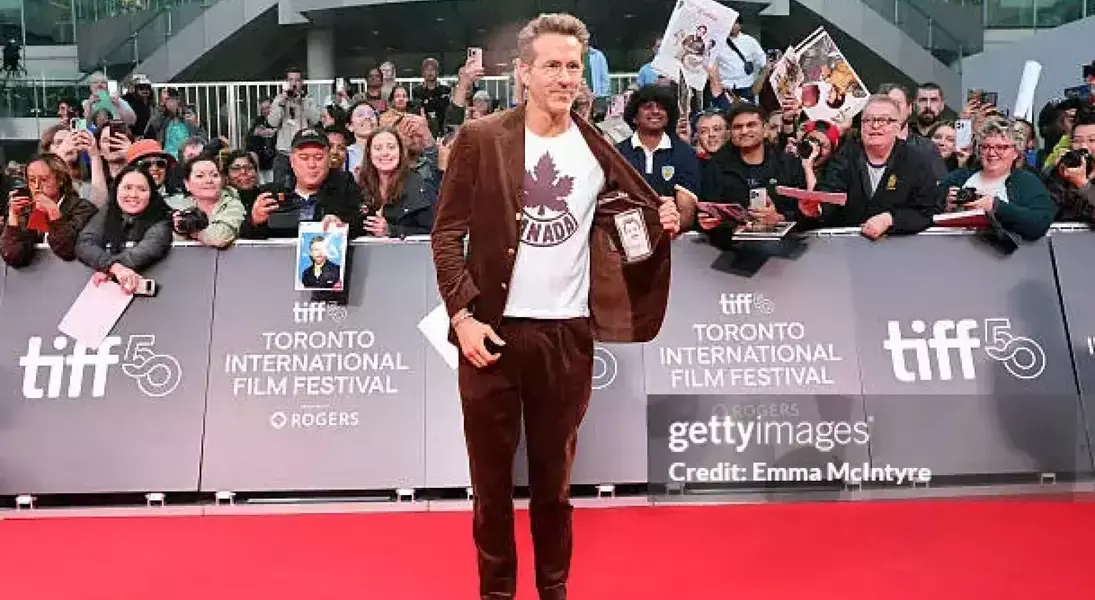
During a recent appearance at the Toronto Film Festival, celebrated actor and producer Ryan Reynolds offered a candid reflection on his Canadian heritage and its profound impact on his professional journey in Hollywood. He articulated a clear stance against the divisive rhetoric prevalent in contemporary culture, advocating instead for collaboration and understanding. Furthermore, Reynolds shared poignant insights into his latest production, a documentary honoring the legendary Canadian comedian John Candy, delving into the emotional complexities of Candy's life and his private battles with mental health. This comprehensive discussion illuminated Reynolds's unique perspective on navigating the entertainment industry, from the foundational lessons learned in his youth to his current role as a visionary producer, emphasizing the enduring values that have shaped his distinguished career.
Reynolds, known for his work in the 'Deadpool' series, asserted his neutral position in the ongoing cultural debates, stating unequivocally, \"I’m not MAGA. I’m not extreme anything.\" He acknowledged the human desire for beliefs to be affirmed but cautioned against the pitfalls of identity politics, which he views as overly polarizing and creating an 'us versus them' mentality. He attributed his collaborative spirit and openness to learning on film sets to his upbringing in Vancouver and his early training in improvisational comedy. Reynolds underscored the vital role Canada played in grounding him, remarking, \"It’s important to keep your head screwed on right. And Canada helped me with that. Canada was a third parent. That business is tough. It can destroy you. I have seen the illusion of it and sort of the thin ice.\"
The festival also marked the global debut of 'John Candy: I Like Me,' a documentary produced by Reynolds and directed by Colin Hanks, which explores the life of the iconic Canadian comic. Visibly moved after watching a trailer for the film, Reynolds spoke of Candy as an extraordinary performer who, despite his charm and comedic genius, grappled with undisclosed personal struggles and mental health challenges. Reynolds observed, \"One of the things about John, he was a people pleaser, and he was struggling with mental health issues. Everybody deals with mental health issues. John was on the cusp of talking about it. But he was a people pleaser.\"
Reynolds linked Candy's people-pleasing nature to the health issues that ultimately led to his premature passing at 43. He stressed the critical importance of open dialogue about mental health, stating, \"As a people pleaser, you don’t want to burden people with anything. And the only way to talk about mental health problems is to talk about them. You have to take a step forward and you have to talk about you.\" A lifelong admirer of Candy, Reynolds recounted being a fan since watching 'SCTV,' praising the show's blend of brilliance and candid experimentation. He drew parallels between the risk-taking ethos of 'SCTV' and his own career, which began with modest roles in Canadian television, fostering a disciplined yet humble approach to acting.
Reflecting on his transition to Hollywood, Reynolds highlighted a shared Canadian trait: a deep-seated commitment to justice. He humorously noted his own tendency to become upset when witnessing injustice, viewing it as a productive impulse that distinguishes Canadian professionals. His breakthrough came with the sitcom 'Two Guys, A Girl and a Pizza Place,' where a pivotal piece of advice from creator Danny Jacobson — to 'take the stage' and command attention rather than deferring — transformed his perspective and career trajectory, enabling him to shed his humble Canadian persona and embrace a leading role.
Reynolds also cited 'Green Lantern,' Martin Campbell's superhero film, as a crucial learning experience. It propelled him to take on producing roles, notably with 'Deadpool,' the first R-rated superhero movie over which he claimed full creative ownership. This venture instilled in him a pragmatic understanding of filmmaking, leading to the realization that excessive budgets often stifle creativity. He passionately argued that \"Too much time and too much money will destroy creativity. Constraint and pressure will create asymmetric thought and you will start to think outside the box.\" He even expressed bewilderment at some colossal Hollywood production budgets, believing genuine connection with an audience stems not from extravagant effects, but from authentic storytelling and relatable themes, as exemplified by the enduring appeal of simple narratives like Christopher Reeve's Superman.
Ryan Reynolds’s journey from a Canadian improv student to a Hollywood powerhouse illustrates a career built on principled choices and a commitment to authenticity. His reflections at the Toronto Film Festival underscore a philosophy that prioritizes genuine connection, creative freedom, and a balanced perspective, elements he attributes significantly to his Canadian upbringing. His work, both as an actor and a producer, continues to be characterized by this thoughtful approach, challenging conventional norms within the entertainment industry and advocating for a more grounded, impactful form of storytelling.
