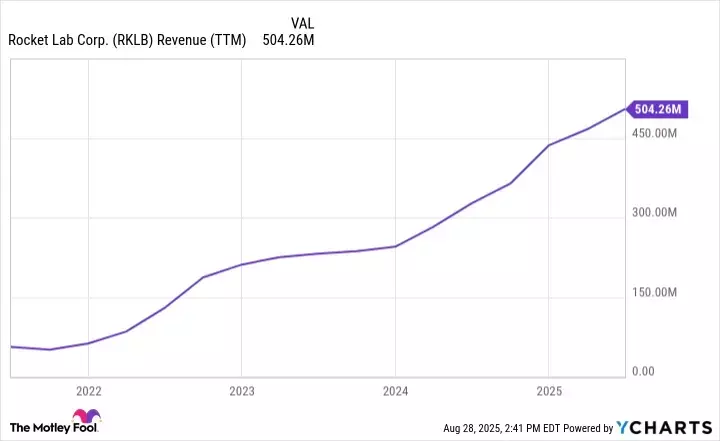

Rocket Lab has emerged as a formidable presence in the space sector, achieving remarkable stock performance over the past year. Driven by substantial U.S. government backing and an innovative vertically integrated business model, the company is rapidly expanding its influence. While its existing Electron rocket and comprehensive space systems have propelled revenue to impressive levels, the anticipated launch of the Neutron rocket signifies a pivotal moment, promising to unlock unprecedented growth and further solidify Rocket Lab's position in the evolving space economy. This trajectory, however, faces scrutiny as market valuation currently appears to outpace the company's immediate financial metrics and profitability.
The company's strong financial growth, reflected in its soaring stock price and increasing revenue, underscores the growing demand for its services in both commercial and governmental sectors. The strategic development of the Neutron rocket is poised to dramatically enhance Rocket Lab's launch capabilities, enabling it to handle larger payloads and secure more lucrative contracts. Despite this promising outlook, investors are urged to consider the current valuation against the company's path to sustained profitability. While the long-term vision is compelling, the journey to a $100 share price requires significant operational leverage and market adoption, demanding a cautious yet optimistic perspective on its future.
The Ascent of a Space Innovator
Rocket Lab has demonstrated extraordinary growth, with its stock price experiencing a staggering 676% increase over the past year. This impressive performance is attributed to a combination of strong backing from the U.S. government and the company's strategic pursuit of a vertically integrated space flight business model. By developing both launch vehicles and essential space systems, Rocket Lab aims to provide comprehensive solutions for its diverse clientele. This integrated approach has been a key factor in its rapid expansion and rising investor confidence, as the company positions itself to become a dominant force in the global space economy.
The company's initial success with the Electron rocket laid the groundwork for its current standing. Beyond launching payloads, Rocket Lab has diversified into manufacturing critical space systems, including sensors, satellites, solar arrays, and semiconductors. These components are vital for its contracted customers, including governmental entities. The U.S. government has recognized Rocket Lab's strategic importance, providing a $24 million grant to bolster domestic semiconductor production, thereby securing the supply chain. This robust demand for both launch services and space systems has fueled a remarkable financial surge, with revenue reaching $500 million over the last 12 months—an 800% increase since its 2021 IPO. With a substantial $1 billion backlog, Rocket Lab is clearly meeting a critical need, supported by its growing relationship with the U.S. government, which is increasingly focused on space defense initiatives like the Golden Dome project, valued at $175 billion.
Neutron Rocket: Catalyzing Future Growth
The impending introduction of Rocket Lab's Neutron rocket represents a significant leap forward, designed to dramatically enhance the company's growth trajectory. Currently undergoing testing, the Neutron rocket is slated for commercial readiness by 2026. Its substantially larger payload capacity, comparable to that of SpaceX's rockets, is expected to unlock a new tier of contract opportunities and revenue potential for Rocket Lab. This advanced vehicle will allow the company to undertake missions involving much larger satellites and orbital constructions, thereby increasing the value of each launch.
The Neutron rocket is poised to create a step change in Rocket Lab's revenue, with each launch potentially generating between $50 million and $100 million solely for orbital insertion services. Furthermore, this larger launch capability is expected to drive demand for Rocket Lab's vertically integrated space systems, including satellite design and semiconductor manufacturing, which can be deployed on these more powerful rockets. Such a synergistic effect could propel the company's revenue from its current $500 million to $1 billion, $2 billion, and even higher in the coming years, mirroring the scale seen by industry leaders like SpaceX, which projects $15 billion in revenue this year. However, Rocket Lab's current valuation, with a market capitalization of $24 billion and a share price of $47, raises questions about its immediate investment appeal. Achieving a $100 share price would imply a $50 billion market cap—a substantial valuation for a company that is currently unprofitable, burning cash, and operating with gross margins just over 30%. Even with an optimistic scenario of $10 billion in revenue and a 15% net income margin, a $50 billion market cap would translate to a price-to-earnings ratio of 33, suggesting that while long-term potential is present, the stock may not offer compelling short-term returns for individual investors given its aggressive valuation.
