
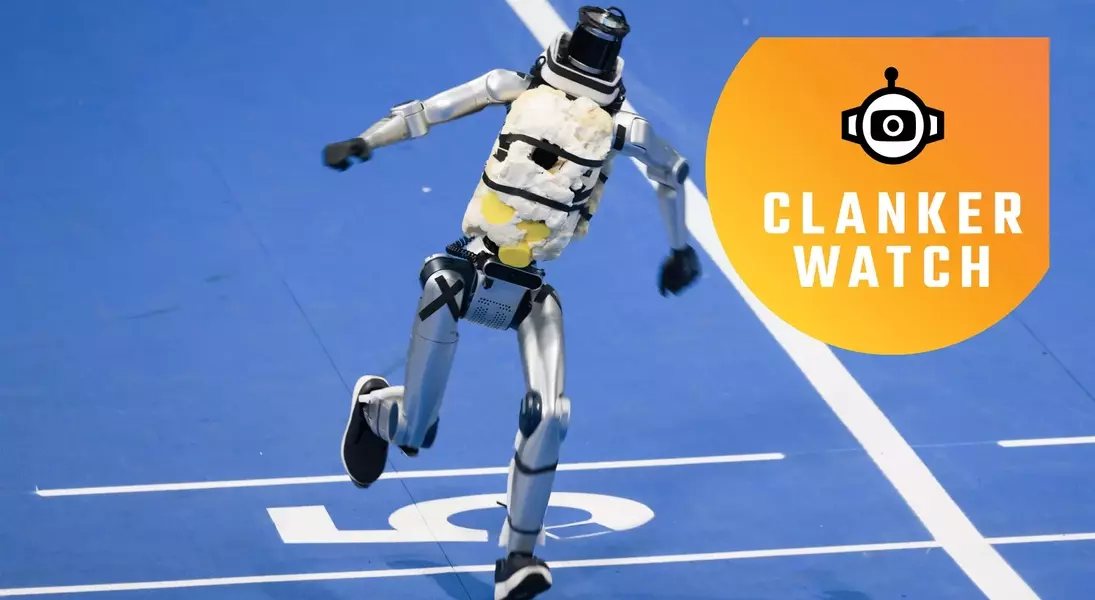
In a striking display of both ambition and mechanical vulnerability, a humanoid robot participating in the World Humanoid Robot Games in Beijing recently encountered a significant setback during a high-speed training run. This event underscores the inherent difficulties and unpredictable nature of advancing autonomous robotic systems at an accelerated pace.
Details of the Robotic Mishap in Beijing
This week, the vibrant city of Beijing is the host for the second iteration of the World Humanoid Robot Games, an international spectacle that drew considerable attention upon its debut last year. Envisioned as a futuristic "robot Olympics," the competition gathers thousands of advanced humanoid robots, steered by numerous skilled teams, to engage in over 50 diverse events. These challenges span a wide array of disciplines, from feats of strength like weightlifting to intricate scenario-based tasks such as simulated fire rescue operations.
The current buzz around this year's games is largely due to a video that has rapidly circulated online. The footage dramatically shows a robot runner suffering a spectacular malfunction. During a high-speed sprint, the robot, exhibiting singular determination, crashed headfirst into a safety barrier. The impact caused the robot to reel backward, its limbs flailing comically as if trying to defy the laws of physics. The unfortunate sequence culminated in its torso hyperextending at the waist joint, resulting in a shower of sparks and a puff of smoke from its internal mechanisms. A nearby event staff member, startled by the sudden eruption, recoiled from the scene, leaving the incapacitated competitor to its fate. Organizers of the World Humanoid Robot Games have clarified that the competition includes two main categories: competition events and scenario-based events. The latter evaluates robots on their proficiency in executing specific roles in environments like retail or food service, with fully autonomous robots earning higher accolades than their remotely controlled counterparts. The competition events, conversely, involve more traditional athletic contests, where humanoid robots autonomously vie in Olympic-style sports, including long jump, gymnastics, and track races. The widely shared footage of the robotic mishap is believed to stem from a training session for one of these track events.
This incident serves as a vivid reminder that the journey towards fully autonomous and robust robotic systems is fraught with unexpected challenges. While the drive to push technological boundaries is commendable, moments like these prompt reflection on the balance between rapid development and ensuring the reliability and safety of advanced AI and robotic technologies. It's a testament to the fact that even with the most sophisticated engineering, unforeseen circumstances can lead to dramatic and visually impactful failures, reminding us that every technological leap comes with its own set of trials and tribulations.
