
The highly anticipated arrival of Rhythm Heaven Groove on the Nintendo Switch marks a significant moment for fans of the eccentric rhythm game series. This latest iteration continues the franchise's tradition of presenting a medley of musical minigames, each demanding precise timing and keen auditory perception. However, the gaming landscape has evolved considerably since the series' last major release, with a new wave of independently developed rhythm titles pushing creative boundaries. This review delves into how Groove navigates this changed environment, assessing its ability to captivate an audience that has grown accustomed to more experimental and narrative-driven rhythm experiences.
Embrace the Rhythm, Rediscover the Fun: Groove's Timeless Charm
A Legacy Reimagined: The Evolution of a Cult Classic
Initially encountering Nintendo's Rhythm Heaven series over a decade ago felt like unearthing a peculiar treasure from an distant realm. During my final year of college, my roommate's unusual game on the Wii, a collection of interactive, animated sketches, was unlike anything I had witnessed. It captivated with its whimsical wrestlers and peculiar birds, all moving in sync with vibrant pop melodies. Such singular games leave a lasting impression for years.
Groove's Place in a Crowded Rhythmic World
The gaming world has changed significantly between 2011's Rhythm Heaven Fever and the current Rhythm Heaven Groove on the Nintendo Switch. While the series once epitomized eccentricity, Groove now feels somewhat less bizarre compared to contemporary titles. Its unique brand of musical minigames is no longer solitary; the past 15 years have seen a proliferation of Rhythm Heaven-inspired games, many of which have elevated the genre's standards.
The Core Gameplay: Unchanged Yet Engaging
Rhythm Heaven Groove finds itself in a peculiar position. It's a comprehensive collection of enjoyable minigames, yet it lacks the innovative spark that once made the series a standout. While it provides entertaining digital musical diversion, Groove is merely one among many, rather than a pioneering force.
The Enduring Appeal of Rhythmic Challenges
The fundamental gameplay of Groove remains consistent. Its main single-player mode involves navigating through various musical minigames, culminating in a Remix stage that consolidates all learned elements. Each minigame immerses players in a cartoon world, where button presses must align with audio and visual cues. Most levels focus on two or three rhythmic cues, introducing complexity by combining them within a song and placing cues on off-beats. This tests both rhythm and reaction time, all set against amusing animations that playfully try to divert attention from the goal of completing stages and achieving perfection for medals. (These simple rules are often preceded by optional, sometimes lengthy, tutorials).
The Humor Quotient: A Mixed Bag of Giggles
The appeal of a Rhythm Heaven game is intrinsically linked to the comedic quality of its characters and scenarios, and Groove offers a moderate level of absurdity. Many minigames are relatively subdued: a woman rhythmically catching vegetables, three cars accelerating and braking in unison, frogs leaping between lily pads. These are accompanied by clear, impactful sound cues that are easy to follow but occasionally fall short in terms of comedic memorability. More successful games cleverly challenge the player; for instance, a stage involving bouncing macarons between crabs becomes mischievously difficult when a soda can temporarily obstructs the view.
Finding the Sweet Spot: Moments of Pure Joy
Only a handful of games truly elicited laughter, akin to the series' memorable wrestling interviews or choir minigames. A particular highlight involves high-fiving robots dancing as images of muscular construction workers flash on screen. This exemplifies the ideal Rhythm Heaven level: the challenge lies in maintaining rhythm while trying to suppress laughter. While some stages perfectly capture this formula, many others rely on the charming eccentricity of their animated characters.
Innovation within Familiarity: New Rhythmic Twists
Some minigames invigorate the established formula with unconventional rhythm patterns; one requires catching frisbees as a dog, necessitating a button press on the seventh beat for the dog to catch it on the eighth. Others utilize two-button mechanics, such as a standout game where players control two characters hopping over windshield wipers. These concepts ensure Groove's limited rhythmic premise remains diverse, alongside truly memorable tunes that are a delight to tap along to. Yet, there are moments when the series seems to reach its creative zenith. How can such an idea be continually refreshed over decades? Perhaps Groove represents the pinnacle of what Rhythm Heaven can offer.
The Shadow of Inspiration: Competing with Successors
However, this perspective doesn't fully capture the reality. In the 11-year gap since Rhythm Heaven Megamix, numerous independent developers have successfully experimented with the format. Melatonin stands out by theming its minigames around a dream sequence. Last year's exceptional Bits & Bops integrates more narrative, transforming vignettes into concise stories about conversing lovebirds and thieving ants. Rhythm Doctor goes further, transforming Rhythm Heaven's core mechanic into a complex game built entirely around seven-note sequences. These innovations represent exciting variations on the theme, whereas Groove comfortably reiterates its established style. There's a one-sided conversation between Rhythm Heaven and its inspired offshoots, and the former could benefit from engaging in dialogue.
Beatspell: A Glimpse of Experimental Potential
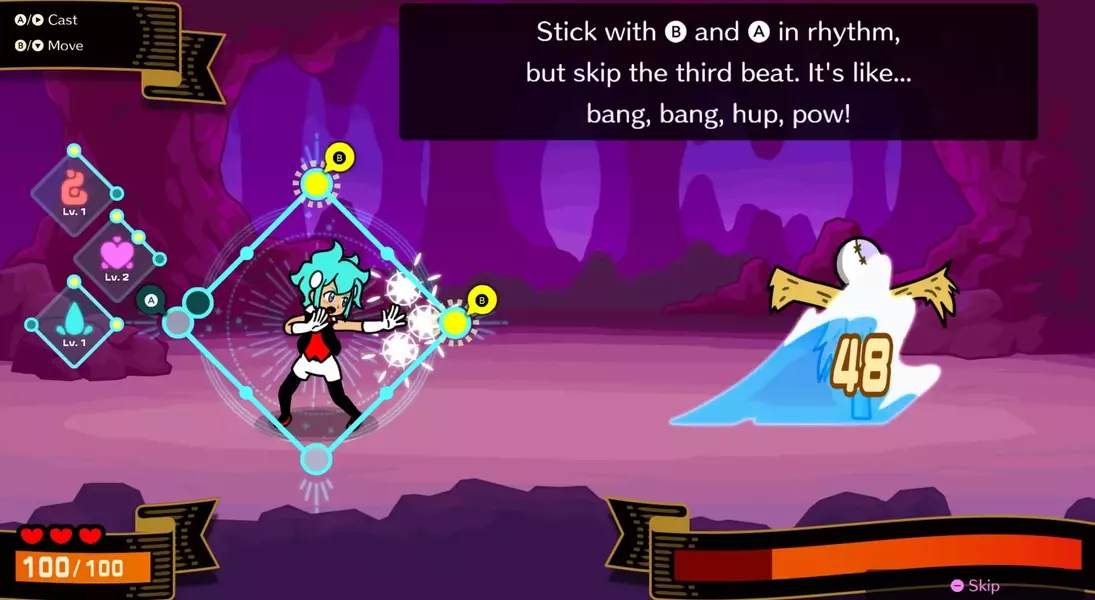
Groove does offer some experimental elements beyond its main solo playlists. A new addition is Beatspell, an RPG dungeon crawler minigame where players cast magic and healing spells by hitting specific button combinations in time with the music. A basic fire attack requires pressing B and A consecutively, while advanced spells involve complex patterns incorporating half-beats and rests. This stroke of brilliance is exactly what a static series needs, though it feels like an early iteration of a more developed concept. Most Beatspell levels resemble tutorials for a rhythm roguelike that is only hinted at towards the end.
Multiplayer Mayhem: Untapped Party Potential
Similar sentiments apply to the multiplayer offerings, which include 10 co-op and competitive games, each with three variations. There are excellent concepts here that could form a robust party game collection rivaling WarioWare. One four-player game brilliantly parodies RPGs, with tennis players striking incoming monsters with timed shots. The competitive games are even more compelling, despite their limited number. A personal favorite involves players around a table attempting to grab a piece of cake by pressing A when a countdown concludes. When the timer disappears, players must mentally count to achieve perfect timing. This leads to both tension and humor as players wildly miss the rhythm, creating the game's most memorable laughs.
Missed Opportunities: The Quest for Depth
Many of these experiences don't quite achieve the depth needed for repeated play. A potentially excellent game, where players blast blocks to reach the center of a grid, only hints at a tactical minigame filled with special blocks that could open up Bomberman-style strategies. I would welcome a Rhythm Heaven game that develops a few strong modes rather than one that simply fills a treasure chest with numerous musical novelties.
A Wealth of Diversions: Content for Completionists
Groove certainly offers a plethora of activities. It includes a suite of high-score minigames, simple beat pads for creating loops, and a collection of challenging drum lessons unlocked by earning gold medals, among other features. This is complemented by numerous collectible comic strips and story fragments, providing ample motivation for completionists. While it represents the series' most extensive minigame compilation to date, a significant portion of the extras serve as little more than novel distractions.
A Familiar Tune: Reintroducing a Classic
Given the decade-long hiatus since the previous installment, Rhythm Heaven Groove's role as a reintroduction rather than a complete overhaul is understandable. It delivers familiar, engaging silliness to a new generation of Nintendo players, while offering just enough novelty to surprise long-time fans returning to a consistent series. However, without the inherent charm that once made the series uniquely distinctive, Groove feels somewhat too content with its tried-and-true formula. A fresh approach, or at least a significant remix, is necessary if the series is to continue competing with the evolving landscape of musical eccentricities.
