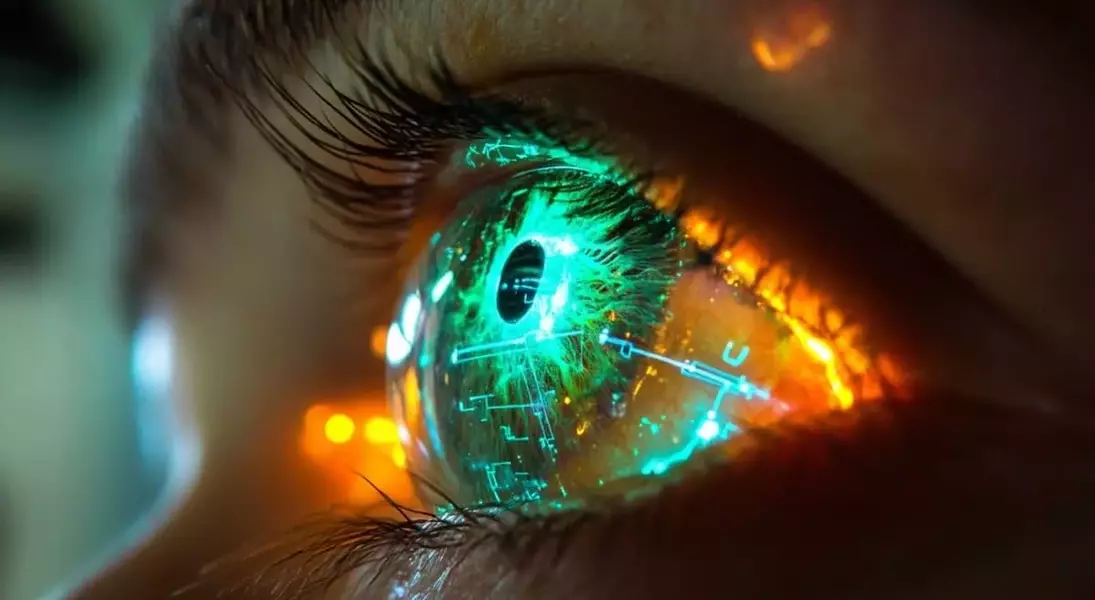
A groundbreaking innovation developed by researchers at UC Berkeley is transforming our understanding of human vision. By employing advanced laser technology, scientists have introduced a never-before-seen color—olo—a vivid blue-green hue that challenges the boundaries of natural perception. This advancement not only offers insights into the mechanics of human sight but also holds potential for addressing vision impairments and enhancing visual experiences.
Unveiling a Spectral Marvel That Could Reshape How We See the World
Imagine witnessing a shade so vibrant it defies comparison to anything found in nature. This is precisely what participants experienced when exposed to olo, a hyper-saturated blue-green tone generated through precision laser stimulation of specific photoreceptor cells within the eye.
Exploring the Science Behind Olo's Creation
The development of olo hinges on a sophisticated technique known as Oz, which leverages microdoses of laser light to stimulate individual retinal cones with unparalleled accuracy. Unlike traditional methods that rely on external light sources, Oz targets up to 1,000 photoreceptors simultaneously, enabling the creation of colors far beyond the natural spectrum.
This process involves mapping the unique arrangement of S, M, and L cone cells in an individual’s retina. By activating predominantly M cones, researchers can produce olo, a color described as more saturated than any monochromatic equivalent. Participants often compare it to an intensely luminous teal, highlighting its striking contrast against conventional hues.
Pioneering Research Into Human Color Perception
Beyond its aesthetic appeal, olo serves as a powerful tool for investigating the intricacies of human vision. Scientists are now able to explore how the brain interprets complex sensory inputs by manipulating photoreceptor activity directly. For instance, they can simulate scenarios where certain cone types are absent or impaired, providing valuable data for studying vision disorders.
Moreover, this technology opens doors to understanding tetrachromacy—the ability to perceive four distinct color channels. While rare in humans, such capabilities could potentially be replicated using Oz, offering new possibilities for enriching visual experiences. Researchers remain optimistic about the brain's adaptability, believing it can integrate novel stimuli effectively over time.
Applications Beyond Aesthetic Exploration
Oz holds immense promise for medical applications, particularly in diagnosing and treating ocular conditions. By simulating various forms of vision loss, clinicians gain critical insights into patient experiences, aiding in the design of targeted therapies. Additionally, the platform may assist individuals with color blindness by expanding their range of perceivable shades.
In experimental settings, volunteers reported immediate shifts in perceived color when the laser targeting was altered even slightly. Such sensitivity underscores the precision required for successful implementation of Oz technologies in clinical environments. As research progresses, these findings could pave the way for personalized treatment plans tailored to individual needs.
Challenges and Future Directions
Despite its revolutionary potential, several hurdles must be overcome before Oz becomes widely accessible. Current prototypes operate on a limited scale, focusing on small patches of the retina roughly the size of a fingernail. Scaling up this technology to encompass broader areas of vision presents significant technical challenges requiring further innovation.
Furthermore, ethical considerations arise regarding the implications of altering human perception artificially. Ensuring safety while maximizing benefits will necessitate rigorous testing and collaboration among experts across disciplines. Nevertheless, the prospect of enhancing quality of life through improved vision remains a compelling motivator for continued exploration.
