
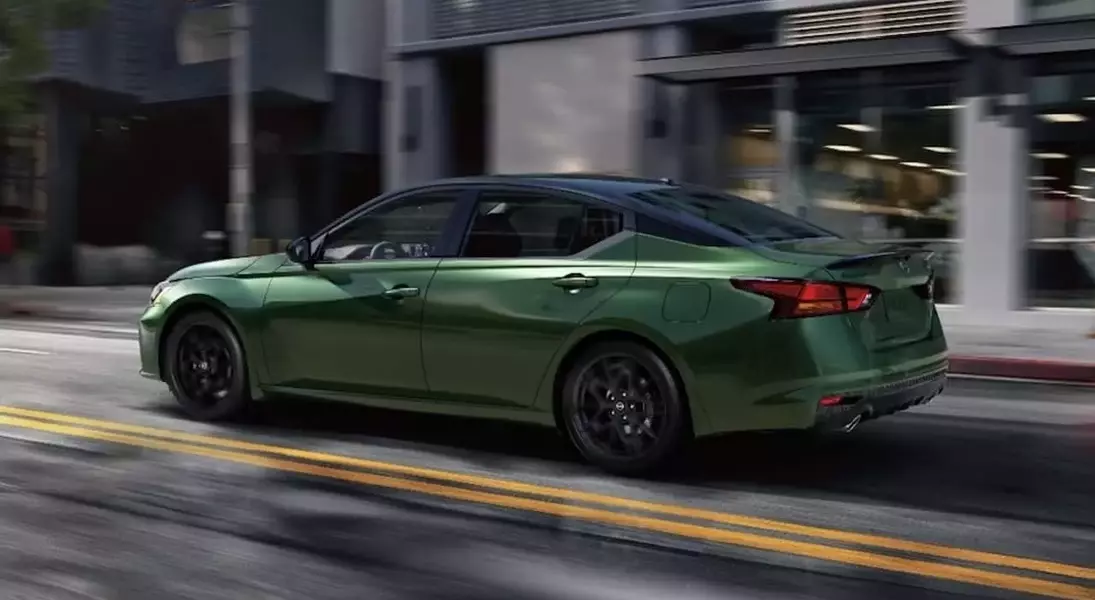
In an automotive landscape increasingly dominated by SUVs and crossovers, the mid-size sedan segment has faced considerable challenges, leading many manufacturers to cease production of their once-popular models. However, defying market trends and earlier speculation about its demise, the Nissan Altima is slated to return for the 2026 model year, albeit with significant adjustments to its available configurations and a notable increase in price. This decision underscores Nissan's commitment to the Altima, even as it navigates a shifting consumer preference.
The 2026 Altima's strategy involves streamlining its offerings, which means the previous entry-level S and the top-tier SL trims will no longer be available. This move aims to simplify the purchasing process and concentrate on the more popular configurations. As a result, the Altima SV now assumes the role of the base model, introducing a higher entry price point compared to its predecessors. This repositioning, coupled with a general price hike across the remaining models, reflects the evolving economics of automotive production and marketing. Despite these changes, the core mechanicals, including the reliable 2.5-liter four-cylinder engine and the Xtronic continuously variable transmission, remain constant, providing a familiar driving experience for loyal Altima customers.
Refined Offerings and Increased Investment in the Altima
The 2026 Nissan Altima lineup has been strategically reconfigured, reflecting a careful balancing act between market demand and product sustainability. The base 'S' and premium 'SL' trims have been retired, leaving the 'SV' as the new entry point, commanding a starting price of $28,825 after factoring in the destination charge. This represents a modest increase of $150 over the previous 'SL' model and a more substantial $580 jump from the former 'S' trim. The 'SR' trim now stands as the top-tier option, priced at $30,325, which is $250 more than its 2025 counterpart. All-wheel drive, a sought-after feature for many consumers, continues to be available as a $1,400 upgrade, notably $100 less than the previous model year, enhancing its value proposition. The SR trim further distinguishes itself with aesthetic and performance enhancements such as 19-inch wheels, paddle shifters, a sport-tuned suspension, and upgraded interior features like a 12.3-inch infotainment display, wireless connectivity, and sport seats with distinctive contrast stitching.
The strategic adjustments to the Altima's trim levels and pricing reflect Nissan's adaptive approach to the mid-size sedan market. By eliminating the lowest and highest volume sellers, Nissan aims to optimize production and focus on the most competitive offerings. The inclusion of premium features as standard in the SR trim, such as the advanced infotainment system and sport-oriented design elements, seeks to attract buyers looking for a blend of style, technology, and performance. The availability of all-wheel drive across both remaining trims, with a slightly reduced cost, caters to a broader audience, especially those in regions experiencing diverse weather conditions. Furthermore, the introduction of the SR Premium and SR Midnight Edition packages provides additional customization options, allowing consumers to personalize their vehicles with features like heated seating, advanced audio, navigation, and unique blacked-out exterior accents, thereby broadening the Altima's appeal and enhancing its competitive edge in a challenging market segment.
Mechanical Continuity and Market Resilience
Under the hood, the 2026 Nissan Altima retains its familiar powertrain options, which have been a staple of the model for years. The standard engine is a 2.5-liter four-cylinder unit, producing 188 horsepower and 180 pound-feet of torque in front-wheel-drive configurations. For those opting for all-wheel drive, the engine delivers a slightly adjusted output of 182 horsepower and 178 lb-ft of torque. Power is consistently managed by Nissan’s Xtronic continuously variable transmission (CVT), which remains the sole transmission offering across all variants. This commitment to the established powertrain underscores Nissan's focus on reliability and fuel efficiency, rather than introducing new mechanical innovations for this model year. The decision to carry over the existing engine and transmission suggests a strategy aimed at maintaining cost efficiency and leveraging proven technology.
The continued presence of the Altima in the market, despite earlier widespread expectations of its discontinuation after 2025, highlights its unexpected resilience in a contracting segment. This persistence is particularly notable given the declining sales figures for the model, with a 12 percent drop for the current year, building on an 11 percent decrease in 2024. In contrast, the smaller Nissan Sentra, which recently received a significant refresh, has seen a 1.6 percent increase in sales during the first three quarters of the year. The Altima’s survival for another year could be interpreted as a strategic move by Nissan to continue catering to a niche of sedan enthusiasts, or perhaps to gauge market response to its revised trim structure before making a final decision on the model's long-term future. This suggests that Nissan might be extending the Altima's lifespan to buy time, either for a potential future redesign or to slowly phase it out as the market fully transitions towards other vehicle types.
