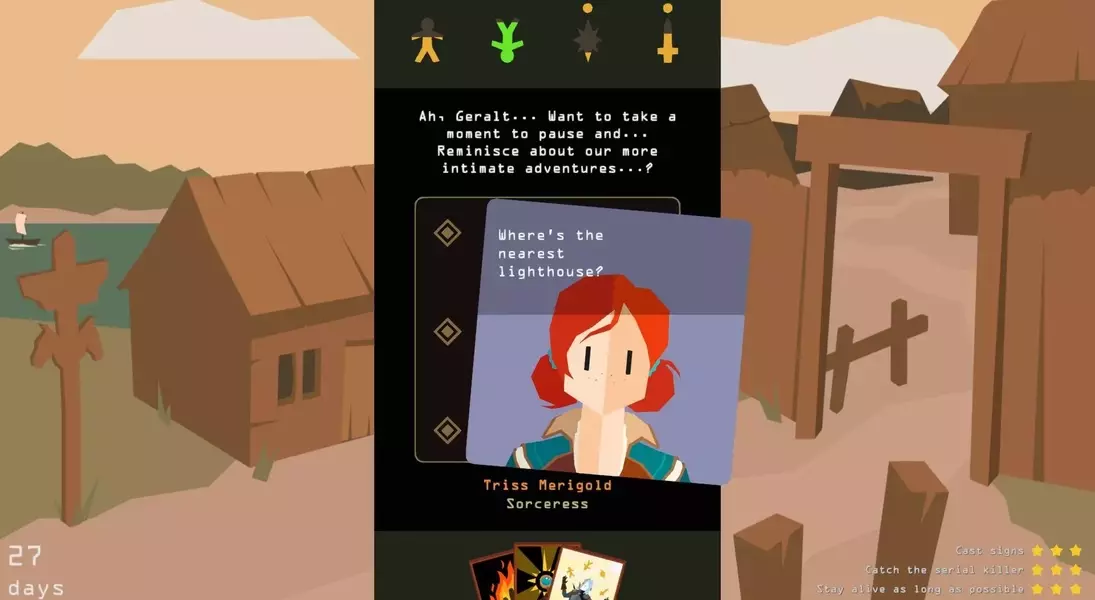
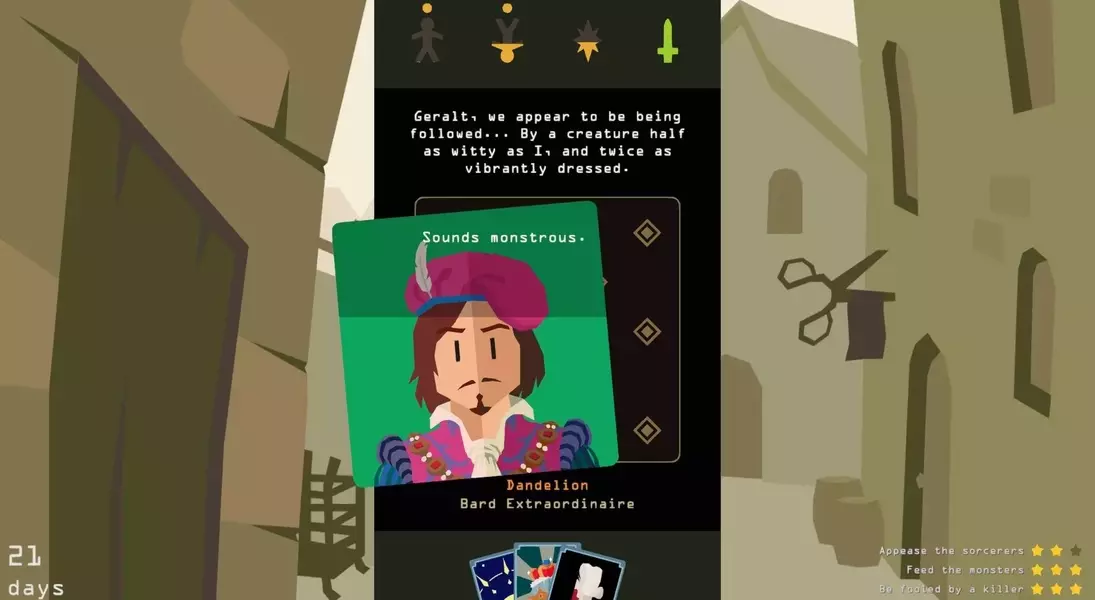
Reigns: The Witcher delivers a unique narrative experience by blending the classic swipe-based decision-making from the Reigns series with the immersive universe of The Witcher. Players step into the shoes of Geralt of Rivia, making critical choices that influence his relationships with various factions and ultimately determine his fate. The game stands out for its witty humor and complex, branching storylines, which are central to its appeal. However, the overall enjoyment is somewhat diminished by a poorly executed combat mini-game that feels out of place with the core mechanics. Despite this drawback, the engaging narrative and the charming ambition of Dandelion, Geralt's bardic companion, to document his adventures make for a compelling, albeit imperfect, journey through the Continent.
The game's primary mechanic involves swiping left or right to make decisions, balancing Geralt's interactions with humans, nonhumans, and sorcerers, alongside his witcher duties. These choices directly impact his survival and the unfolding narrative. A key aspect is Dandelion's ambition to become a renowned bard by chronicling Geralt's exploits, with players earning points to unlock new titles and performance venues for Dandelion. This system, coupled with often humorous and unexpected consequences, provides a fresh perspective on the Witcher lore. However, the recurring combat sequences, presented as an awkward mini-game, frequently disrupt the narrative flow and detract from the otherwise engaging experience, leaving players wishing for a more integrated or skippable alternative.
Guiding Geralt: Choices and Consequences
In Reigns: The Witcher, players are tasked with navigating Geralt of Rivia's life through a series of critical decisions, presented in a card-swiping format. This unique mechanic, characteristic of the Reigns series, allows players to influence Geralt's relationships with various factions—humans, nonhumans, and sorcerers—as well as his professional obligations as a witcher. The core objective is to maintain a delicate balance across these four attributes; an imbalance in any can lead to Geralt's demise, often in humorous and unexpected ways. For instance, too much favor with sorcerers might lead to an untimely end at a party. The game excels in offering absurd humor and tricky moral dilemmas, where choices often have unforeseen consequences, adding depth and replayability to each run. Dandelion, Geralt's ever-present bard, chronicles these adventures, with players earning points that enhance his fame and unlock new narrative possibilities, making every decision a part of a larger unfolding story.
The narrative structure of Reigns: The Witcher is cleverly intertwined with Dandelion's aspirations to become a celebrated storyteller. Each playthrough sees players managing a set of character cards representing Geralt's traits or goals, such as 'Geralt the Parent' or 'Save the Snakewoman'. Successfully addressing these cards through decisions not only earns points but also shapes Dandelion's evolving reputation. As Dandelion gains status, he performs for nobles, tailoring his tales based on player choices and the cards selected. This system ensures that every decision, even those leading to Geralt's demise or a seemingly mundane career change, contributes to Dandelion's repertoire of stories, each culminating in a witty poem. The allure of collecting these diverse outcomes and the continuous progression of Dandelion's fame form a significant part of the game's appeal, encouraging players to experiment with different choices and explore the full spectrum of Geralt's potential lives, despite the brevity of individual runs.
The Unwelcome Intrusion of Combat
While Reigns: The Witcher offers a compelling narrative and decision-making experience, its integration of a combat mini-game proves to be a significant detractor. Unlike the intuitive and engaging card-swiping system that defines the series, the combat sequences shift to a poorly implemented mechanic where players control Geralt's head sliding across the screen. The objective is to collect magical signs and falling weapons while avoiding monster attacks, but the lack of precise control and the clustered drop patterns make these segments frustrating and often unfair. This abrupt change in gameplay style not only breaks the immersion but also feels disconnected from the game's core strengths. The combat mini-game's awkwardness contrasts sharply with the thoughtful decision-making, leading to moments of irritation rather than excitement, and dampening the overall enjoyment of an otherwise well-crafted narrative adventure.
The design choice for combat in Reigns: The Witcher seems to miss an opportunity to integrate it more cohesively with the established gameplay mechanics. Instead of a quick, reactive mini-game, a more fitting approach might have involved card-based combat, similar to the narrative decisions, where players choose how Geralt attacks, defends, or uses potions and signs based on information gathered during the run. Such a system would leverage the game's strengths in strategic decision-making and consistency, allowing for combat to feel like an extension of the narrative choices rather than a jarring interruption. The current combat mechanic feels like an unnecessary hurdle, making players hope for a future update that allows them to bypass these sections entirely. This would enable a purer focus on the compelling storytelling and character development that are the true heart of Reigns: The Witcher, allowing players to fully immerse themselves in Geralt's adventures without the frustration of an ill-conceived mini-game.
