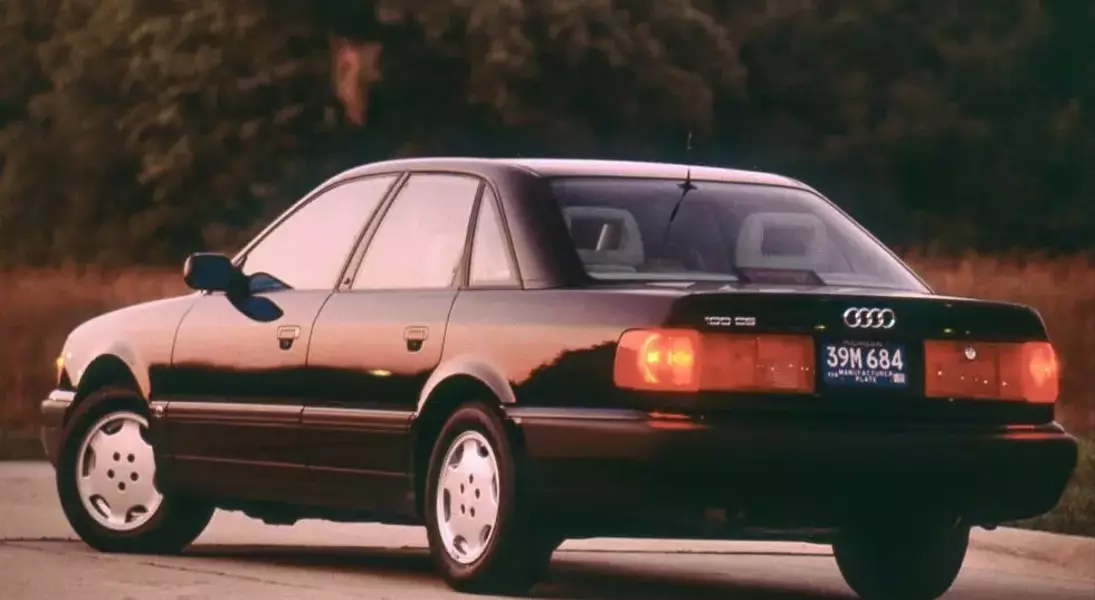


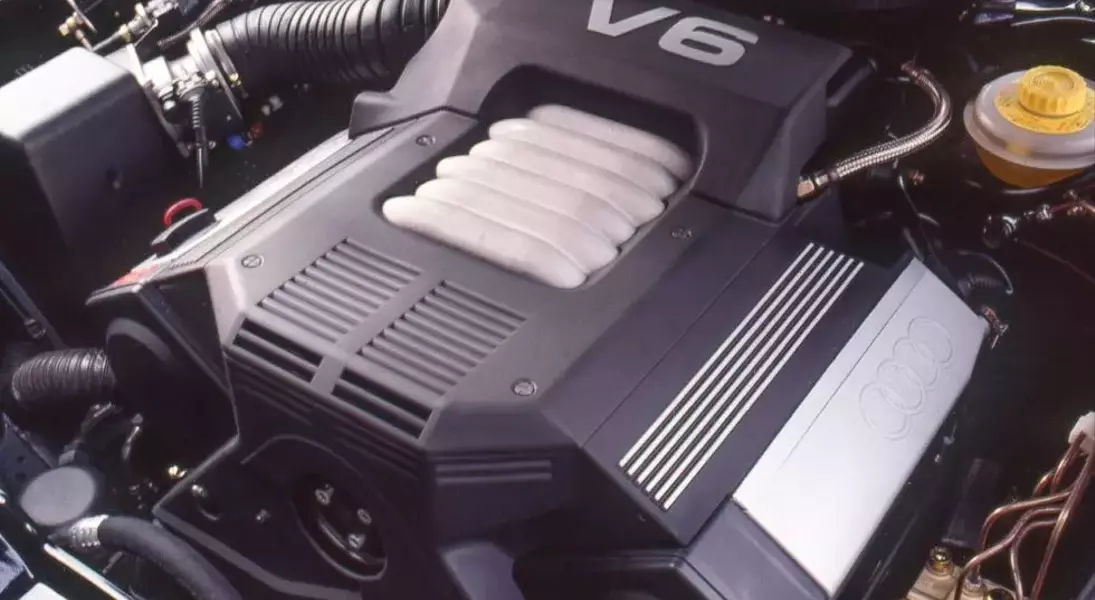

The 1992 Audi 100 V-6 was introduced as a notable advancement, presenting itself as a polished, contemporary, and agile vehicle. This lively five-seater sedan exhibited a marked improvement over its predecessors, clearly demonstrating the German manufacturer's ability to produce a car that could compete globally. While Audi positioned it against the pricier, rear-wheel-drive German models like the BMW 525i and Mercedes-Benz 300E 2.6, consumers might also have considered it alongside the Acura Legend, Lexus ES300, and the then-new Mazda 929. The Audi 100 range comprised three distinct models—the 100CS, 100S, and the standard 100—all featuring front-wheel drive and powered by Audi's innovative 2.8-liter V-6 engine, which simplified engine explanations compared to the previous inline five-cylinder units. Although not excessively powerful, the new Audi was widely regarded as an excellent example of a car built for driving enthusiasts.
Visually, the updated Audi presented a sleeker profile than its predecessor, despite being slightly longer overall and marginally narrower, with a fractionally increased height. The new bodywork, while maintaining the same 0.32 drag coefficient, offered a more aesthetically pleasing design. It gave the illusion of being more compact externally, while paradoxically feeling more spacious inside. The new 2.8-liter V-6 engine delivered a smooth 172 horsepower at 5500 rpm and a robust 184 pound-feet of torque at a low 3000 rpm. A dual-path intake manifold was instrumental in achieving strong low-end torque and optimal power at higher speeds, ensuring the driver experienced consistent power delivery across the entire operating range. Both the five-speed manual and four-speed automatic transmissions provided an enjoyable driving experience, with excellent power delivery. Initial tests, which included comparisons with the previous Audi 100, BMW 525i, and Mercedes-Benz 300E 2.6 on various terrains, showed the new Audi held its own in terms of ride quality and comfort, although it conceded some points in power and handling feel to the BMW. However, the Audi was perceived to have an advantage in interior design.
Stepping into the 1992 Audi 100 V-6 immediately conveyed a sense of robust construction and solidity, a noticeable improvement over previous models, attributed to a 30-percent increase in torsional rigidity. This enhanced stiffness became even more apparent while driving, contributing to a planted feel. The cockpit maintained Audi's characteristic no-nonsense design, with instruments neatly arranged under a smooth, legible curve on the dashboard, featuring pleasant red backlighting at night. The 100CS model boasted an efficient automatic climate-control system, reflecting the precision of all the vehicle's controls. The interior's aesthetic was impeccably tasteful, characterized by clean lines, pleasing surfaces, and discreet genuine wood trim. The seating remained ergonomically sound, offering firm support, with the driver's seat providing ample adjustability, including a tilt and telescoping leather-wrapped steering wheel. Safety features included an adjustable upper mount for the three-point belts and a driver's airbag. The cabin felt spacious and airy, complemented by a large, easily accessible luggage compartment. The engine started quietly, and the manual version demonstrated spirited acceleration, achieving 0 to 60 mph in 8.4 seconds—respectable for its class—and a top speed of 135 mph. The four-wheel disc brakes with ABS provided adequate feedback, though the 206-foot stopping distance from 70 mph was not groundbreaking. The Audi truly excelled at highway speeds, exhibiting remarkable refinement in reducing wind and tire noise, making long journeys particularly pleasant. Despite a 250-pound increase in weight, the 100CS weighing 3389 pounds, the vehicle maintained a surprising sense of agility and responsiveness, feeling light and eager whether in traffic or on winding roads. Priced between an estimated $27,000 and $34,000 for a fully equipped 100CS, the Audi 100 V-6 was competitively positioned against the Acura Legend and BMW 525i, making it a strong contender in the luxury sedan segment.
The meticulous engineering and sophisticated design of the 1992 Audi 100 V-6 represent a testament to relentless pursuit of excellence and continuous improvement. This vehicle embodies the philosophy that even in established segments, there is always room for innovation that enhances the user experience. By focusing on fundamental aspects like structural integrity, powertrain refinement, and interior ergonomics, Audi delivered a car that not only met but often exceeded expectations, setting a benchmark for what a luxury sedan could offer. The success of such a comprehensively improved model reinforces the idea that true progress lies in thoughtful attention to detail and a commitment to elevating every facet of a product, ultimately leading to a more satisfying and enjoyable experience for all.
