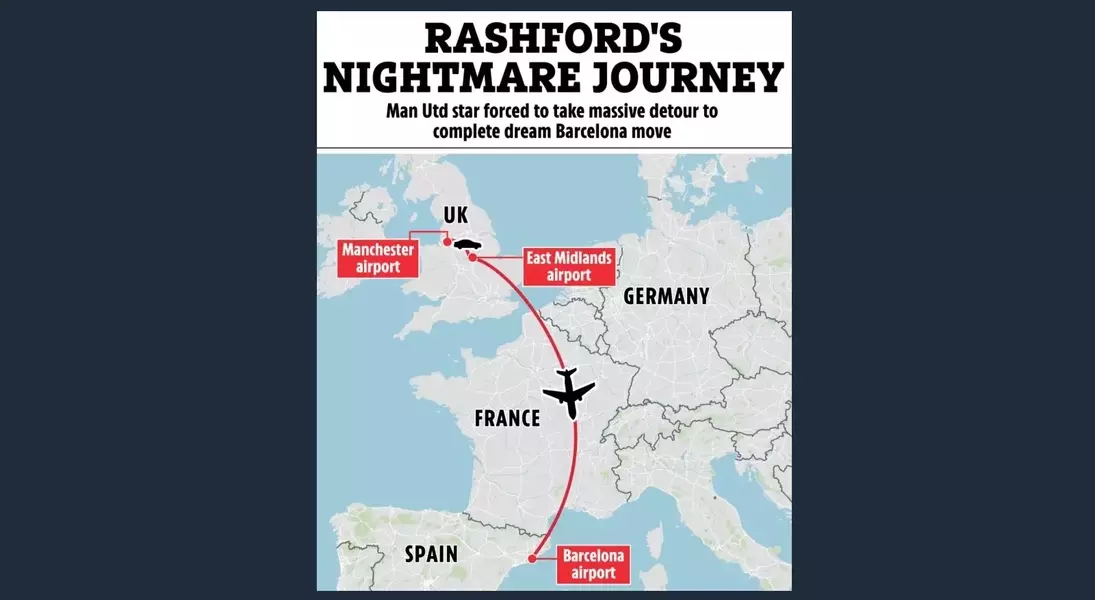

The recent transfer saga involving Marcus Rashford's loan move to Barcelona has highlighted the intricate interplay between player movements, media narratives, and club strategies in modern football. While the journey itself was fraught with minor inconveniences, its portrayal by the press amplified a routine logistical hiccup into a dramatic near-collapse. This situation not only underscores the hyper-scrutiny faced by high-profile athletes but also brings into focus the varying perspectives on what constitutes a successful transfer for both the selling and acquiring clubs.
Amidst the fanfare and media frenzy surrounding Rashford's transition, the broader implications for Manchester United and Barcelona are worth noting. For United, offloading a high-earning player, even temporarily, is viewed by some as a financial victory, despite the perceived loss of a talented academy product. Conversely, Barcelona gains a versatile forward with a proven track record, enhancing their attacking options for a modest outlay with a future buy option. This dynamic illustrates how a single transfer can be interpreted vastly differently based on a club's immediate needs and long-term objectives.
The 'Nightmare Journey' and Media Hype
Marcus Rashford's journey to finalize his loan agreement with Barcelona became an exaggerated media spectacle, with certain publications depicting a routine travel delay as a catastrophic event. What was essentially a short diversion to a different airport for a private flight was blown out of proportion, labeled a 'nightmare journey' and 'almost scuppered' by unforeseen circumstances. This sensationalized coverage raises questions about journalistic ethics and the tendency to create dramatic narratives around celebrity athletes, often at the expense of accuracy and proportionality. The media's portrayal contrasted sharply with the reality of a player eager to join a new club, highlighting the constant pressure and public scrutiny footballers face.
The media's description of Rashford's travel woes as a 'journey from hell' involved an 'immense detour,' which was illustrated with an over-the-top graphic map. This melodramatic framing transformed a minor inconvenience—a brief drive to an alternative airport due to a scheduling conflict—into a harrowing ordeal. Such exaggerated reporting contributes to a public perception of athletes as detached from reality, capable of enduring 'hell' over trivial matters, when in fact, the player was simply navigating logistical hurdles common in high-stakes transfers. This incident serves as a stark reminder of how news outlets can manipulate narratives, crafting sensational headlines from everyday events to captivate audiences, irrespective of the actual gravity of the situation.
Transfer Dynamics: United's Gain or Barcelona's Strategic Coup?
The loan transfer of Marcus Rashford to Barcelona has been met with contrasting interpretations regarding its benefit to the involved clubs. While some pundits suggest Manchester United emerged as the primary beneficiaries by offloading a high-earning player and freeing up salary space, others argue that Barcelona secured a strategic advantage. Barcelona acquired a talented and experienced international player at a manageable cost, with an option to buy, significantly bolstering their attacking options for various competitions without a substantial upfront investment. This move aligns with Barcelona's strategy to enhance squad depth and competitiveness, especially in a World Cup year, offering Rashford a prime opportunity to compete for trophies and play Champions League football.
From Manchester United's perspective, this move could be seen as an effective way to manage their squad and salary structure, particularly given the perceived decline in Rashford's form and the club's desire to reshape its roster under new management. However, dismissing the move as solely beneficial for United overlooks the fact that they are letting go of a prominent academy product with considerable potential, even if it is on a temporary basis. Barcelona, meanwhile, gains a player who has consistently demonstrated goal-scoring and assisting capabilities throughout his career, indicating a shrewd acquisition that strengthens their team for the remainder of the season and potentially beyond, at a favorable valuation compared to his earlier market price. This complex interplay of financial implications, strategic advantages, and player aspirations defines the narrative of this high-profile loan deal.
