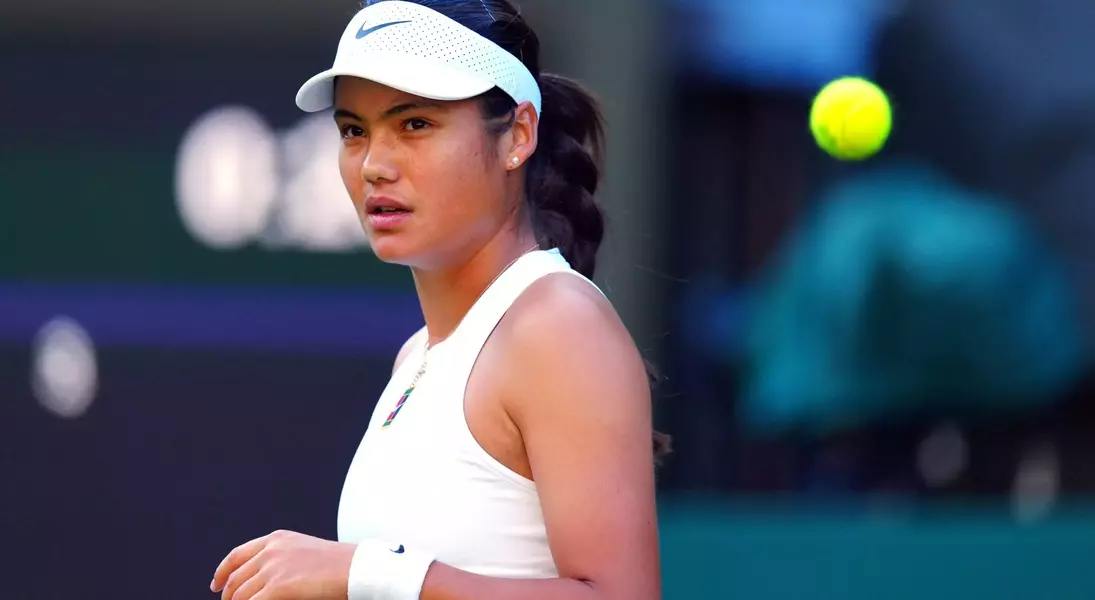
British tennis star Emma Raducanu is once again at a crossroads regarding her coaching setup, sparking considerable discussion after her departure from this year's Wimbledon tournament. Her recent third-round loss has intensified speculation about further shifts in her support team. Raducanu’s career has been characterized by a notable frequency of coaching changes, a pattern that continues to draw attention as she navigates the demanding landscape of professional tennis. The potential for another coaching transition highlights the ongoing search for stability and optimal guidance in her quest for consistent high-level performance.
This latest development underscores a broader narrative in Raducanu's journey since her breakthrough US Open victory in 2021. Despite her undeniable talent and past achievements, finding a long-term coaching partnership has proven challenging. Each change brings new approaches and strategies, but also introduces an element of uncertainty. As she reflects on her Wimbledon performance, the decisions she makes regarding her coaching staff will be pivotal in shaping her future trajectory and her ability to consistently compete at the sport's highest echelons.
Uncertainty Surrounds Coaching Future for Raducanu
British tennis star Emma Raducanu has hinted at another potential change in her coaching staff, following her exit from the 2025 Wimbledon Championships. This speculation emerges after her third-round defeat to World No. 1 Aryna Sabalenka. Raducanu's current coach, Mark Petchey, an LTA coach, had temporarily stepped away from his commentating duties to assist her through the Wimbledon campaign. Their arrangement was explicitly short-term, leading to discussions about its continuation. Raducanu acknowledged Petchey's sacrifice and expressed gratitude for his support, indicating that a comprehensive review of their partnership would occur after Wimbledon, once the immediate pressure subsided. Petchey, a former coach to Andy Murray, has also expressed a desire to minimize extensive travel, particularly to North America, making a long-term commitment challenging.
The possibility of a coaching change is not new territory for Raducanu, whose professional career has been marked by a series of such transitions. Since her remarkable 2021 US Open triumph, she has collaborated with multiple coaches, including Andrew Richardson, Torben Beltz, Dimitry Tursunov, Sebastian Sachs, Nick Cavaday, and Vladimir Platenik. While her partnership with Petchey began in April 2025 and she has publicly stated her enjoyment of working with him, the absence of a WTA final appearance under his guidance, coupled with his personal commitments, creates a scenario where a new coaching direction is highly probable. This ongoing search for a stable and effective coaching relationship reflects Raducanu's continuous effort to refine her game and achieve consistent success on the WTA Tour, emphasizing the critical role of strategic guidance in her evolving career.
Raducanu's Coaching Odyssey Continues
The British tennis sensation, Emma Raducanu, is contemplating yet another coaching adjustment as she looks beyond her 2025 Wimbledon exit. This marks a recurring theme in her professional career, characterized by frequent changes in her coaching team since her monumental US Open win in 2021. Raducanu's journey through various coaching styles and methodologies underscores her determination to find the perfect fit that can unlock her full potential and deliver sustained success. Each coach has brought a different perspective and set of strategies, but the consistent shifts suggest an ongoing search for an approach that can provide both technical development and mental fortitude necessary for the elite level of professional tennis.
Her recent collaboration with Mark Petchey, while seemingly positive on a personal level, faces practical hurdles. Petchey's established career as a commentator and his preference for less travel pose significant challenges to a long-term engagement that would involve extensive commitments like the North American hard court swing. This situation highlights the complex interplay between a player's needs, a coach's availability, and the demanding schedule of the WTA Tour. Raducanu's openness about evaluating her options post-Wimbledon indicates a pragmatic approach to her career, prioritizing her developmental needs and performance objectives as she strives to regain and surpass her previous career highs. The tennis world will keenly observe her next move, anticipating how this decision might influence her path forward in the competitive landscape of women's tennis.
