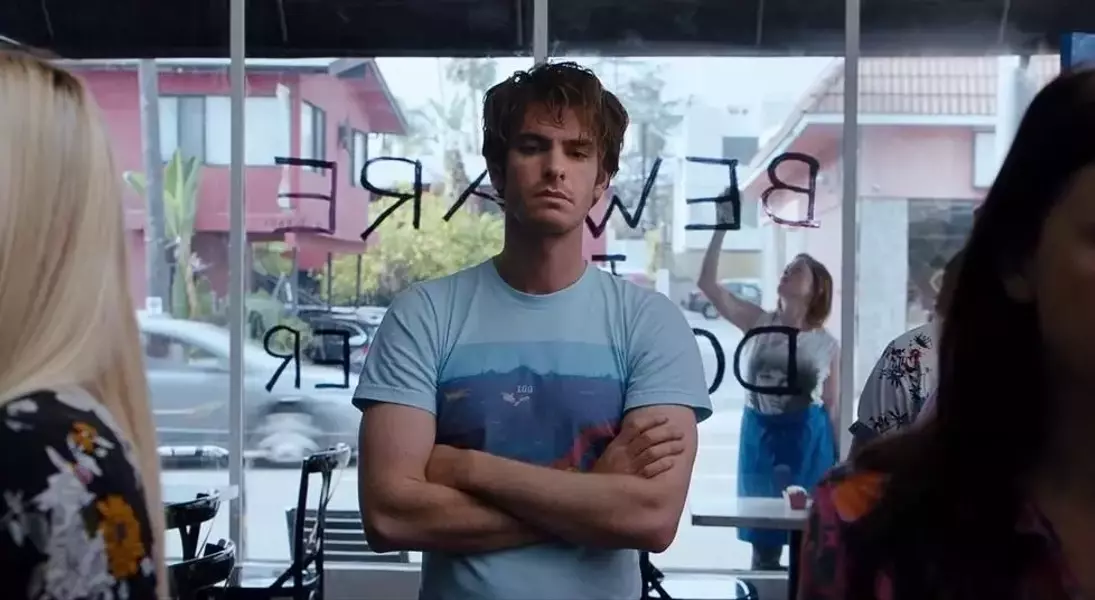



"Under the Silver Lake," a 2018 film currently streaming on Tubi, offers a refreshing, satirical approach to the paranoid thriller genre, distinguishing itself from its more serious predecessors and contemporaries.
This film playfully skewers the prevalent obsession with unraveling intricate puzzles, focusing on Sam, a listless man in his thirties, who immerses himself in a peculiar conspiracy unfolding in Silver Lake, Los Angeles. Despite facing imminent eviction, Sam dedicates his time to deciphering dubious codes, improbable treasure maps, and tenuous coincidences, all to construct a narrative that satisfies his conspiracy-driven mind. Following the disappearance of his neighbor, Sarah, shortly after a flirtatious encounter, and the simultaneous vanishing of billionaire Jefferson Sevence, Sam embarks on an unending quest. He is convinced that a network of subliminal messages is hidden in plain sight, leading him to attempt to expose what he perceives as Hollywood's sinister underbelly. The audience is left to question whether Sam's intense fixations are grounded in reality or merely the manifestations of a disengaged and disillusioned psyche. The movie cleverly uses pop culture references to construct its faux-conspiracy, with Sam poring over old magazines and game guides to solve mathematical equations and pinpoint coordinates, creating a coherent pattern only in his increasingly paranoid worldview. This narrative style sets it apart from other films in the genre, like "Something in the Dirt," which grounds its conspiracy in shared delusion stemming from isolation or trauma, whereas "Under the Silver Lake" embraces incoherence and absurdity, reminiscent of David Lynch's works, to deepen its rabbit-hole premise.
Beyond its clever satire, the film delves into Sam's existential crisis, revealing his attempts to impose meaning on a mystery where none exists as a way to grasp his own life. The movie critiques the inclination to evade reality through grand, fabricated conspiracies, yet Sam's journey ultimately highlights that the lack of clear-cut solutions is precisely the point. There's no profound enigma to solve, no satisfying resolution to a conspiracy storyline that is designed to be inconclusive. While Sam relentlessly seeks complex answers, he remains oblivious to his own significant flaws, including his inherent misogyny. This hypocrisy is skillfully utilized by the director to introduce compelling commentary on detached nihilism without reducing Sam to a mere caricature. It vividly illustrates the profoundly human tendency to lose oneself in an elaborate fantasy world rather than confront a harsh, self-made reality. Nearly a decade after its release, "Under the Silver Lake" resonates even more deeply today, serving as a somber reflection on an era where deciphering hidden clues and connecting unlikely dots has become a widespread cultural phenomenon. The film encourages viewers to critically examine their own perceptions of reality and the narratives they construct.
