This article explores the innovative development of a new quantum radar system designed for superior underground imaging. By harnessing the unique properties of Rydberg atoms, this technology offers a compact and highly sensitive alternative to conventional radar, promising advancements in various subsurface exploration fields.
Unveiling the Unseen: Quantum Radar's Groundbreaking Potential
Revolutionizing Subsurface Detection with Atomic Precision
A team of physicists has unveiled a groundbreaking radar system poised to transform underground exploration. This novel device leverages a precisely controlled cloud of atoms encased in a glass cell to perceive returning radio signals. Functioning as a quantum sensor, this invention taps into the fundamental quantum-mechanical characteristics of matter for precise measurement. While currently a prototype, its primary objective is to enhance the visualization of subterranean structures, including essential utilities, natural gas reservoirs, and historical archaeological sites.
Beyond Conventional Systems: The Quantum Leap in Radar Technology
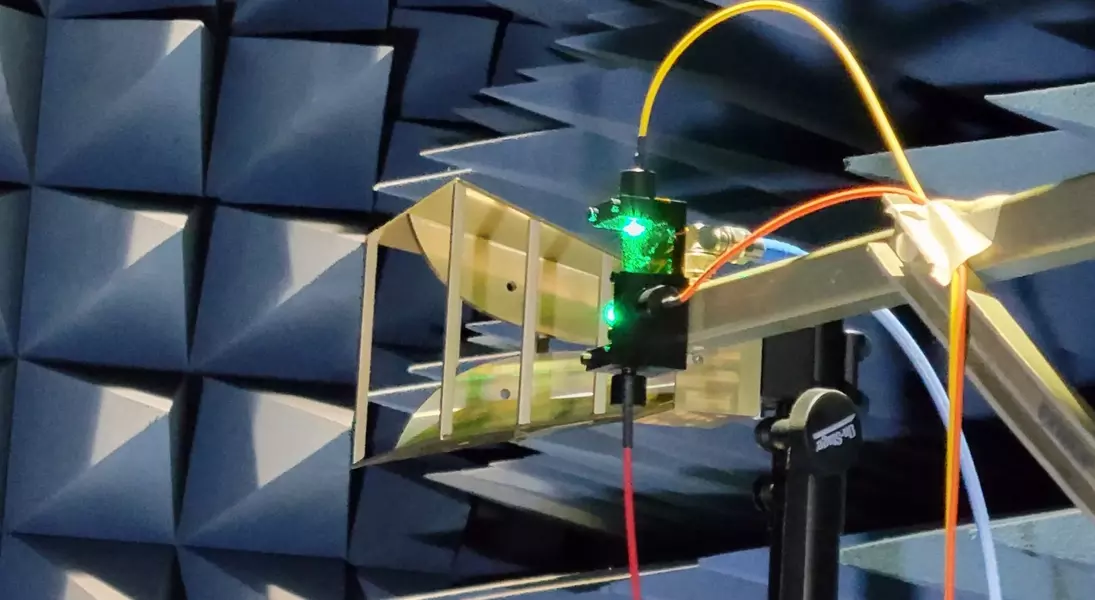
Similar to established radar principles, this apparatus emits radio waves that bounce off nearby objects, with the return time indicating their location. However, unlike traditional radar that relies on bulky antennas and receiver components, this new system registers the reflected waves by monitoring their interaction with the atomic cloud. The current experimental setup retains some bulkiness due to its connection to optical testing equipment, but researchers anticipate a much more compact final product. Matthew Simons, a physicist at the National Institute of Standards and Technology (NIST) and a key member of the research team, notes that the small, centimeter-sized glass cell of atoms replaces the need for sizable metal receiver structures, hinting at the potential for significant miniaturization. This development was a collaborative effort between NIST and the defense contractor RTX.
Harnessing Rydberg Atoms: The Core of Quantum Sensitivity
The quantum heart of this radar is a glass cell filled with cesium atoms maintained at room temperature. Lasers are employed to excite these individual cesium atoms, causing them to expand dramatically, reaching approximately 10,000 times their normal size, akin to a bacterium. These enlarged atoms are termed Rydberg atoms. When incident radio waves encounter these Rydberg atoms, they disrupt the electron distribution surrounding their nuclei. This disturbance is detected by observing changes in the color of light emitted by the atoms when illuminated by lasers. Monitoring these color shifts effectively transforms the atoms into a radio receiver. Michał Parniak, a physicist from the University of Warsaw not involved in this project, highlights that Rydberg atoms are inherently sensitive to a broad spectrum of radio frequencies without requiring physical adjustments, suggesting a single compact radar unit could operate across diverse frequency bands for various applications.
Rigorous Testing and Promising Outcomes
Simons's team rigorously evaluated the radar's performance in a specialized chamber designed to mimic an expansive open environment. This room featured foam spikes on all surfaces to absorb nearly all radio waves, preventing unwanted reflections. Within this controlled setting, they positioned a radio wave transmitter, along with their Rydberg atom receiver, connected to an external optical table. They directed radio waves at a copper plate, some pipes, and a steel rod, each placed up to five meters away. The radar successfully pinpointed the objects with an accuracy of 4.7 centimeters. The team disseminated their research findings in a paper submitted to the arXiv preprint server in late June.
Advancing Towards Commercialization and Broader Applications
This achievement propels quantum radar closer to commercial viability. Parniak commends the elegant integration of components, acknowledging that while Rydberg atoms have previously been demonstrated as radio wave detectors, this team has achieved a more streamlined integration. Other research endeavors have also explored the utility of Rydberg atoms in diverse radar applications. For instance, Parniak's group recently developed a Rydberg atom sensor for precise radio frequency measurements, aiding in the troubleshooting of automotive radar chips. Additionally, researchers are investigating the potential of Rydberg-atom-based radar for measuring soil moisture content.
The Intrinsic Advantages of Quantum Sensors
A significant benefit of quantum sensors lies in the inherent consistency of their foundational elements. Each cesium atom within this device is intrinsically identical, and the radio receiver's operation is predicated on the unchanging fundamental structure of these atoms. Simons emphasizes that the properties of these atoms are directly linked to fundamental physical constants, meaning quantum sensors demand less frequent calibration than their non-quantum counterparts. Governments globally have committed substantial investments to cultivate quantum sensors and quantum computers, which share common underlying components. For example, Rydberg atoms have been employed as qubits in quantum computers. Consequently, breakthroughs in quantum sensing can potentially fuel advancements in quantum computing, and vice versa. Parniak has recently adapted an error-correction technique from quantum computing to enhance a Rydberg-atom-based sensor.
Future Directions and Targeted Applications
Continued development is essential for quantum radar to achieve widespread commercial adoption. Future efforts will concentrate on improving the device's sensitivity to weaker signals, potentially involving enhancements to the glass cell's coatings. Simons acknowledges that this technology is unlikely to supersede all existing radar applications. Instead, he envisions its utility in specific scenarios demanding a compact and highly accurate detection solution.
