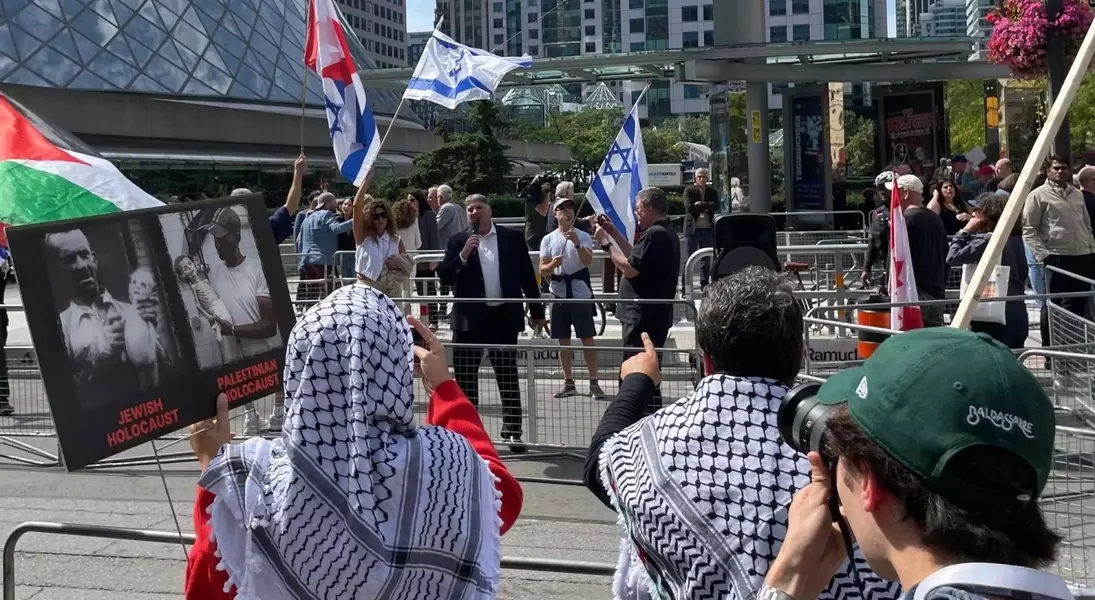
Tensions flared at the Toronto Film Festival during the premiere of a documentary addressing the Oct. 7, 2023, events. Supporters and opponents of the film, "The Road Between Us: The Ultimate Rescue," engaged in heated exchanges outside Roy Thomson Hall. The documentary, centered on an Israeli general's mission to rescue his family, ignited a contentious debate, with one side defending it as a truthful account and the other condemning it as propaganda. Despite the verbal confrontations, a significant police presence ensured that the demonstrations remained peaceful, albeit noisy.
The controversy surrounding the film prompted organizers to initially reconsider its inclusion, only to reinstate it after discussions with the Toronto Jewish community. This decision, aimed at balancing artistic expression with community concerns, ultimately led to the public spectacle of conflicting narratives playing out on the streets of Toronto, highlighting the deep divisions and strong emotions tied to the portrayal of the recent history in the region.
Divisions and Demonstrations
The Toronto Film Festival became a focal point for geopolitical tensions as a documentary chronicling the events of October 7th faced a passionate backlash and equally fervent defense. Pro-Palestinian demonstrators gathered to voice their opposition, claiming the film, \"The Road Between Us: The Ultimate Rescue,\" presented a biased and propagandistic view of the conflict. They argued that such narratives distort the reality of a century-long struggle, aiming to mislead public opinion. Conversely, pro-Israeli counter-protesters staunchly defended the documentary, asserting its authenticity as a depiction of a retired general's harrowing attempt to protect his family during a critical moment. This stark divergence in perspectives underscored the profound emotional and political chasm between the two sides, transforming the film premiere into a highly charged public forum.
The scene outside Roy Thomson Hall was one of organized chaos, with approximately 100 police officers on foot, bicycles, and horseback forming a human barrier between the opposing factions. Each group utilized sound systems and megaphones, attempting to drown out the other's chants and messages. Film attendees, caught in the midst of the demonstration, experienced extended waits as they navigated security checkpoints, including metal detectors and bag searches, before entering the high-profile venue. The intensity of the protests, though largely peaceful thanks to law enforcement, highlighted the significant societal impact and sensitivity surrounding the film's subject matter. This public display of dissent mirrored the broader international debate over the Israeli-Palestinian conflict, bringing it to the forefront of a major cultural event.
Navigating Narrative and Conflict
The core of the dispute at the Toronto Film Festival revolved around the portrayal of the October 7th events in the documentary. Pro-Palestinian activists, such as Anas, labeled the film as "Israeli propaganda," arguing that it misrepresents facts and serves a political agenda. They emphasized their objective to educate the public and correct what they perceive as misinformation. On the other hand, Winston Siegel, a pro-Israeli counter-protester, asserted the film's legitimacy, describing it as a true story of survival under dire circumstances. This clash of narratives extended to the very essence of the documentary, questioning its historical accuracy and its broader implications for understanding the ongoing conflict. The documentary's focus on a retired Israeli general's personal ordeal became a lightning rod for deep-seated political and historical grievances, making it more than just a cinematic event.
The Toronto Film Festival's initial decision to exclude the documentary, followed by its reinstatement after appeals from the Toronto Jewish community, further fueled the controversy, demonstrating the delicate balance festivals must strike when programming politically charged content. Meir Weinstein, an organizer of the pro-Israeli counter-protest, accused the pro-Palestinian demonstrators of attempting to "whitewash" the actions of certain groups, while Tarek Haj Ebrahim, a pro-Palestinian protester, maintained that the film was part of a larger Israeli propaganda effort, claiming a long history of factual manipulation. This microcosm of the larger Israeli-Palestinian conflict played out on the streets of Toronto, illustrating how cultural platforms can become arenas for political expression and contention. The protests ultimately underscored the powerful role of media in shaping public perception and the intense, often irreconcilable, viewpoints on historical events within the region.
