
Despite the prevailing sentiment that monthly expenses outpace income growth, hindering the ability to save for retirement, this article asserts a contrary viewpoint. It underscores that even a small, consistent savings habit, particularly when started early, can culminate in substantial financial freedom. The essence of wealth creation, it argues, lies not in the magnitude of initial capital, but in the diligent application of time and the miraculous effect of compounding. This often-underestimated principle allows investments to grow exponentially over an extended period, transforming modest contributions into a significant nest egg. The path to becoming a self-made millionaire, therefore, is paved with consistent effort and unwavering commitment, even during periods of slow apparent growth.
The Transformative Journey of Consistent Investment
In the contemporary financial landscape, many individuals grapple with the perception that their earnings are barely keeping pace with the escalating cost of living, leading to skepticism about the feasibility of meaningful retirement savings. Yet, financial experts continually highlight the profound impact of long-term investment, particularly through the mechanism of compounding. Consider an investment strategy mirroring the S&P 500's historical average annual growth of 10%, inclusive of dividend reinvestment. A mere $1 initial investment, if left untouched, would remarkably transform into $2.59 within a decade, expand to $6.73 over two decades, and astonishingly reach $17.45 after 30 years. This counter-intuitive acceleration is a testament to compounding, where annual gains themselves begin generating returns, creating a self-sustaining growth cycle.
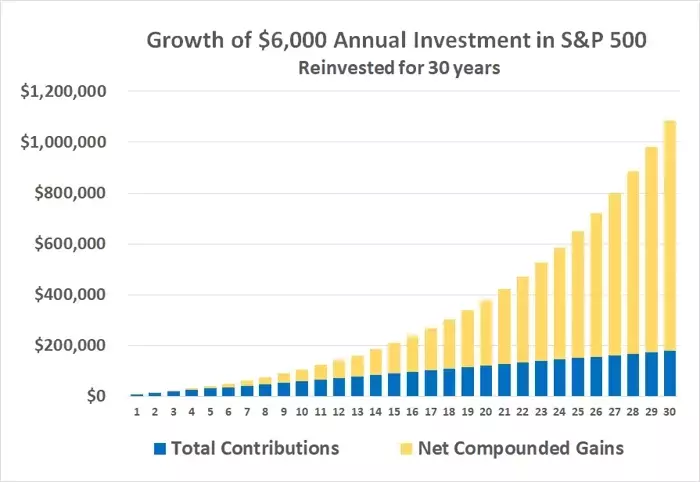
To illustrate this principle with a more tangible example, imagine consistently contributing $500 each month to a retirement fund, totaling $6,000 annually, while achieving the same 10% average yearly return. After ten years, your portfolio would stand at approximately $105,000, with your personal contributions accounting for $60,000 of that sum. The true power becomes evident in the subsequent decades: by the twentieth year, your total balance would soar to $378,000, with only $120,000 originating from your direct deposits. Fast forward to 30 years, and your account could potentially reach nearly $1.1 million, with a staggering $906,000 attributed solely to the growth generated by your initial $180,000 in contributions. This remarkable trajectory underscores that the most significant portion of wealth accumulation often materializes in the latter stages of the investment journey, emphasizing the critical importance of sustained commitment.
Embracing the Long View in Financial Planning
While the mathematical projections of compounding are compelling, it is crucial to acknowledge practical considerations such as taxation and inflation. The impact of taxes can vary depending on the type of retirement account used, such as a Roth IRA, which offers tax-free withdrawals, versus a traditional IRA, which typically incurs taxes upon distribution. Furthermore, inflation will naturally diminish the purchasing power of accumulated wealth over time; for instance, $1.1 million in 30 years might possess only half the value in today's dollars, assuming an average annual inflation rate of 2.5%. However, this concern is mitigated by the expectation that income and savings capacity will generally increase proportionally with inflation.
The profound takeaway from this analysis is the immense significance of patience and perseverance in investment. It is common for investors to experience discouragement during the initial years when personal contributions outweigh investment gains. Yet, the compounding effect ensures that growth accelerates dramatically in later stages. For instance, in the illustrative scenario, two-thirds of the total net gains were realized in the final nine years of the 30-year period. This highlights that the seemingly slow progress early on is laying the essential groundwork for explosive growth later. True self-made millionaires are those who maintain their saving and investing discipline, even through challenging times, ultimately positioning themselves to capitalize on the powerful, late-stage surge of their growing assets. The journey may feel arduous at first, but the long-term rewards undeniably justify the commitment.
