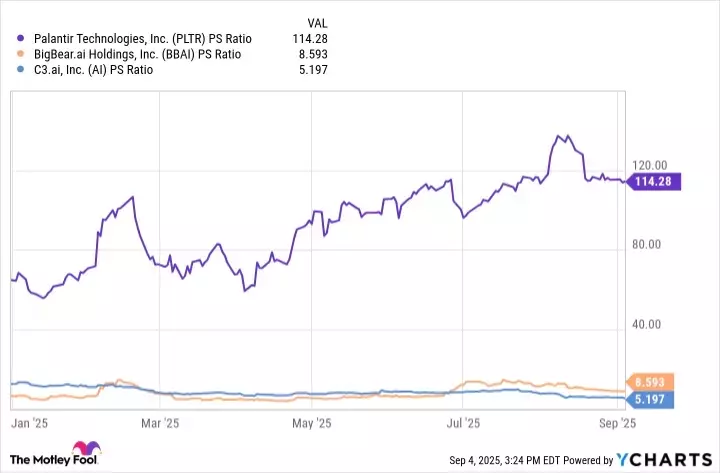

In the dynamic landscape of artificial intelligence software, a notable divergence in fortunes has emerged between two prominent players: Palantir Technologies and C3.ai. While C3.ai has faced significant setbacks, marked by a substantial decline in its stock value and missed financial projections, Palantir has experienced a remarkable surge, cementing its status as a dominant force in both governmental and commercial markets. This contrast underscores Palantir's strategic superiority and expanding influence, particularly as C3.ai struggles to maintain its market position.
Detailed Report on AI Software Market Dynamics
In a recent development observed on September 4th, the financial markets delivered a decisive verdict on the comparative performance of AI software providers. Palantir Technologies has seen its stock value more than double this year, soaring by an impressive 105%. Conversely, C3.ai’s shares have experienced a sharp decline, plummeting by 54% to reach a multi-year low. This stark difference in trajectories follows a question posed in January regarding C3.ai’s potential to emulate Palantir’s success, a query now definitively answered.
Adding to C3.ai’s woes, the company recently announced its first-quarter results for fiscal year 2026, ending April 30th, which significantly underperformed its own revenue and operating income forecasts. Revenue came in at $70.3 million, falling short of the $100 million to $109 million guidance, while the operating loss widened to $57.8 million, nearly double the pessimistic end of its projection. Furthermore, C3.ai has retracted its full-year guidance, leaving investors uncertain about its future financial stability and raising concerns about management credibility.
Palantir, on the other hand, has capitalized on its rival's struggles. Initially criticized for client concentration, both companies have aimed to broaden their customer bases. However, Palantir’s expansion efforts have yielded far more impactful results. Its Maven Smart System contract expanded by $795 million in May, bringing its total value to $1.28 billion. More recently, the U.S. Army consolidated 75 agreements into a single contract with Palantir, potentially worth up to $10 billion over the next decade. Beyond domestic government, Palantir secured a significant agreement with NATO, reinforcing its international presence. In the commercial sphere, it partners with aviation leaders like Archer Aviation and American Airlines, alongside strategic alliances with technology giants such as Oracle, Accenture, Amazon Web Services, Microsoft, and Deloitte. These collaborations not only extend Palantir's market reach but also integrate its solutions deeply into enterprise AI infrastructures, positioning it as the preferred choice for critical deployments, while C3.ai is relegated to smaller opportunities.
Insights into the Future of AI Investments
The stark performance disparity between Palantir and C3.ai offers valuable lessons for investors in the artificial intelligence sector. While C3.ai may appear superficially attractive due to its lower price-to-sales ratio, its ongoing operational and financial challenges indicate it could be a 'value trap.' Investors seeking robust growth and sustained relevance in the long term would be better served by focusing on established leaders like Palantir. Palantir's ability to consistently secure and expand high-stakes contracts across both government and commercial domains highlights its strategic importance and reinforces its position as a frontrunner in the evolving AI landscape. This demonstrates that in high-growth, competitive markets, fundamental strength and strategic positioning often outweigh perceived bargains.
