OpenAI's latest breakthrough, GPT-5, has officially been released, signaling a new phase for artificial intelligence. This advanced large language model promises a transformative user experience with its enhanced precision, accelerated processing, and customizable functionalities. Designed to overcome previous limitations, particularly in generating factual inaccuracies, GPT-5 integrates a suite of powerful capabilities, making it a versatile tool for various tasks. Its public availability for all ChatGPT users underscores OpenAI's commitment to democratizing cutting-edge AI, paving the way for more intuitive and effective interactions across numerous applications.
The debut of GPT-5 marks a pivotal moment in the evolution of conversational AI. This foundational model is engineered to be more intelligent, swifter, and significantly more precise than its predecessors, drastically reducing instances where the AI fabricates information. OpenAI's leadership emphasized that GPT-5 functions as an omnipresent subject matter expert, capable of executing a wide array of tasks. From crafting narratives and developing code to creating dynamic applications, managing communications, and conducting extensive research, its versatility is unmatched. The model’s integrated architecture means users no longer need to manually select specific models for different tasks; GPT-5 intelligently determines the optimal approach for any given prompt.
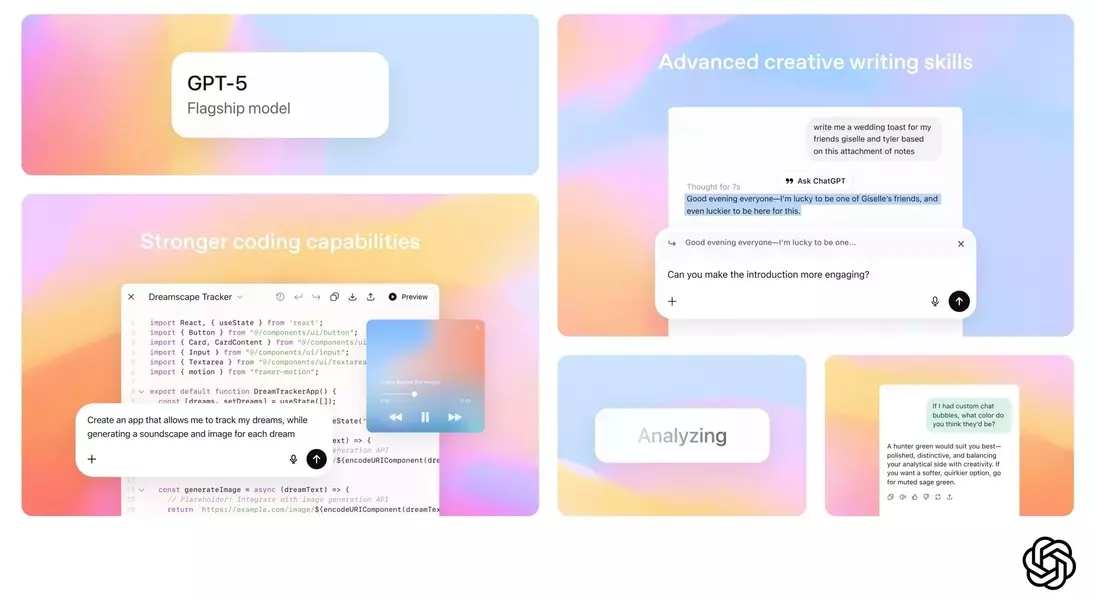
Alongside the flagship GPT-5, OpenAI has also introduced more economical variants, GPT-5 Mini and GPT-5 Nano. These smaller models offer a cost-effective solution for developers, automatically becoming active for users who reach their GPT-5 usage thresholds. Despite their compact size, OpenAI assures that these models retain substantial capabilities, often surpassing previous versions like GPT-4. This strategic tiered offering aims to broaden accessibility while maintaining high performance standards. A key highlight of GPT-5 is its enhanced coding proficiency. OpenAI envisions it as a personal coding assistant, capable of translating simple requests into functional, interactive applications. While acknowledging that perfection may not be immediate, this feature represents a considerable stride for both seasoned programmers and those with nascent coding interests, often referred to as 'vibe-coders'.
Furthermore, GPT-5 extends its prowess to profound research and analytical reasoning. Leveraging OpenAI's most sophisticated reasoning models, available now to all ChatGPT users, it can undertake complex, multi-faceted searches and condense vast datasets into coherent responses. Sam Altman, OpenAI's CEO, even suggested that GPT-5's research capabilities could rival those at a doctoral level. Beyond textual output, the model can generate bespoke visualizations, interactive tools, and educational content, offering diverse methods for information assimilation. User interaction is also being revolutionized with the introduction of four distinct preset personalities: Cynic, Robot, Listener, and Nerd. These customizable personas allow users to tailor ChatGPT's conversational style to specific needs, addressing previous concerns such as excessive flattery observed in GPT-4o. The improved Voice Mode further enhances usability, adapting to user instructions and making AI interactions more fluid and natural, a much-anticipated upgrade for custom GPTs.
Connectivity with external applications has also received a significant boost. The ability to link ChatGPT with services like Gmail, Google Calendar, and Google Contacts streamlines workflows by allowing the AI to automatically access and reference personal data. While offering immense convenience, users retain full control over data sharing, alleviating potential privacy concerns. Moreover, subtle yet impactful user interface enhancements, such as the option to assign different colors to chats, aim to improve organization and navigation within the platform. While GPT-5 introduces many advancements, particularly in health-related information (though professional medical consultation remains paramount), it acknowledges certain existing models still excel in specific areas. For instance, GPT-4.1 retains a larger context window, essential for processing massive information volumes, ensuring its continued support for specialized applications. OpenAI continues to innovate, balancing groundbreaking features with practical utility and user control.
