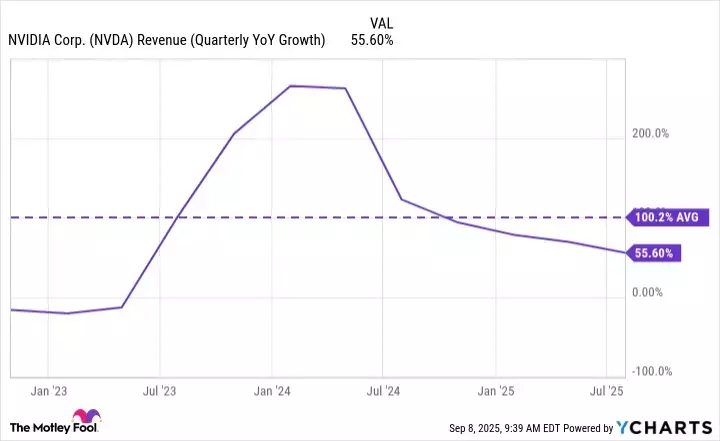

NVIDIA, a prominent developer of artificial intelligence chips, is poised to significantly enhance its financial performance by tapping into the vast opportunities within the Chinese market. Although the company has experienced a deceleration in its growth trajectory in recent quarters, the strategic entry into China, particularly with its next-generation Blackwell chips, is anticipated to reverse this trend. This expansion could provide a substantial uplift to its top-line figures, compensating for any slowdowns observed in other regions.
NVIDIA's Strategic Moves in the Global AI Landscape
In a significant development for the semiconductor industry, NVIDIA, a leading innovator in artificial intelligence processing units, is actively pursuing a major expansion into the burgeoning Chinese market. As of early September 2025, CEO Jensen Huang has engaged in discussions with U.S. President Donald Trump, signaling a potential breakthrough for NVIDIA to introduce its cutting-edge Blackwell chip technology to China. This initiative comes at a time when the company, despite previously achieving remarkable growth driven by its essential AI chips, has observed a natural moderation in its expansion rate.
Currently, the Chinese market is slated to receive NVIDIA's H20 chip, which incorporates earlier technological advancements. This arrangement includes a commitment for 15% of the sales revenue from these chips to be directed to the U.S. government. While H20 sales are not presently factored into NVIDIA's financial forecasts due to market uncertainties, the company envisions a multi-billion dollar opportunity, particularly if its more advanced Blackwell chips gain market access. Huang identifies China as a pivotal AI market, projecting it to represent a $50 billion opportunity within the current year, with an anticipated annual growth of approximately 50%.
NVIDIA's most recent financial disclosures for the quarter ending July 27 revealed a robust revenue of $46.7 billion, marking a 56% increase year-over-year. This impressive growth was achieved even without sales of the H20 chip to Chinese clients. The company's consistent, high-rate growth has been remarkable, making any deceleration a natural progression. However, the prospect of entering the Chinese market with its advanced products could reignite rapid growth, cementing NVIDIA's position at the forefront of the global AI chip industry.
Future Prospects and Market Implications
From an investor's perspective, NVIDIA's strategic pivot towards the Chinese market presents a compelling narrative for sustained growth. Despite its current valuation as one of the world's most valuable companies with a market capitalization exceeding $4 trillion, the untapped potential in China could render its stock significantly undervalued. If NVIDIA successfully accelerates its growth and maintains its impressive profit margins by penetrating this lucrative market, its price-to-earnings ratio could become even more attractive.
Furthermore, the company's price-to-earnings-growth (PEG) multiple of 1.25 suggests that, when considering its long-term growth prospects, NVIDIA remains a sensible investment. As long as the global demand for AI technologies continues its upward trajectory, investors who acquire NVIDIA shares today may witness substantial future gains, particularly as the company solidifies its presence in key high-growth regions like China.
