


This analysis delves into Nvidia's remarkable performance amid the artificial intelligence surge, assessing its current market valuation and strategic financial decisions. The report aims to provide a comprehensive overview of whether the semiconductor giant’s stock can continue its upward trajectory, considering its past growth and future potential.
Nvidia's Strategic Moves in the AI Era: Beyond the Hype
The Unprecedented Rise Fueled by AI Dominance
Nvidia, a leading semiconductor innovator, has undeniably been the prime beneficiary of the artificial intelligence revolution. Since the emergence of generative AI tools like ChatGPT in late 2022, the company's stock has seen a tenfold increase in value. Major tech entities, including Microsoft, Alphabet, Meta Platforms, Amazon, and Oracle, have significantly invested in AI infrastructure, with a substantial portion dedicated to equipping their data centers with Nvidia's cutting-edge chips. This extraordinary demand has propelled Nvidia's market capitalization from approximately $345 billion at the onset of the AI boom to over $4 trillion today.
Examining Nvidia's Current Market Valuation
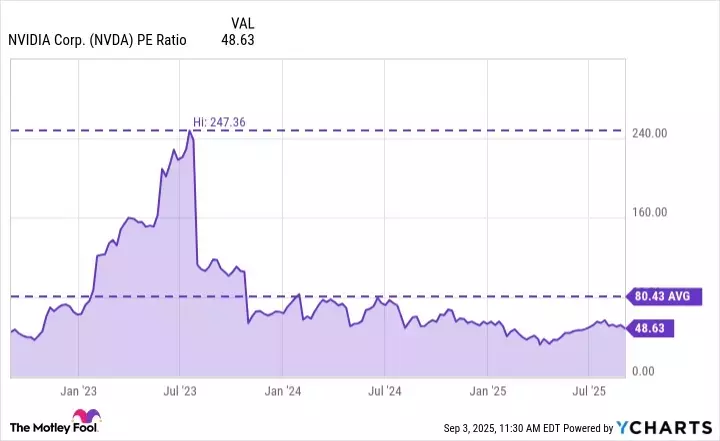
Following such substantial gains, it is natural for investors to question if Nvidia's peak performance is behind it. However, the company's valuation metrics suggest a more nuanced picture. Nvidia's price-to-sales (P/S) ratio aligns with its three-year average and remains notably below the high points observed during the initial phases of the AI frenzy. While this might suggest a relative discount compared to past AI euphoria, it's essential to consider that even during the dot-com bubble, many high-growth stocks only reached P/S multiples in the 30 to 40 range. Furthermore, Nvidia's price-to-earnings (P/E) multiple, currently at 49, appears significantly lower than its historical averages. This reflects a dramatic expansion in the company's profitability, indicating a normalization of earnings rather than a less aggressive growth valuation by investors. Despite the demanding absolute valuation, management's recent actions provide further insight into the stock's future.
Management's Confidence: The $60 Billion Share Repurchase
In a significant show of confidence, Nvidia's management recently approved an additional $60 billion stock buyback program, following $24.2 billion in repurchases during the first half of the year. Such substantial buybacks are typically a strong signal that leadership believes in the sustainability of the company's cash flows and considers repurchasing its own stock to be an optimal use of capital. This move also suggests a strategic underpinning. While Nvidia's growth has primarily been driven by chips for training large language models, future growth is anticipated from more advanced applications such as robotics, quantum computing, and autonomous systems, each representing multi-trillion-dollar markets. These next-generation applications will demand even greater computing power, necessitating new chip architectures like Nvidia's upcoming Rubin.
Navigating Future Growth and Long-Term Prospects
While the full impact of these sophisticated use cases on Nvidia's profitability may take five to ten years to materialize, the company's growth is expected to continue, albeit at a potentially slower pace in the interim. The new stock buyback program serves as a strategic bridge, maintaining robust earnings per share (EPS) momentum during this transitional period. By aggressively reducing its outstanding share count, Nvidia can sustain EPS growth as the AI infrastructure wave evolves in the background. This proactive approach underscores Nvidia's commitment to shareholder value and its strong position in the secular tailwinds of AI infrastructure spending. Considering its robust cash generation and management's shareholder-friendly capital allocation, Nvidia remains a compelling long-term investment in the burgeoning AI landscape.
