Nvidia has consistently delivered outstanding returns for investors, cementing its position as a market leader in the technology sector. The company's exceptional growth trajectory, particularly in the burgeoning field of artificial intelligence, presents a compelling case for continued investment. Despite its past successes, a closer examination reveals several factors that suggest Nvidia's stock still holds significant upside potential. These include the sustained and increasing demand for AI computing infrastructure, the inherent lifespan and replacement cycle of its core products, and a stock valuation that, when viewed in the context of its growth, appears more attractive than commonly perceived. These elements collectively paint a picture of a robust company poised for future expansion.
Nvidia's Future: Unpacking the Pillars of Continued Growth
Nvidia's journey has been nothing short of spectacular, especially in recent years. Since the commencement of the artificial intelligence boom in 2023, its stock has soared by an astonishing 1,220%. Looking back a decade, an initial investment of $10,000 in Nvidia would now be worth close to $3 million, and over a 20-year span, that figure escalates to an astounding $6.9 million. While we cannot rewind time to capitalize on these historical gains, the future prospects for Nvidia remain remarkably bright, making it a compelling investment today.
A primary driver for Nvidia's anticipated growth is the ever-increasing need for AI computing power. The landscape of artificial intelligence is continuously expanding, with new data centers being announced regularly. This surge indicates that the full potential of AI integration into both commercial enterprises and daily life is far from being realized. Furthermore, the construction and deployment of these data centers are not instantaneous processes; there is often a time lag between an investment announcement and the actual revenue generation from equipping these facilities with Nvidia's computing hardware. Hyperscale AI providers have projected a substantial increase in their capital expenditures for data centers in 2026, significantly surpassing the already high levels of 2025. Nvidia is strategically positioned to be a major beneficiary of this immense spending. Given that these clients likely engage with Nvidia years in advance regarding their graphics processing unit (GPU) requirements, the company's bold forecasts for future AI computing demand warrant serious consideration from investors.
During a recent quarterly earnings call, Nvidia's leadership shared a striking projection: global data center capital expenditures are expected to reach an astounding $3 trillion to $4 trillion by 2030, a dramatic leap from the current figure of approximately $600 billion. While this growth may seem extraordinary, it becomes more plausible when considering the nascent stage of AI infrastructure development in regions like Europe, the ongoing substantial investments in the United States, and China's own expanding footprint in this area. If management's projections for 2030 prove accurate, Nvidia would unequivocally become a must-have stock. Even if actual spending falls somewhat short of these ambitious targets, the overarching trend of increased data center capital expenditure undoubtedly bodes well for Nvidia's sustained success.
Beyond new installations, another critical factor contributing to Nvidia's enduring demand is the finite lifespan of its GPUs. These units are subjected to intense operational demands within data centers. Experts, including a specialist from Alphabet, estimate that GPUs have a functional life span ranging from one to three years. This implies that the GPUs acquired since the beginning of the AI race in 2023 are likely nearing the end of their operational cycles and will soon require replacement. This impending replacement cycle will generate a fresh wave of demand for Nvidia's GPUs, supplementing the existing demand driven by the need for enhanced computing capacity. Consequently, even after the initial build-out phase of AI infrastructure is complete, Nvidia will continue to enjoy a consistent revenue stream from replacing these essential components, ensuring the company's long-term stability and profitability.
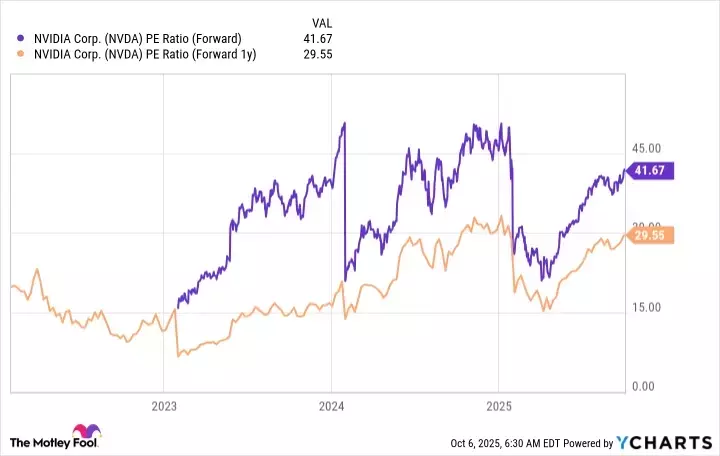
Despite its remarkable success and growth, Nvidia's stock might not be as overpriced as some observers believe. Currently, it trades at approximately 42 times its forward earnings and around 30 times next year's projected earnings. While these figures do not suggest a 'cheap' stock, they also do not indicate an unsustainable valuation bubble. The company is generating substantial real profits, and if the market continues to underestimate its growth potential, as it has in previous years, the stock could actually be more undervalued than it appears. Historically, many investors who doubted Nvidia's growth prospects have been proven wrong, while those who maintained faith in the company's vision have reaped significant financial rewards. Management's recent market projections have undoubtedly bolstered its credibility, and if investors are confident in the continued escalation of AI hyperscaler spending on data centers over the next half-decade, then trusting Nvidia's trajectory seems a logical conclusion.
In summary, Nvidia remains an exceptional investment opportunity. While the astronomical returns of over 1,000% seen in the past three years may not be replicated, the company is still well-positioned to outperform the broader market. Its integral role in the AI revolution, coupled with strong demand fundamentals and a reasonable valuation, makes it a compelling choice for forward-thinking investors.
Nvidia's strategic positioning within the AI sector offers profound insights into the future of technological investment. The relentless demand for AI computing, coupled with the predictable cycle of hardware replacement, suggests a sustainable growth model. This report underscores the importance of long-term vision in investment, urging a focus on foundational technologies that power emerging trends rather than chasing fleeting hype. It highlights that even market leaders, when their core business aligns with major technological shifts, can continue to offer substantial value and outperform expectations, provided their valuations are assessed within the context of their unique growth drivers and competitive advantages.
