In a notable development within the semiconductor industry, Nvidia, a leader in AI chip design, is reportedly engaging Intel Foundry to manufacture specific parts of its forthcoming Feynman chips. This collaboration marks a significant shift, as Intel's manufacturing arm has historically faced difficulties in securing major clients amidst fierce competition, primarily from TSMC.
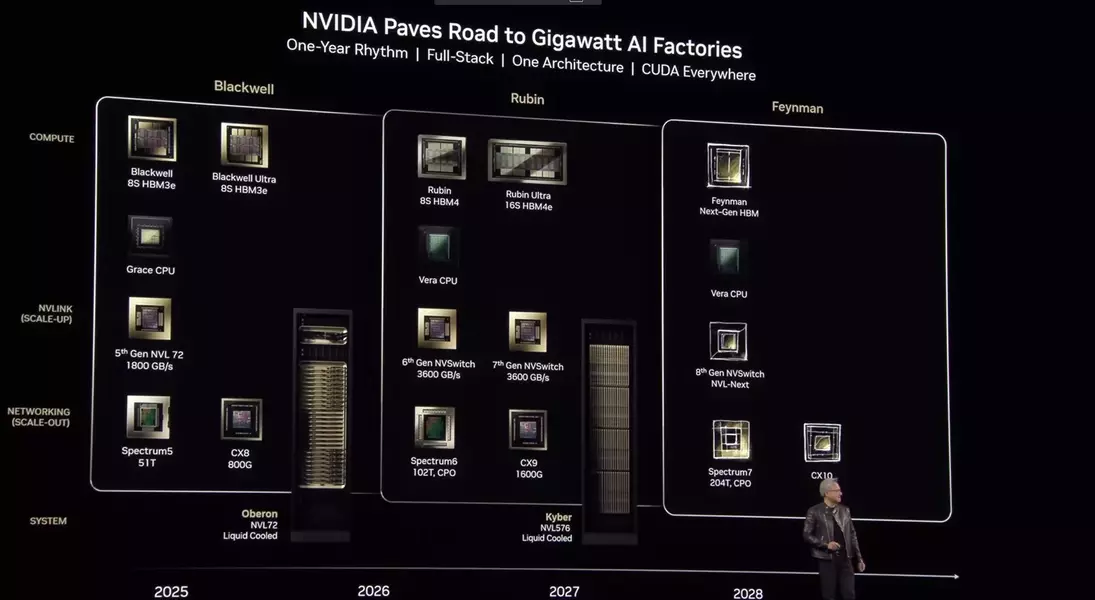
Sources from the supply chain indicate that Nvidia plans to utilize Intel Foundry for the production of non-core chip components, with a choice between Intel's 18A or 14A process nodes. The final decision hinges on Intel's ability to demonstrate sufficiently high yields for mass production. Despite this partnership, TSMC is expected to retain its role as the primary manufacturer for the critical GPU units of these chips, likely employing its advanced A16 process node. The Feynman architecture, succeeding Rubin and Rubin Ultra, is anticipated to launch in 2028, with Nvidia CEO Jensen Huang briefly touching upon its potential for powering 'Gigawatt AI Factories' at a recent event.
This strategic alliance comes at a time when Intel has expressed caution regarding its 14A production roadmap, as highlighted by CFO David Zinsner. He indicated that significant investment in 14A capacity is contingent upon securing sufficient customer demand. Furthermore, an earlier SEC filing revealed that the economic viability of Intel's advanced nodes, including 14A, was dependent on attracting substantial external clientele. The landscape has since evolved, with both the U.S. government and Nvidia investing in Intel's business, suggesting that geopolitical pressures to diversify chip manufacturing geographically, particularly within the United States, played a role in fostering this unexpected partnership. Intel is also set to contribute its EMIB technology for packaging approximately 25% of the Feynman chips, integrating various dies, while TSMC handles the remainder. Although a tentative victory for Intel, the long-term success of Intel Foundry will require sustained competitive advantages beyond external pressures to rival established industry giants like TSMC.
The evolving dynamics in the semiconductor sector underscore a future where collaboration and diversification are paramount. This partnership not only strengthens Intel's position in advanced manufacturing but also highlights a collective effort to innovate and secure the supply chain for critical technologies. Such strategic alliances are vital for driving technological progress and fostering a resilient, competitive industry landscape.
