The landscape of the semiconductor industry is currently defined by a sharp contrast between Nvidia's soaring dominance in artificial intelligence (AI) chips and Intel's strenuous efforts to regain its footing, particularly with recent governmental backing. Nvidia, leveraging its cutting-edge Hopper and Blackwell GPUs, has become an indispensable force in powering advanced AI applications, achieving remarkable revenue growth from its data center sales. Concurrently, Intel, traditionally a leader in central processing units (CPUs), is navigating intense competition while striving to invigorate its foundry division, a critical step towards re-establishing its market presence amidst the AI revolution.
Nvidia’s trajectory in the AI domain is nothing short of meteoric. The company’s graphics processing units (GPUs) are the industry's preferred choice for developing and deploying sophisticated AI models, generative AI, and other high-performance computing tasks. A significant factor in Nvidia's success is its proprietary CUDA parallel computing platform, which locks developers into its ecosystem. This platform enables efficient parallel processing, allowing thousands of operations to be performed simultaneously, thereby optimizing processing times and resource utilization for computationally intensive workloads. The demand for its new Blackwell architecture chips has been extraordinary, generating billions in sales within months of their release, underscoring Nvidia's virtually unchallenged position in this specialized market.
In stark contrast, Intel, a long-standing titan in the data center CPU market, is contending with increasing pressure from Advanced Micro Devices (AMD) and Arm Holdings. Projections suggest a decline in Intel’s market share in the coming years as competitors gain ground. Furthermore, Intel’s ambitions in the third-party foundry business have faced considerable obstacles, with the company struggling to secure clients and even halting plans for new fabrication plants in Germany and Poland. Despite these setbacks, Intel is committing over $100 billion to its domestic foundry operations, with a new facility anticipated to open soon in Arizona, signaling a renewed focus on in-house manufacturing capabilities.
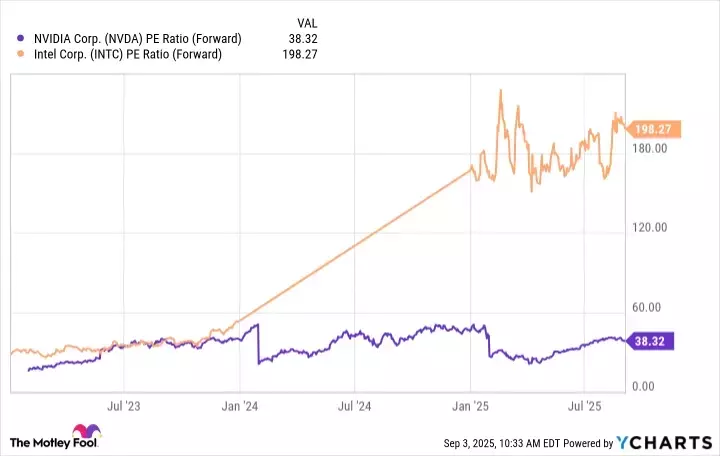
A notable development impacting Intel is the substantial investment from the U.S. government. In August, the Trump administration acquired a 9.9% stake in Intel, along with warrants for additional shares, as part of a broader national initiative to foster the development and manufacturing of advanced semiconductors within the United States. This strategic move aims to fortify the domestic supply chain and ensure the U.S. remains at the forefront of semiconductor technology. Despite a 20% surge in Intel's stock since the beginning of 2025, largely attributed to this governmental endorsement, market analysts remain cautious. They point to Intel's elevated forward price-to-earnings ratio, which significantly surpasses Nvidia's, as a sign of inflated expectations. With recent quarterly net losses totaling $21 billion, skeptics question Intel's capacity for a rapid financial turnaround sufficient to justify its current valuation.
The financial community's assessment reflects a prevailing skepticism regarding Intel's prospects. While the government's investment provides a potential tailwind, the company's arduous journey to catch up in the AI race and its struggle with profitability present significant challenges. Industry experts and analysts largely maintain a "hold" rating on Intel stock, forecasting a potential downside in its share price. Ultimately, while Intel's long-term vision of becoming a leading domestic chip manufacturer is commendable, Nvidia's established leadership in GPU technology and comprehensive AI infrastructure positions it as a more secure investment for those looking to capitalize on the burgeoning artificial intelligence sector.
