This article thoroughly examines Nintendo's game release patterns for the Switch 2's first year, evaluating how closely they aligned with a previously established 'Nintendo Playbook.' This playbook was constructed using extensive historical data to identify recurring trends and behaviors in Nintendo's game development over several console generations. The analysis reveals that a significant portion of the predicted titles, particularly those from major franchises, did materialize. However, there were also notable discrepancies, most strikingly the absence of a primary Mario game. Looking ahead, the article forecasts the potential game lineup for the Switch 2's second year, taking into account expected increases in software volume and strategic price adjustments.
Two years prior, a comprehensive prediction model was developed, outlining the potential first-party game releases for the Switch 2's initial five years. This model, termed the 'Nintendo Playbook,' was not based on speculation but on a meticulous analysis of Nintendo's long-standing publishing habits. Key factors considered included the average intervals between franchise releases, the total number of releases per franchise per console generation, and the typical generational year for each franchise's debut. This data-driven approach aimed to create a schedule that Nintendo theoretically could have followed. As the first year concludes, it's timely to assess the accuracy of these predictions.
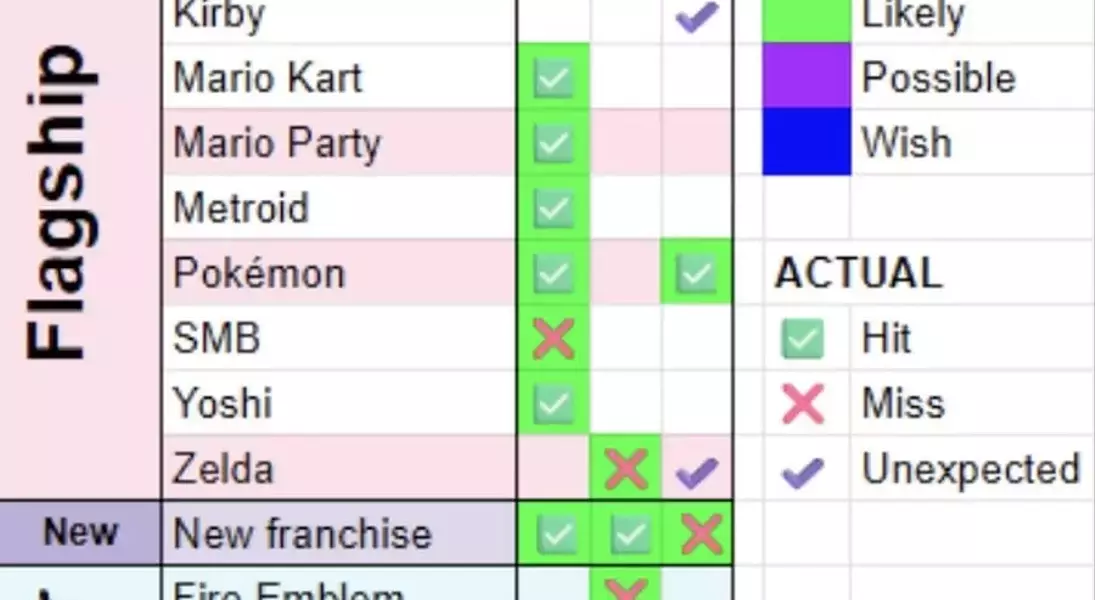
During the Switch 2's debut year, Nintendo launched 13 first-party titles, excluding updated versions of older games. The 'Playbook' accurately foresaw 10 of these. This included six core entries for popular franchises like Donkey Kong, Mario Kart, Mario Party, Metroid, Pokémon, Yoshi, and Star Fox, alongside two new intellectual properties and two spin-off titles within the Pokémon and Zelda series. The inclusion of Mario Kart and Pokémon titles in the first year was largely anticipated, given their historical prevalence. Similarly, Metroid Prime 4's appearance was a relatively straightforward prediction, owing to its planned concurrent launch across both Switch platforms. While some predictions, such as a 3D Donkey Kong title after 26 years and a revival of the Star Fox series, might seem audacious, they were rooted in the playbook's statistical insights. Yoshi's earlier-than-expected release was also indicated by the mathematical model. Even Super Mario Party Jamboree, though initially released on the original Switch, received a significant Switch 2 Edition, fulfilling its projected Year One slot.
Despite the successes, the 'Nintendo Playbook' wasn't entirely infallible, demonstrating that Nintendo's strategy, while often predictable, can also deviate. The most surprising anomaly was the absence of a mainline Super Mario game, a stark contrast to previous console launches where a core Mario title was almost a given. This marks a significant departure from historical trends. Other unexpected omissions included new Xenoblade Chronicles titles, a Fire Emblem remake, and the introduction of a third new IP. The earlier-than-predicted arrival of Mario Tennis Fever and Kirby Air Riders also represented deviations from the model, indicating areas where Nintendo chose a less conventional path.
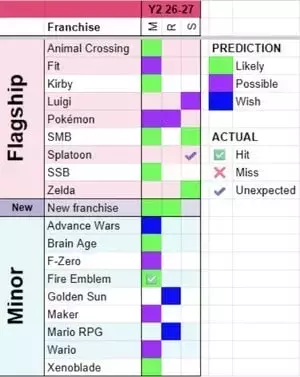
The first year of the Switch 2 saw some departures from established patterns, setting the stage for an even more critical assessment of Nintendo's historical adherence in its second year. President Furukawa has hinted at an increased volume of software releases for Year Two, which is unusual for a console's second year. This heightened output is likely a strategic move to counteract an impending price increase for the console, necessitating a robust lineup of system-selling titles. Therefore, Year Two will be a crucial test, where the 'Playbook's' predictions confront the economic realities of a price adjustment. The initial predictions for Year Two include mainline entries for major franchises such as Smash Bros, Kirby, Animal Crossing, and Nintendo Fit, along with titles from 'minor' franchises like Mario Maker, Fire Emblem, and Big Brain. Additionally, spin-offs for Mario and Zelda, revivals of Wario Land and F-Zero, and remakes or remasters for Mario & Luigi, Pokémon, and Golden Sun franchises were anticipated, alongside two new IPs. However, adjustments to these predictions are already necessary, with a Splatoon spin-off confirmed and a 3D Mario sequel now almost certain. The exact timing of the next mainline Pokémon release, such as Pokémon Winds & Waves, will further influence the Year Two schedule.
In summary, the inaugural year of the Switch 2 yielded a mix of anticipated releases and surprising omissions, highlighting both the consistency and unpredictability of Nintendo's game development cycle. While a data-driven model proved largely effective in forecasting many key titles, the absence of a flagship Mario game and other unexpected choices demonstrated Nintendo's willingness to diverge from its own historical 'playbook.' The upcoming second year is poised to be particularly significant, with increased software releases planned to coincide with a console price adjustment, presenting a new challenge to predictive analysis and potentially shaping the console's long-term trajectory. Observers and fans alike will be watching closely to see how Nintendo navigates these strategic decisions and whether its future releases align more closely with or further diverge from established patterns.
