My personal attempts to discern AI-generated images have always been a humbling experience, despite my confidence in spotting typical AI artifacts like distorted lighting or odd background elements. It seems the rapid evolution of AI technology has surpassed our ability to keep pace with its increasingly realistic outputs.
The Evolving Challenge of AI Face Detection: A Deeper Look into Human Perception
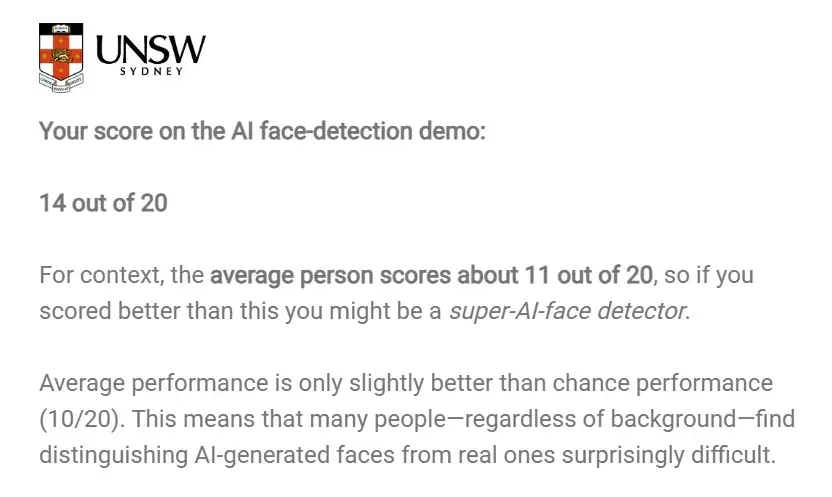
Researchers at UNSW Sydney recently unveiled findings from a test focusing on human faces, where participants were challenged to identify whether 20 presented faces were 'Human' or 'Computer-generated (AI).' The average score was a mere 11 out of 20, slightly above random chance. Even individuals identified as 'super-recognizers'—those exceptionally skilled at facial recognition—achieved only a marginal improvement, scoring 14 out of 20. This indicates a widespread difficulty in differentiating between authentic and synthetic imagery, even among those with superior visual processing abilities.
Dr. James D. Dunn, the lead researcher, noted a crucial observation: participants tended to be overconfident in their ability to detect AI-generated faces, despite their actual performance not matching this self-assurance. The study also revealed that 'AI discrimination ability' correlated with sensitivity to the 'hyper-average' appearance often found in AI-generated faces. Given that generative AI models operate on probabilities to create statistically likely outputs, faces exhibiting a highly 'average' look might be a subtle indicator of their artificial origin.
A follow-up report from UNSW Sydney elaborated that people with average face-recognition skills frequently depend on 'outdated visual cues'—such as blurry backgrounds, misaligned accessories, or distorted teeth—to identify AI images. However, the latest generative models have advanced considerably, often eliminating these once-obvious tells, making detection much more challenging. This aligns with a larger Microsoft study from the previous year, which found that participants could only correctly identify AI-generated images across a broader range of content about 62% of the time.
While these studies present a challenging picture for human perception in the age of advanced AI, the context in which an image appears can still provide valuable clues. For instance, receiving an unsolicited message on social media from a new account, or encountering a post that seems unusually perfect or is replicated across multiple disparate profiles, could be red flags. Such situational awareness, combined with a healthy skepticism towards unverified content and unusual links, remains a vital defense against deception. Despite the impressive strides in generative AI, the inherent 'average-ness' of its creations may continue to be a tell-tale sign, preventing them from achieving perfect indistinguishability from genuine human experiences.
