
Nebius Group, a Dutch company at the forefront of AI-focused data centers, has experienced a remarkable surge in its stock value this year, dwarfing the returns of prominent AI entities such as Nvidia and Palantir Technologies. This unexpected performance highlights the company's pivotal role in the rapidly expanding artificial intelligence sector, driven by an insatiable demand for robust computational infrastructure capable of handling complex AI tasks.
In the dynamic realm of artificial intelligence, companies like Nvidia and Palantir have carved out significant niches, with Nvidia dominating hardware and Palantir excelling in software solutions. Both have consistently demonstrated robust revenue and earnings growth, as their cutting-edge products attract a burgeoning customer base. However, Nebius Group has emerged as a dark horse, with its stock price skyrocketing by an astonishing 136% in 2025. This far exceeds Nvidia's 24% gain and Palantir's 102% increase, positioning Nebius as a high-flying growth stock to watch.
Nebius operates within the burgeoning cloud Infrastructure-as-a-Service (IaaS) market, a sector that has witnessed exponential growth in recent years. This surge is largely due to organizations increasingly seeking scalable data center capacity to develop and deploy AI models and applications in the cloud. Nebius distinguishes itself by providing a flexible cloud computing platform, powered by advanced Graphics Processing Units (GPUs) from Nvidia, available for on-demand rental. This infrastructure is critical for customers running intensive AI workloads. Furthermore, Nebius' AI Studio platform offers clients access to a variety of large language models (LLMs), facilitating the creation of AI applications and the execution of inference operations across its extensive data center network.
The demand for Nebius' services is exceptionally strong. In the first half of 2025, the company reported an astounding 545% increase in revenue, reaching $156 million. Management revealed during their August earnings call that all of Nvidia's previous generation Hopper GPUs had been fully utilized. Currently, Nebius is deploying Nvidia's latest Blackwell systems across its data centers to meet the surging customer needs. A key focus for Nebius is the continuous expansion of its data center capacity to satisfy the immense demand for AI cloud infrastructure. The company aims to achieve 220 megawatts (MW) of connected data center capacity by the end of the year, with an even more ambitious target of over 1 gigawatt (GW) of contracted data center capacity by the close of 2026. This aggressive expansion strategy is crucial, as the cloud AI infrastructure business is fundamentally a game of capacity: the greater the capacity a provider can offer, the higher the potential for revenue generation.
This strategic expansion is reflected in Nebius' upward revision of its annualized run-rate revenue (ARR) guidance for 2025, with the midpoint now projected at $1 billion, up from an earlier expectation of $875 million. The company calculates its ARR by extrapolating the revenue from the last month of the quarter over 12 months, and this forecast is likely to increase further as Nebius continues to add capacity. An encouraging sign for investors is that Nebius' adjusted net loss grew by only 38% year-over-year in the previous quarter, a significantly lower rate compared to its revenue spike. This indicates a positive trajectory for the company's future profitability. A contributing factor to this improved bottom line is Nebius' ability to generate robust margins from its software and services offerings, demonstrating sound financial management.
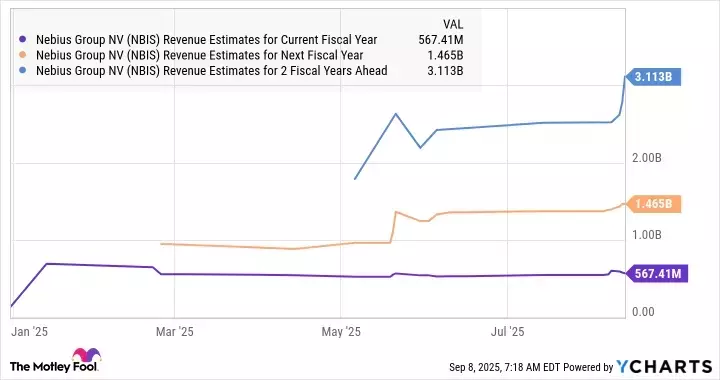
Nebius' CFO, Dado Alonso, highlighted the company's pricing strategy during a recent earnings call, emphasizing their aim for healthy margins on a per-hour compute basis for GPUs. He stated that for the Hopper generation, they anticipate breaking even at a gross profit level within approximately two to three years, covering both hardware costs and associated operational expenses. This estimate, notably, does not factor in the higher-margin software and services revenue, suggesting that as these scale, the return on invested capital could shorten further. This strategic approach, combined with analysts' forecasts for significant revenue growth over the next couple of years, positions Nebius for sustained financial improvement.
Despite trading at 63 times sales, Nebius' valuation appears justified by its exceptional growth, especially when compared to Palantir's price-to-sales ratio of 114, given Nebius' faster current growth rate. The company's capacity expansion plans suggest it can maintain this outstanding growth, capitalizing on the vast opportunities within the cloud AI infrastructure market. This sustained momentum could drive continued appreciation in its stock value over the long term.
