
The stock market's benchmark, the S&P 500, finds itself at an intriguing juncture, having ascended to historical highs. This remarkable rally, particularly since early 2023, has ignited discussions among financial experts regarding its sustainability, especially considering the index's Shiller price-to-earnings ratio, which signals an elevated valuation. In this dynamic environment, a distinct investment vehicle, the equal-weight S&P 500 Exchange Traded Fund (ETF), emerges as a compelling alternative, offering a diversified approach compared to the traditional market capitalization-weighted index. This strategy aims to dilute the concentrated influence of a few colossal technology firms, providing a potentially more balanced exposure to the broader market and offering a buffer against potential downturns.
Unpacking the S&P 500's Ascent and the Equal-Weight Alternative
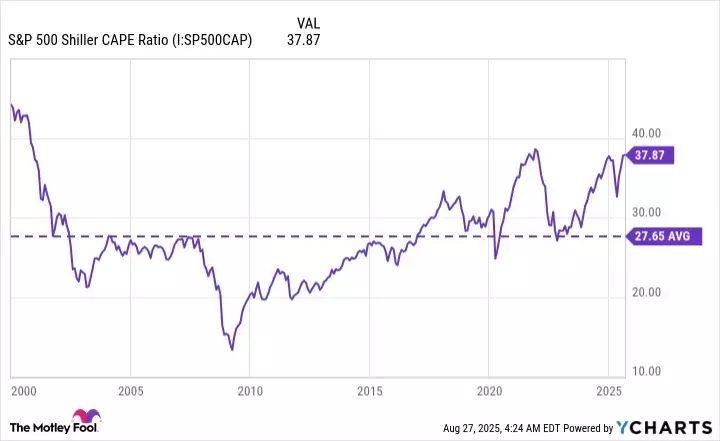
In recent times, the S&P 500, a key barometer of the American economy, has experienced a phenomenal surge. Following a significant downturn in 2022, the index embarked on a robust bull run, witnessing an increase of over 68% since the dawn of 2023. While this upward trajectory signals strong market performance, it has simultaneously propelled the index's valuation to historically significant thresholds. Notably, its Shiller price-to-earnings (P/E) ratio, which assesses stock prices against inflation-adjusted average earnings over a decade, has reached levels previously observed before sharp market corrections.
A critical characteristic of the conventional S&P 500 is its market capitalization weighting, meaning larger companies wield a disproportionately greater influence on the index's movement. For instance, a select group of leading technology companies, often dubbed the “Magnificent Seven”—including giants like Nvidia, Microsoft, Apple, Amazon, Alphabet, Meta, and Tesla—now collectively constitute approximately one-third of the entire index. This high concentration has been beneficial during periods of rapid growth in the tech sector, especially fueled by advancements in artificial intelligence. However, it also introduces a vulnerability: any significant decline in these few dominant stocks could severely impact the overall index.
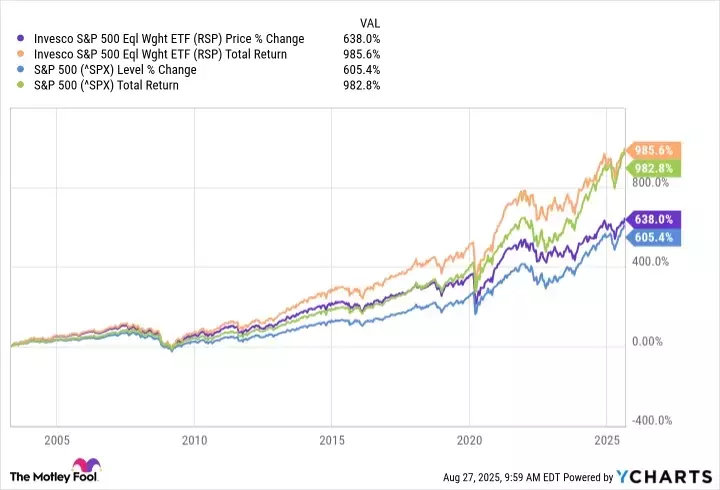
Conversely, the Invesco S&P 500 Equal Weight ETF (RSP) presents a different approach. In this ETF, each of the 500 companies within the index is allocated a roughly equivalent weighting. This means that the “Magnificent Seven” account for a mere 2.18% of this equal-weight variant. This structural difference fundamentally alters the risk profile; a downturn in any single megacap tech stock would have a much less pronounced effect on the equal-weight ETF compared to its market capitalization-weighted counterpart. While the standard S&P 500 has outshone the equal-weight ETF over the past decade, the equal-weight ETF has demonstrated superior performance since its inception in April 2003. Historically, the equal-weight ETF tends to perform strongly during broad market recoveries or when smaller, value-oriented companies are leading the market, rather than being overshadowed by a handful of tech behemoths.
Given the S&P 500's current elevated valuation and the historical patterns that often precede market adjustments, exploring an equal-weight ETF like RSP could serve as a judicious strategy. It provides investors with a means to participate in the S&P 500's potential growth while simultaneously mitigating the inherent risks associated with a heavily concentrated, market capitalization-weighted index that heavily relies on the sustained stellar performance of a few technology giants.
From an analytical standpoint, the current market dynamics prompt investors to critically assess their portfolio allocations. The S&P 500's ascent, while impressive, necessitates a keen awareness of its underlying composition. The significant sway held by the "Magnificent Seven" highlights a structural concentration risk. As a market observer, one might ponder if the current trajectory is sustainable given the historical precedents associated with such high valuations. This scenario underscores the utility of diversified investment tools like equal-weight ETFs, which offer a balanced exposure to the market's broader health rather than being predominantly driven by a select few. It serves as a reminder that robust long-term investment strategies often involve not just seeking growth, but also actively managing and diversifying against potential risks, especially in periods of unprecedented market highs.
