
Nasdaq, a name synonymous with stock exchanges and technology initial public offerings, is undergoing a profound transformation. This report delves into the company's strategic pivot beyond its traditional market operations, highlighting its significant expansion into financial technology and crime prevention through recent key acquisitions. Discover how Nasdaq is leveraging these new capabilities to drive impressive growth and reinforce its position as a dominant force in the global financial landscape.
Unlocking New Horizons: Nasdaq's Strategic Evolution in Financial Markets
Nasdaq's Enduring Market Dominance and Unseen Growth Drivers
While the S&P 500 has seen substantial returns, and the Nasdaq-100 even more so, the Nasdaq company itself has outpaced both, demonstrating remarkable growth. Investors typically associate Nasdaq with its prominent stock exchanges, index management, and its pivotal role in facilitating technology companies' entry into public markets. However, a deeper look reveals an emerging force that promises to propel Nasdaq's future success beyond these familiar areas. This hidden engine, powered by strategic acquisitions, is poised to sustain its trajectory of outperforming market benchmarks.
Fortifying the Financial System: Nasdaq's New Mandate
Nasdaq, which sees an astonishing 21% of the world's market capitalization traded on its platforms, is undeniably recognized for its trading venues and indices. Yet, its substantial investments, including the 2020 acquisition of Verafin for $2.75 billion and the 2023 purchase of Adenza for $10.5 billion, signify a bold leap into establishing itself as a fundamental pillar of the global financial infrastructure. Nasdaq's CEO, Adena Friedman, articulates this shift as becoming the 'trusted fabric of the financial system,' emphasizing its expanded role in safeguarding and enhancing financial operations.
Verafin: Leading the Charge Against Financial Malfeasance
With the integration of Verafin, Nasdaq has vigorously entered the arena of combating financial misconduct, addressing issues such as widespread fraud and money laundering. Nasdaq's 2023 estimates highlighted a staggering $3.1 trillion in laundered funds globally, coupled with an additional $500 billion lost to various fraudulent activities. By harnessing advanced cloud technologies and artificial intelligence, Nasdaq's comprehensive suite of financial crime management tools empowers its banking clients to effectively counter these illicit schemes. Since the Verafin acquisition, its revenue has expanded by 23% annually, with management forecasting continued mid-20% growth in the coming years. The introduction of new AI analytics for detecting terrorist financing and drug trafficking, alongside securing its first European banking client, underscores the strong potential for this division.
Adenza: Modernizing Financial Operations and Fostering Synergy
While Verafin focuses on preventing financial crime, the Adenza acquisition equips Nasdaq with essential new capabilities in risk management, regulatory compliance, and capital markets software for financial institutions. Adenza specializes in streamlining outdated processes, preparing financial entities for the evolving landscape of digital assets, including stablecoins and cryptocurrencies. Crucially, combining Adenza with Nasdaq's existing services—Verafin, surveillance, and market technology—transforms the company into a comprehensive solution provider, facilitating lucrative cross-selling opportunities. In the two years following the Adenza acquisition, cross-sales now constitute over 15% of the financial technology unit's deal pipeline. Management anticipates that the regulatory and market capital technology sectors, now bolstered by Adenza, will achieve high-single to low-double digit sales growth in the foreseeable future.
Exceptional Cash Flow, Dividend Stability, and Investment Appeal
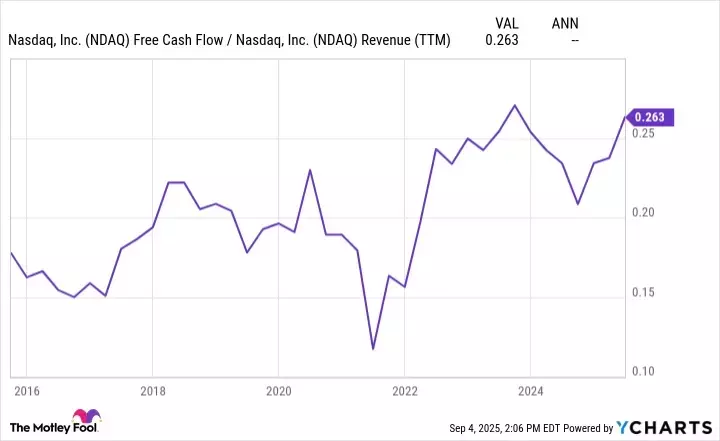
Driven by the robust double-digit growth of its high-margin, innovative business segments, Nasdaq has achieved near record-high free cash flow (FCF) margins. This expansion has enabled a 15% annual increase in the company's free cash flow over the past decade. Notably, for dividend-focused investors, this impressive FCF growth has supported a significant 19% annual increase in Nasdaq's dividend over the same period. Despite this generous dividend growth, Nasdaq allocates only 27% of its FCF to its 1.1% dividend yield, indicating substantial capacity for future increases, particularly as it reduces debt from the Adenza acquisition. Although Nasdaq's share price has surged by approximately 80% in the last two years, leading to an enterprise value-to-FCF (EV/FCF) ratio of 29 (slightly above its 10-year average of 26), the company's strategic positioning in combating financial crime and modernizing the financial ecosystem justifies this valuation. Coupled with its leadership in IPO listings, a buoyant trading environment, and a recent 13% dividend increase, Nasdaq remains a compelling investment.
