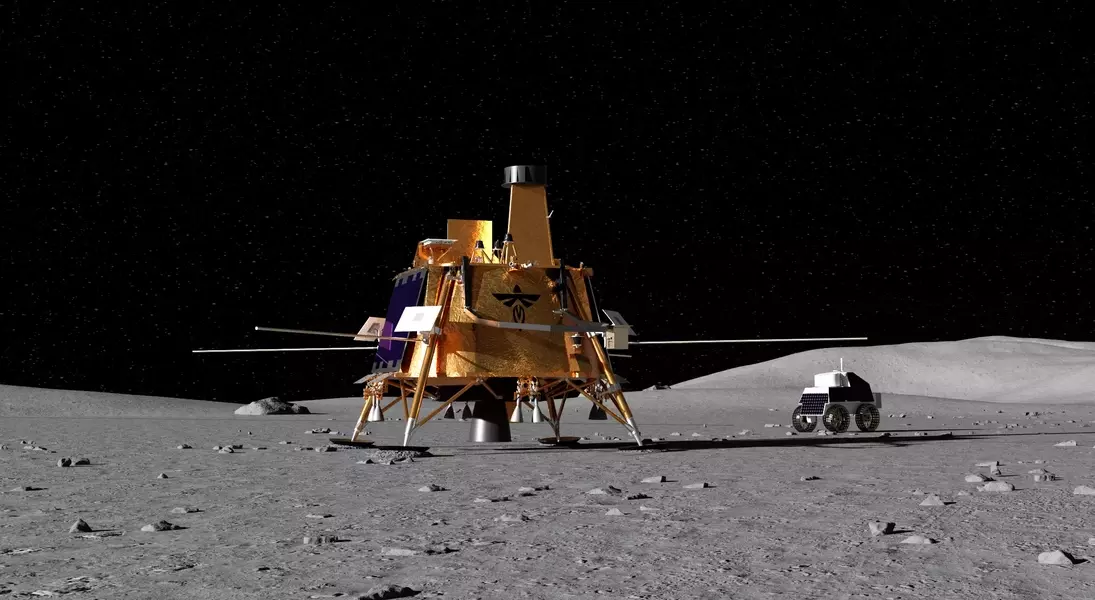
NASA is constantly pushing the boundaries of lunar exploration, and their latest initiative with Firefly Aerospace is set to take us to new heights. This fourth task order awards Firefly $179 million to deliver six crucial experiments to the lunar surface. The target is the Gruithuisen Domes on the near side of the Moon in 2028, marking a significant step in our understanding of planetary processes and evolution.
Unveiling the Artemis Campaign and CLPS Initiative
As part of NASA's broader Artemis campaign, Firefly will bring a group of science experiments and technology demonstrations to these lunar domes. The Gruithuisen Domes, located within ancient lava flows, offer a unique opportunity to study planetary processes. Through the CLPS (Commercial Lunar Payload Services) initiative, NASA is enhancing our knowledge of the Moon's environment and preparing for future human missions. This approach aligns with the agency's Moon to Mars exploration strategy.Deputy Associate Administrator's Perspective
Joel Kearns, deputy associate administrator for exploration at NASA Headquarters in Washington, emphasizes the importance of the CLPS initiative. He states, "The CLPS initiative conducts U.S. scientific and technical studies on the Moon's surface using robot explorers. As we gear up for future human exploration, CLPS continues to support the growth of the lunar economy with American companies. Understanding the formation of the Gruithuisen Domes and the surrounding lava flows will help us answer crucial questions about the lunar surface."First Lunar Delivery and Upcoming Missions
Firefly's first lunar delivery is scheduled for mid-January 2025 and will land near Mons Latreille within Mare Crisium on the Moon's near side. Their second lunar mission includes two task orders: a lunar orbit drop-off of a satellite combined with a delivery to the far side and a delivery of a lunar orbital calibration source in 2026. The 2028 delivery will send payloads to the Gruithuisen Domes and Sinus Viscositatus, providing valuable insights into lunar formation and evolution.Studying the Gruithuisen Domes
The Gruithuisen Domes have long intrigued lunar scientists. It is suspected that they were formed by a silica-rich magma similar to granite. Since the Moon lacks the key ingredients for granitic rock formation like plate tectonics and water, understanding how these domes formed and evolved over time is crucial. NASA's contract for "mobility" or roving for some scientific instruments after landing will enable new types of scientific investigations.Instrumentation for Lunar Exploration
Chris Culbert, manager of the CLPS initiative at NASA's Johnson Space Center in Houston, explains the six instruments that will be delivered. The Lunar Vulkan Imaging and Spectroscopy Explorer consists of two stationary and three mobile instruments to study rocks and regolith on the dome summit. Heimdall is a flexible camera system for taking pictures from above the horizon to the ground. The Sample Acquisition, Morphology Filtering, and Probing of Lunar Regolith robotic arm will collect and filter lunar regolith samples. Low-frequency Radio Observations from the Near Side Lunar Surface will study the Moon's surface environment in radio frequencies. The Photovoltaic Investigation on the Lunar Surface will demonstrate light-to-electricity power conversion with the latest solar cells. And the Neutron Measurements at the Lunar Surface will characterize the neutron radiation environment.Through the CLPS initiative, NASA is purchasing lunar landing and surface operations services from American companies. This supports a growing lunar economy while leveraging the innovation of the commercial space industry. Upcoming CLPS flights in early 2025 will deliver payloads to different parts of the Moon.Learn more about CLPS and Artemis at:https://www.nasa.gov/clpsYou May Like