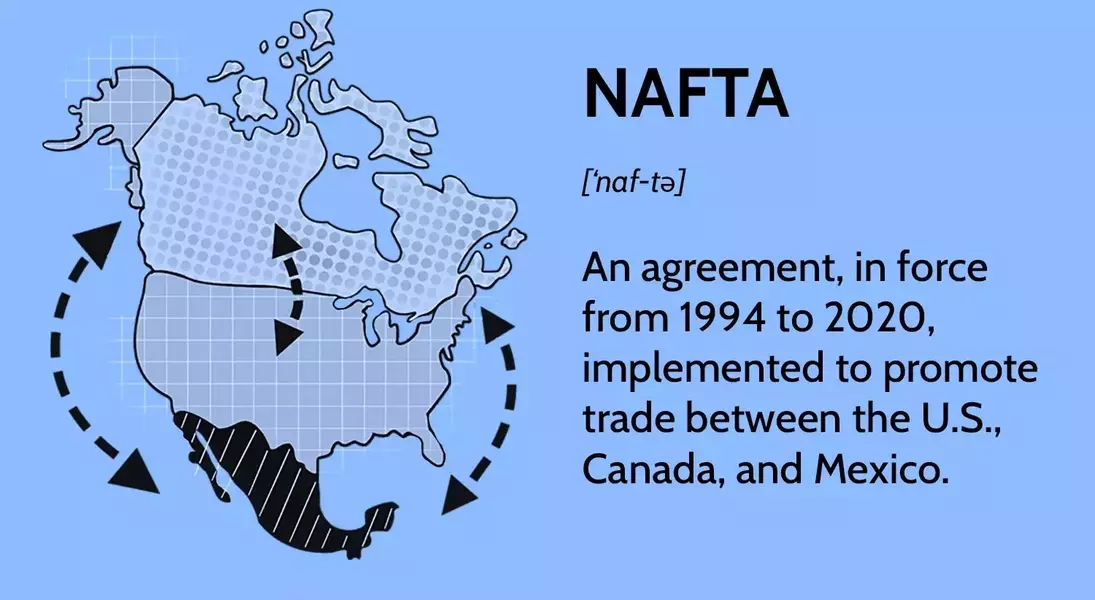
The North American Free Trade Agreement (NAFTA), enacted in 1994, was a landmark accord designed to foster economic collaboration among the United States, Canada, and Mexico. This agreement sought to diminish or abolish tariffs on a wide array of goods, particularly in sectors such as agriculture, automotive, and textiles, thereby establishing a vast free-trade zone across the continent. Beyond trade liberalization, NAFTA also incorporated crucial side agreements focused on upholding stringent standards in workplace safety, labor rights, and environmental protection, aiming to deter businesses from relocating to exploit lower wages or weaker regulations. Despite its ambitions, NAFTA remained a subject of considerable debate, demonstrating both positive and negative effects on the economies of its member nations. It was eventually superseded by the United States-Mexico-Canada Agreement (USMCA) in 2020, which built upon NAFTA's foundations while introducing new provisions and modernizations to address evolving economic landscapes.
Detailed Report on NAFTA: Historical Context, Provisions, and Evolution
In the vibrant dawn of January 1, 1994, a new era of North American economic partnership began with the official implementation of the North American Free Trade Agreement (NAFTA). This seminal agreement, initially conceived during the presidency of George H.W. Bush as part of his Enterprise for the Americas Initiative, represented a significant expansion of the existing U.S.-Canada Free Trade Agreement established in 1989. The core objective of NAFTA was to stimulate trade and investment across the United States, Canada, and Mexico by progressively eliminating tariffs on a broad spectrum of goods, a process that fully materialized by January 1, 2008.
Under the Clinton administration, fervent proponents optimistically projected that NAFTA would generate a substantial number of jobs within the U.S., foreseeing an increase of 200,000 jobs within two years and a million within five years, driven by the anticipated surge in exports. Indeed, NAFTA catalyzed a dramatic increase in cross-border commerce and investment. By 2011, the total trilateral trade had surpassed the $1 trillion mark, a testament to the agreement's success in fostering economic integration. During its tenure, real per capita Gross Domestic Product (GDP) saw modest growth across all three nations, with Canada and the U.S. experiencing notable upticks.
A critical component of NAFTA's framework included two supplementary agreements: the North American Agreement on Environmental Cooperation (NAAEC) and the North American Agreement on Labor Cooperation (NAALC). These were introduced to allay concerns that economic liberalization might lead to a race to the bottom in environmental and labor standards. The NAAEC created a commission to scrutinize the environmental ramifications of increased trade, while the NAALC aimed to safeguard against child labor and other abuses, though it did not fully secure the right to organize. Moreover, NAFTA established a dispute resolution mechanism to address conflicts between investors, businesses, and government entities, although this aspect drew criticism for potentially allowing multinational corporations to undermine local regulations.
In a forward-looking move, the three NAFTA signatories jointly developed the North American Industry Classification System (NAICS). This innovative system facilitated the consistent classification and comparison of business activity statistics across North America, replacing the U.S. Standard Industrial Classification (SIC) system. NAICS introduced a hierarchical six-digit coding system, organizing all economic activities into 20 industry sectors and undergoing regular reviews to maintain its relevance in a dynamic economy.
The agreement was not without its detractors. Critics voiced concerns about potential job losses in the U.S. due to manufacturing operations relocating to Mexico, attracted by lower labor costs. While some industries, such as automotive and garment manufacturing, did shift production, the precise extent to which NAFTA directly caused these relocations remains a subject of debate. Additionally, the predicted convergence of U.S. and Mexican wages did not materialize as anticipated, contributing to an increased wage gap and fueling discussions about its impact on Mexican immigration to the U.S.
Ultimately, on July 1, 2020, NAFTA was formally replaced by the United States-Mexico-Canada Agreement (USMCA). Initiated by then-President Donald Trump in 2018, the USMCA aimed to modernize and refine the North American trade relationship. While retaining many foundational elements of NAFTA, USMCA introduced significant updates. These included expanding the tariff ban to encompass new technologies like digital music and e-books, incorporating labor and environmental protections directly into the main agreement, and implementing stricter labor laws for Mexico. The USMCA also revised rules regarding automotive components, pharmaceutical protections, dairy market access, and intellectual property rights, signaling a renewed commitment to fair and robust economic growth in the region.
The Enduring Legacy and Future Trajectory of North American Trade
The journey of NAFTA, from its ambitious inception to its evolution into USMCA, offers a compelling case study in the complexities of international trade agreements. It underscores the perpetual tension between economic integration and the preservation of domestic interests, particularly regarding employment and regulatory standards. While NAFTA undeniably spurred a significant increase in trade and investment across North America, its precise impact on individual national economies remains a topic of spirited debate among economists. The challenge lies in disentangling the agreement's direct effects from the broader currents of technological advancement and global economic shifts, such as the rise of China and major financial crises like the Great Recession.
The transition to USMCA reflects a crucial lesson learned: trade agreements are not static. They must adapt to changing geopolitical realities, technological advancements, and evolving societal values. The USMCA's strengthened provisions on labor and environment, its modernization of intellectual property rights, and its updated rules for key industries like automotive, demonstrate a concerted effort to address the shortcomings perceived in its predecessor. From a journalistic perspective, these developments highlight the dynamic nature of international relations and economic policy. They remind us that policies intended to foster growth can also create unintended consequences, requiring continuous evaluation and adjustment.
Looking ahead, the ongoing scrutiny of USMCA, including the prospect of further tariffs as indicated by potential future presidential actions, emphasizes that the quest for equitable and beneficial trade relationships is an ongoing process. It calls for vigilance, adaptability, and a willingness to renegotiate and refine agreements to serve the best interests of all parties involved. For citizens, understanding these intricate agreements is paramount, as they directly influence everything from job markets and consumer prices to environmental quality and labor conditions. The narrative of NAFTA and USMCA serves as a powerful reminder that global economic cooperation is a constantly evolving dialogue, shaped by historical legacies, present challenges, and future aspirations.
