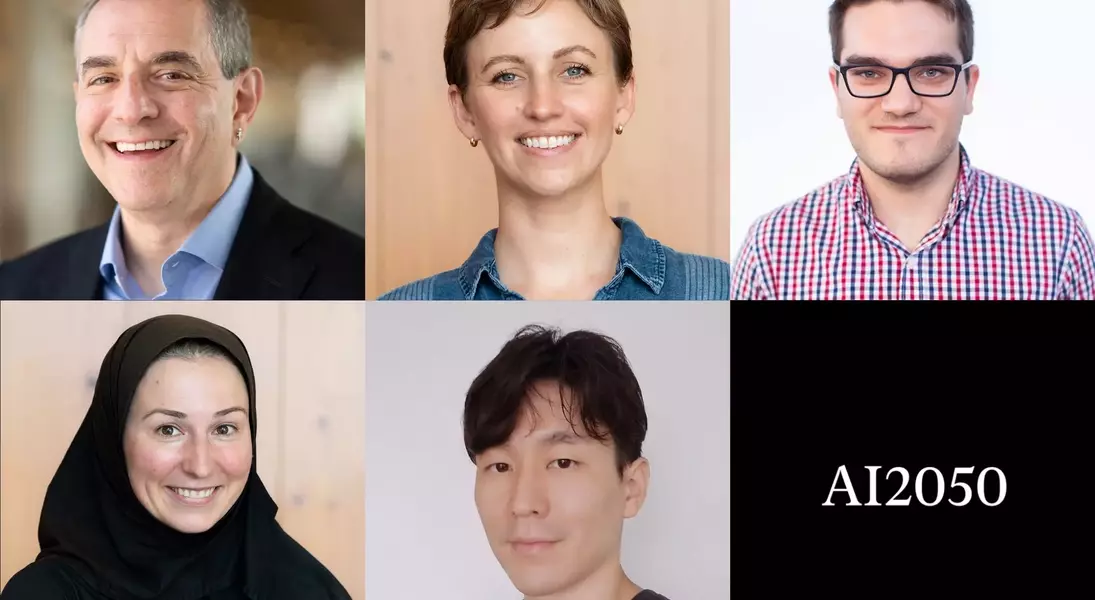
Five esteemed MIT faculty members and two additional alumni have recently been selected to join the 2024 cohort of AI2050 Fellows. This prestigious honor, announced annually by Schmidt Futures, is dedicated to accelerating scientific innovation. The initiative, conceived and co-chaired by Eric Schmidt and James Manyika, aims to address the challenging issues in the field of AI. Each fellow will grapple with the central question of AI2050: "It's 2050. AI has become immensely beneficial to society. What led to this? What are the key problems we solved and the opportunities we realized to ensure this positive outcome?"
Unveiling the 2024 AI2050 Fellows at MIT
David Autor: Shaping the Future of Work with AI
The Daniel (1972) and Gail Rubinfeld Professor in the MIT Department of Economics, David Autor, is a 2024 AI2050 senior fellow. His extensive scholarship focuses on the labor-market impacts of technological change and globalization. He explores how these factors influence job polarization, skill demands, earnings levels, and inequality, as well as electoral outcomes. Through his AI2050 project, he will utilize real-time data on AI adoption to clarify how new tools interact with human capabilities in shaping employment and earnings. His work provides a valuable framework for entrepreneurs, technologists, and policymakers to understand how AI can complement human expertise. Autor has received numerous awards and honors, including a National Science Foundation CAREER Award, an Alfred P. Sloan Foundation Fellowship, an Andrew Carnegie Fellowship, and the Heinz 25th Special Recognition Award. In 2023, he was one of only two researchers across all scientific fields to be selected as a NOMIS Distinguished Scientist. His research has truly transformed our understanding of how globalization and technological change are affecting American workers' jobs and earning prospects.Another aspect of Autor's work is his contribution to the MIT Shaping the Future of Work Initiative and the National Bureau of Economic Research's Labor Studies Program. His insights and research in this area are crucial for shaping the future of work in an AI-driven world.Sara Beery: Building Global-scale Environmental Monitoring with AI
Sara Beery, an assistant professor in the Department of Electronic Engineering and Computer Science (EECS) and a principal investigator in the Computer Science and Artificial Intelligence Laboratory (CSAIL), has been named an early career fellow. Her work centers around developing computer vision methods that enable global-scale environmental and biodiversity monitoring across various data modalities. She tackles real-world challenges such as strong spatiotemporal correlations, imperfect data quality, fine-grained categories, and long-tailed distributions. Beery collaborates with non-governmental organizations and government agencies to deploy her methods worldwide, aiming to increase the diversity and accessibility of academic research in artificial intelligence through interdisciplinary capacity-building and education. She earned a BS in electrical engineering and mathematics from Seattle University and a PhD in computing and mathematical sciences from Caltech, where she was honored with the Amori Prize for her outstanding dissertation. Her research is making significant strides in the field of environmental monitoring and has the potential to bring about positive changes on a global scale.Gabriele Farina: Applying AI to Sequential Decision-making
Gabriele Farina, an assistant professor in EECS and a principal investigator in the Laboratory for Information and Decision Systems (LIDS), is also an early career fellow. His work lies at the intersection of artificial intelligence, computer science, operations research, and economics. He specifically focuses on learning and optimization methods for sequential decision-making and convex-concave saddle point problems, with applications in equilibrium finding in games. Farina's research in computational game theory is highly regarded, and he recently served as a co-author on a Science study about combining language models with strategic reasoning. He is a recipient of a NeurIPS Best Paper Award and was a Facebook Fellow in economics and computer science. His dissertation was recognized with the 2023 ACM SIGecom Doctoral Dissertation Award and one of the two 2023 ACM Dissertation Award Honorable Mentions. His work is pushing the boundaries of AI applications in different fields and has the potential to lead to significant advancements.Marzyeh Ghassemi: Ensuring Robust and Fair ML in Health Settings
Marzyeh Ghassemi, a 2024 early career fellow, is an associate professor in EECS and the Institute for Medical Engineering and Science, a principal investigator at CSAIL and LIDS, and an affiliate of the Abdul Latif Jameel Clinic for Machine Learning in Health and the Institute for Data, Systems, and Society. Her research in the Healthy ML Group creates a rigorous quantitative framework for designing, developing, and deploying ML models in a way that is robust and fair, especially in health settings. Her contributions range from socially aware model construction to improving subgroup- and shift-robust learning methods. She also identifies important insights in model deployment scenarios that have implications in policy, health practice, and equity. Ghassemi has received numerous awards, including being named one of MIT Technology Review's 35 Innovators Under 35 and winning the 2018 Seth J. Teller Award, the 2023 MIT Prize for Open Data, a 2024 NSF CAREER Award, and the Google Research Scholar Award. Her nonprofit, the Association for Health, Inference and Learning (AHLI), is making a significant impact in the field of healthcare and machine learning.Yoon Kim: Bridging NLP and ML with AI
Yoon Kim, an assistant professor in EECS and a principal investigator in CSAIL, is also part of the 2024 AI2050 Fellows. His work straddles the intersection between natural language processing and machine learning. He explores efficient training and deployment of large-scale models, learning from small data, neuro-symbolic approaches, grounded language learning, and the connections between computational and human language processing. Affiliated with CSAIL, Kim earned his PhD in computer science at Harvard University, an MS in data science from New York University, an MA in statistics from Columbia University, and a BA in both math and economics from Cornell University. His diverse educational background and research focus make him a valuable contributor to the field of AI.In addition to the MIT faculty members, additional alumni Roger Grosse PhD '14, a computer science associate professor at the University of Toronto, and David Rolnick '12, PhD '18, an assistant professor at Mila-Quebec AI Institute, were also named senior and early career fellows, respectively. These individuals are making significant contributions in the field of AI and are setting an example for future generations.