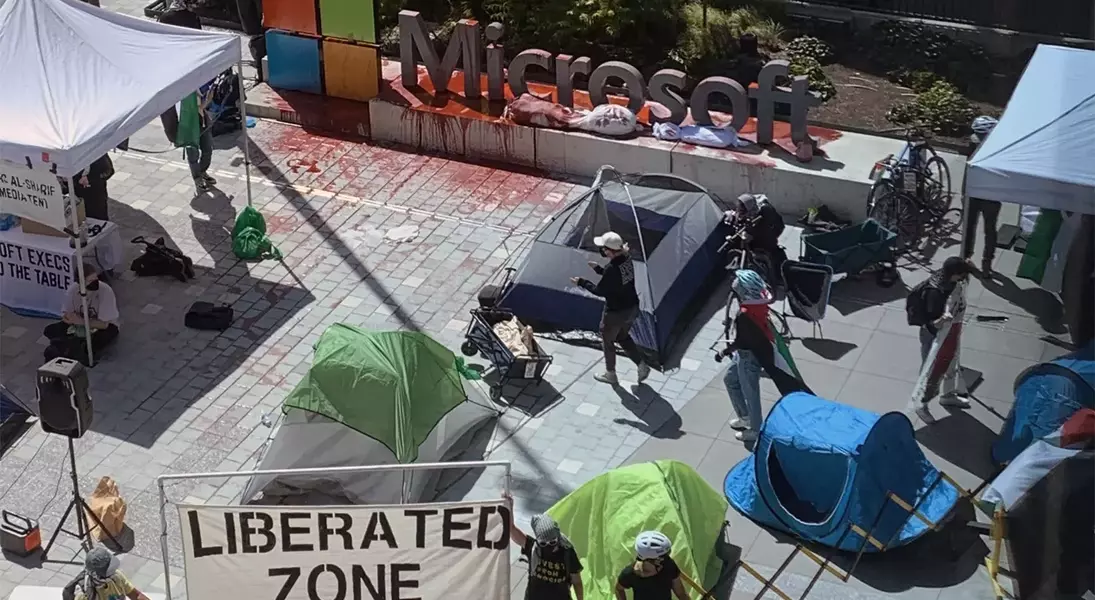
In a significant development, Microsoft has dismissed four employees in total, two recently and two previously, due to their participation in demonstrations protesting the company's business agreements with the Israeli military and government. These actions by the tech corporation underscore a growing internal conflict and heightened employee activism concerning geopolitical issues, particularly involving Microsoft's involvement in contracts perceived as controversial. The ongoing series of protests, initiated by the 'No Azure for Apartheid' group, reflects a determined effort by some employees and activists to challenge the ethical implications of Microsoft's partnerships.
Continued Fallout: Microsoft Terminates Employees Over Anti-Israel Military Contract Protests
On the evening of August 28, 2025, in Redmond, Washington, Microsoft confirmed the termination of two more employees, Nisreen Jaradat and Julius Shan. Their dismissal is directly linked to their involvement in a series of highly publicized protests against Microsoft's cloud computing contracts with the Israeli military and government. These recent firings follow closely on the heels of similar dismissals the previous night, bringing the total number of employees terminated for protest-related activities to four. The 'No Azure for Apartheid' activist group, spearheaded by organizer Hossam Nasr, revealed the details of the latest terminations, stating they were a direct consequence of demonstrations that included establishing encampments at Microsoft's sprawling headquarters.
A particularly notable incident occurred on Tuesday, August 26, 2025, when protesters gained unauthorized access to Building 34, which houses the office of Microsoft President Brad Smith. Activists live-streamed their presence inside Smith's office, amplifying their message against the 'Azure for Apartheid' project. One of the recently fired employees, Nisreen Jaradat, had previously made headlines for circumventing internal company communication restrictions to send a mass email expressing her frustration as a Palestinian worker with Microsoft's stance on the Israel-Palestine conflict, specifically regarding its operations in Gaza.
The 'No Azure for Apartheid' movement has intensified its public actions throughout the year. Earlier in the spring, the group repeatedly disrupted live-streamed presentations featuring Microsoft executives, including those at the company's 50th-anniversary AI event. More recently, activists attempted to occupy a public plaza at the Microsoft headquarters. Following their removal, they returned the next day, setting up tents, tables, and dramatically pouring red paint across a prominent Microsoft sign, an act that led to the arrest of eighteen individuals. In response to the Tuesday protest, President Brad Smith convened a press conference, where he acknowledged the ongoing internal investigation into potential misuse of Azure services in Israel, while firmly asserting that the protesters' disruptive actions were "not acceptable." Microsoft has refrained from issuing an official statement to the press regarding these specific employee terminations.
The escalating situation at Microsoft, marked by employee protests and subsequent terminations, brings into sharp focus the complex interplay between corporate ethics, geopolitical conflicts, and individual freedom of expression. From a journalistic perspective, this ongoing saga highlights the increasing pressure on multinational corporations to align their business practices with global human rights standards and to address the concerns of their diverse workforce. The case of Microsoft serves as a poignant reminder that in today's interconnected world, internal corporate policies and external political landscapes are inextricably linked, often leading to unforeseen challenges and profound moral dilemmas. It prompts us, as observers, to consider the responsibilities of technology giants not only to their shareholders but also to the broader societal implications of their technological prowess and global reach.
