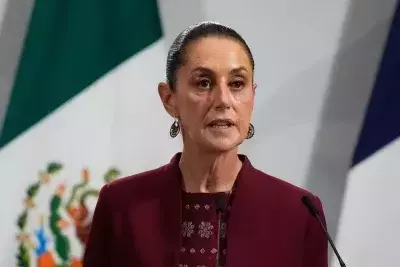
Mexican President Claudia Sheinbaum recently calmed fears that arose from two distinct U.S. military operations close to Mexico's borders. The public's concern escalated after an incident involving Venezuela. Her administration clarified that the U.S. government provided assurances against military overflights in Mexican airspace, and a U.S. transport plane's presence in Toluca was part of a routine logistical training, not requiring legislative approval. These events underscore the delicate balance of bilateral relations, especially given the history of U.S. assertions regarding drug cartels, and reinforce Mexico's insistence on maintaining its national sovereignty.
The unease began last Friday when the U.S. Federal Aviation Administration (FAA) issued a warning to U.S. aircraft operators to proceed with caution when traversing the eastern Pacific Ocean near Mexico, Central America, and South America, citing ongoing "military activities." This advisory immediately sparked questions and apprehension within Mexico. President Sheinbaum disclosed that her government promptly sought clarification, and after a brief delay, the U.S. government provided a written guarantee that no U.S. military flights would infringe upon Mexican territorial airspace. She highlighted that Mexico had not been pre-notified about any such military operations, which further fueled the initial alarm.
Shortly after the FAA's caution, images started circulating across various social media platforms, showing a U.S. military transport aircraft parked on the tarmac at Toluca's airport, situated approximately 63 kilometers west of Mexico City. This sighting exacerbated public concerns and prompted political figures, such as Senator Clemente Castañeda from the opposition Citizen Movement party, to demand a governmental explanation. The senator stressed that Mexican law typically mandates Senate approval for foreign troops to enter Mexican territory or for Mexican troops to be deployed abroad, raising questions about the legitimacy of the U.S. plane's presence.
In response to the growing public and political scrutiny, President Sheinbaum categorized the Toluca incident as a "logistical" operation, asserting that it did not necessitate Senate consent. She elucidated that the U.S. aircraft landed to facilitate the departure of Mexican public servants who were traveling to the U.S. for training purposes. According to Sheinbaum, the Secretary of Defense had authorized this operation. Furthermore, her security cabinet had previously communicated on social media that such training exercises comply with established protocols and bilateral agreements between the two nations, aiming to allay any fears of unauthorized foreign military presence.
These recent occurrences serve as a stark reminder of the underlying sensitivities in U.S.-Mexico relations. The situation is particularly charged due to the Trump administration's earlier actions concerning Venezuela's former President Nicolás Maduro, and recurring discussions from Washington about potential direct military intervention against drug cartels in Mexico. Despite these tensions, President Sheinbaum and former President Trump engaged in discussions last week concerning these matters. Both governments continue to express commitment to cooperation on security issues, with Mexico consistently reiterating its firm stance against any infringement on its national sovereignty.
As a testament to their ongoing collaborative efforts, security officials from both countries are scheduled to reconvene this Friday. The agenda for this meeting, as outlined in a joint statement released last Thursday, focuses on delivering "tangible actions to strengthen security cooperation and meaningful outcomes to counter cartels, and stop the illicit flow of fentanyl and weapons from crossing our shared border." This continuous dialogue aims to navigate the complexities of cross-border security while upholding the principles of mutual respect and sovereignty.
The Mexican President's reassurances were crucial in dispelling concerns stemming from recent U.S. military movements. By clarifying the nature of the FAA advisory and the U.S. transport plane's visit, Sheinbaum effectively managed public sentiment and political inquiries. The incidents highlighted the inherent complexities in U.S.-Mexico security collaborations, especially in the context of previous unilateral actions and ongoing debates about drug cartels. Mexico's firm stance on sovereignty remains a central tenet in these bilateral discussions, emphasizing the need for transparent communication and adherence to established agreements to maintain stability and trust between the two nations.
