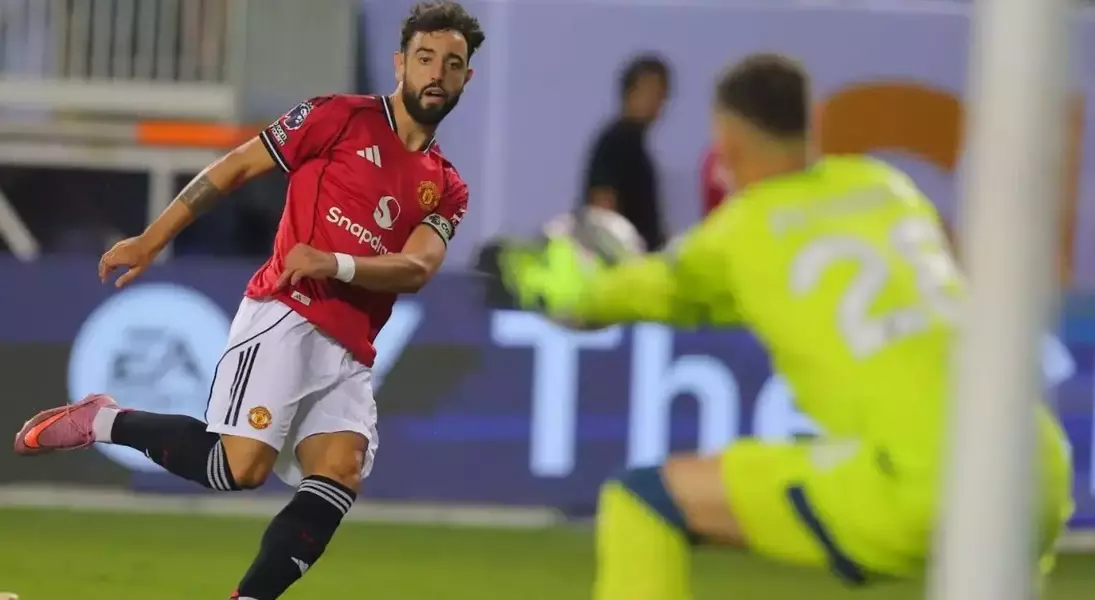
Recent media narratives surrounding Manchester United's pre-season performance have spotlighted Bruno Fernandes, often presenting a confused picture of his contributions and tactical importance. Following a commanding 4-1 pre-season triumph over Bournemouth, various news outlets have offered contrasting interpretations of Fernandes' role. Some reports lauded his efforts, suggesting his actions, such as tracking back to block a cross, indicated a significant 'change' within the team. However, this perspective appears to overlook his consistent work rate throughout his career, implying such dedication is not a new development but rather an inherent aspect of his playing style. Conversely, other analyses have expressed 'concern' over his deeper midfield positioning, arguing it curtailed his attacking prowess, despite the team's convincing win and the manager's expressed satisfaction with his ability to control the game's rhythm. This divergence in media opinion underscores a tendency to create dramatic headlines rather than provide a nuanced understanding of player performance and tactical evolution.
Beyond individual player analysis, the media's focus has also extended to Manchester United's transfer market philosophy, with particular attention paid to an alleged 'golden rule' for recruitment. This supposed rule suggests the club exclusively targets players with proven success in Europe's most competitive leagues who also fit a specific age profile. Yet, this narrative quickly dissolved when the club reportedly pursued Benjamin Sesko, a player without Premier League experience, challenging the very 'rule' that was previously highlighted. This inconsistency reveals how certain media narratives can be constructed to fit a predefined storyline, irrespective of the facts, leading to sensationalized headlines about 'broken' transfer rules. The continuous shifting of these narratives, from celebrating individual actions as transformative to questioning established player roles and transfer strategies, demonstrates a significant disconnect between objective reporting and the pursuit of compelling, albeit sometimes misleading, content.
Ultimately, the continuous push for sensationalism in sports reporting often overshadows a balanced and accurate depiction of events. Whether it's the overanalysis of a player's single moment in a game or the fabrication of 'golden rules' for transfer policy, the media's approach can distort reality. This relentless pursuit of dramatic angles not only misrepresents the true state of affairs within a football club but also inadvertently fosters a culture where superficial observations gain more traction than insightful analysis. For players and clubs alike, navigating this landscape requires resilience and a steadfast focus on their objectives, reminding us that genuine progress and success are built on consistent effort and strategic planning, rather than transient media interpretations.
