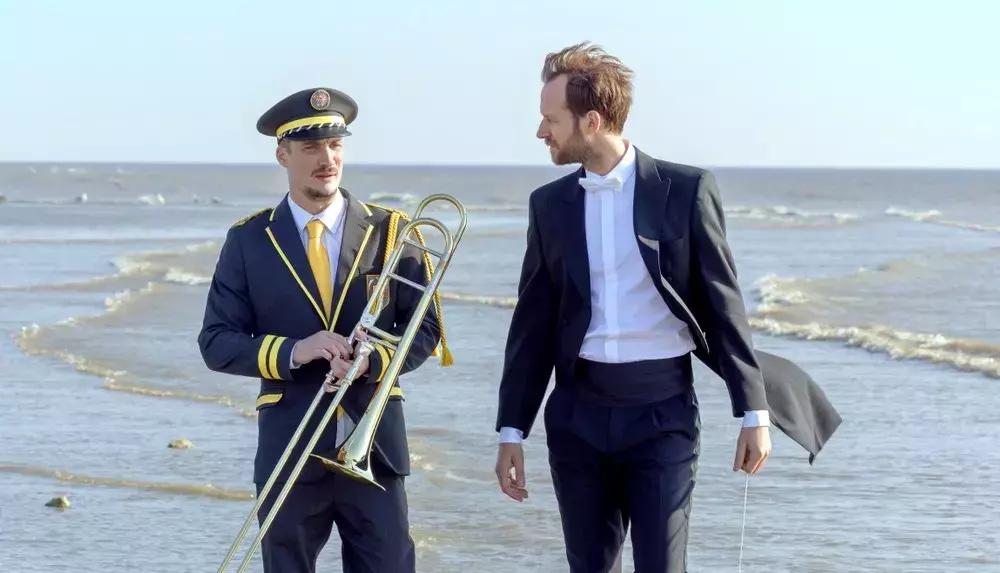
Emmanuel Courcol's latest cinematic offering, 'The Marching Band,' orchestrates a captivating narrative that delves into the lives of two estranged brothers. This French production, which garnered local acclaim in 2024 before its delayed release in the United States, masterfully combines humor, social commentary, and psychological depth. The film's strength lies in its concise storytelling, dynamic pacing, and the nuanced portrayals by its lead actors, Benjamin Lavernhe and Pierre Lottin, who navigate a journey of discovery, connection, and the unifying force of music.
The film opens with a brisk introduction to Thibaut, a sophisticated classical conductor based in Paris, whose world is upended by a leukemia diagnosis requiring a bone marrow transplant. His search leads him to an unexpected revelation: he was adopted, and his biological half-brother, Jimmy, resides in a less privileged, working-class region of northern France. This initial premise, though swiftly introduced, sets the stage for a compelling exploration of contrasting lives. Jimmy, a canteen cook with an innate musical talent, quickly agrees to help his newfound sibling, initiating a bond that transcends their disparate upbringings.
As the narrative progresses, the film shifts its focus from the medical urgency to the burgeoning relationship between Thibaut and Jimmy, subtly weaving in themes of social inequality. A particularly poignant scene highlights Jimmy's extraordinary perfect pitch, revealing the inherent gifts that often go unrecognized in disadvantaged communities. This moment, delicately handled with understated performances and subtle glances, avoids sentimentality, demonstrating the film's commitment to authentic character development. The casting choices of Lavernhe, from classical theater, and Lottin, a veteran of popular comedy, are especially effective, embodying the stark class distinctions and personal histories of their characters. Their interactions, marked by sharp, concise dialogue, effectively convey both their differences and their growing understanding.
The story further enriches itself by portraying the struggles of Jimmy's working-class community, where a local marching band serves as a vital source of unity and hope. Thibaut's involvement with the band, where Jimmy plays trombone alongside his on-again, off-again girlfriend Sabrina, introduces a familiar but comforting cinematic trope reminiscent of 'Brassed Off.' While the film ultimately embraces a predictable crowd-pleasing formula, this doesn't diminish its overall impact. The technical aspects, including Guerric Catala's editing and Christel Birot's costume design, contribute significantly to the film's precision and thematic depth. The vibrant soundtrack, featuring a diverse range of musical pieces from jazz classics to operatic overtures and Ravel's 'Bolero,' further amplifies the film's energetic spirit and emotional resonance.
'The Marching Band' is a testament to the power of shared experience and the universal language of music. Despite its reliance on established narrative arcs, the film's meticulous construction and the exceptional performances of its cast create a heartwarming and thought-provoking experience. It gracefully illustrates how individuals from different spheres can connect and find common ground, proving that even amidst life's challenges, harmony can be found.
