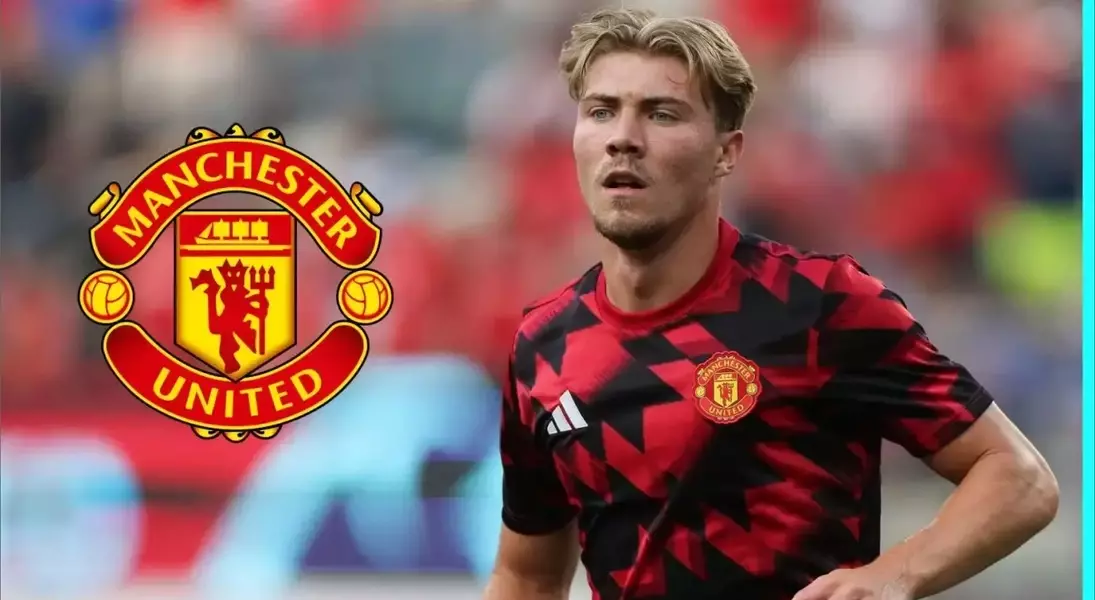
Manchester United faces a crucial decision regarding its attacking lineup as the club reportedly contemplates the sale of Rasmus Hojlund. This potential move is aimed at generating funds for the pursuit of Benjamin Sesko, a promising young striker identified as a key target. While Hojlund's current manager, Ruben Amorim, has publicly supported the Danish forward, emphasizing his valuable contributions beyond goal-scoring, insiders suggest that the club's leadership considers Hojlund a remnant of a former transfer approach. With substantial summer expenditures already made, the imperative to offload players like Hojlund becomes paramount for United to secure additional signings and reshape their squad.
The strategic shift within Manchester United's transfer policy has placed Rasmus Hojlund's future in considerable doubt. According to reports from the Manchester Evening News, journalist Samuel Luckhurst indicated that Hojlund is perceived by the club's board as being linked to a past administrative regime. This perspective suggests that despite his relatively recent arrival, Hojlund might be deemed expendable if the opportunity arises to bring in a new, preferred option like Benjamin Sesko. The urgency for player sales stems from United's substantial summer outlay, which limits their capacity for further acquisitions unless existing squad members are moved on. This financial constraint, coupled with a desire to realign the team with new strategic objectives, underscores the precariousness of Hojlund's position at Old Trafford.
Furthermore, the context of Hojlund's initial transfer, which notably involved a change of agent to coincide with former manager Erik ten Hag's representation, has added another layer of complexity to his situation. This past connection seemingly reinforces the narrative that Hojlund's acquisition was part of a previous strategic direction. Meanwhile, the club's active pursuit of Sesko is evident, with 'exploratory talks' already underway between Manchester United and the player's representatives. Renowned transfer expert Ben Jacobs confirmed that formal discussions have commenced, driven by figures like Director of Recruitment Christopher Vivell, highlighting Sesko as a top priority for the club's forward line.
Despite the prevailing transfer speculations, Manchester United manager Ruben Amorim has vocalized his satisfaction with Rasmus Hojlund's performance and commitment. After a 4-1 victory against Bournemouth in Chicago, Amorim expressed his contentment, stating, 'I’m really happy with Rasmus.' He further elaborated on Hojlund's importance beyond mere goal statistics, emphasizing the striker's ability to link play, hold up the ball, and involve teammates. This public endorsement from the manager, highlighting Hojlund's overall contribution to the team's improved play, contrasts sharply with the apparent internal decision-making by the club's hierarchy to potentially move him on to finance future transfers. The manager's comments underscore a player whose value extends beyond conventional metrics, even as the club navigates complex financial and strategic challenges.
Ultimately, Manchester United's ongoing transfer activities reflect a period of significant transition and strategic realignment. The potential departure of Rasmus Hojlund, despite his manager's backing and valuable on-field contributions, illustrates the club's determination to recalibrate its squad, particularly in the attacking third. The club's substantial summer spending has necessitated creative financial maneuvers, making player sales an integral part of their plan to fund new arrivals like Benjamin Sesko. This complex interplay of managerial confidence, board-level strategy, and financial constraints defines the current landscape at Old Trafford as the transfer window progresses.
