As the new Premier League season approaches, Manchester United is embarking on a strategic revitalization, spearheaded by CEO Omar Berrada. A recent all-staff meeting at Carrington underscored the club's renewed focus on unity, resilience, and a fresh set of guiding principles: 'Badge, Bravery, Spirit.' This internal alignment initiative comes amidst a significant restructuring under the INEOS regime, which has seen considerable changes in both football operations and administrative functions. The club's proactive engagement with staff, coupled with substantial investments in player talent and facility enhancements, demonstrates a clear intent to foster a cohesive and high-performing environment. Despite some lingering internal tensions stemming from recent cost-cutting measures, the leadership is committed to charting a new course for success, emphasizing collective effort and a shared vision for the future.
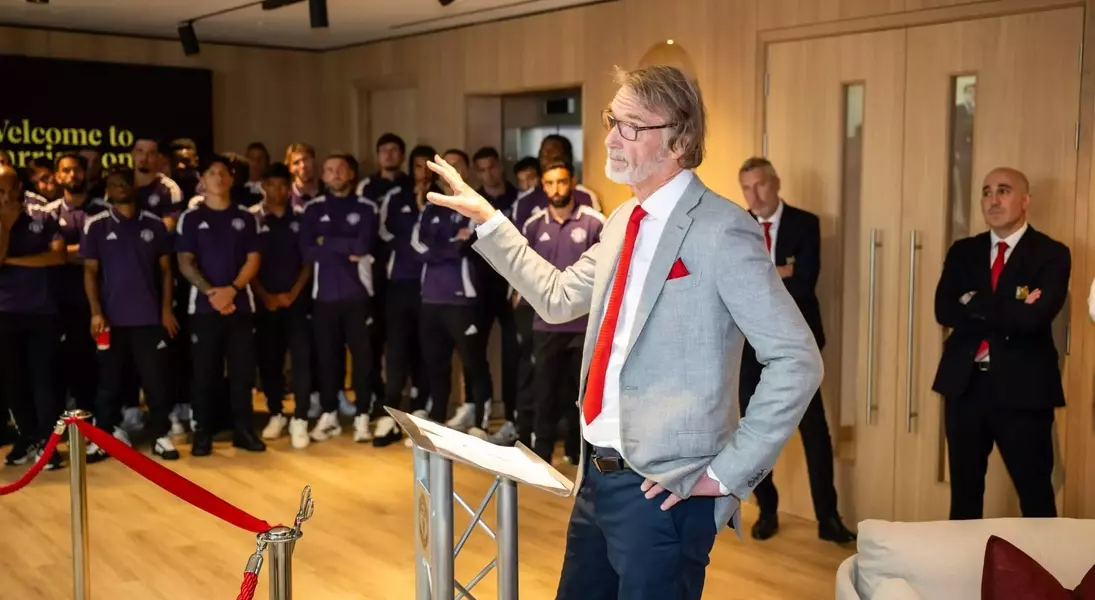
On a Monday at Manchester United's academy and women's building, chief executive Omar Berrada convened staff to inaugurate the new Premier League season. This gathering, held merely six days before United's fixture against Arsenal at Old Trafford, served as a platform for directors Jason Wilcox and Marc Armstrong, alongside Ruben Amorim, to reflect on the summer's progress. This season marks a pivotal moment, being the first time the club embarks on a campaign with both its head coach and football structure selected by Sir Jim Ratcliffe's INEOS leadership.
During the assembly, Berrada unveiled three foundational values intended to guide the club's endeavors: 'Badge, Bravery, and Spirit.' He elaborated on the significance of these principles, emphasizing their resonance with United's illustrious past and ambitious future. Bravery, he clarified, pertains to maintaining resilience during adversity, while the 'badge' symbolizes an entity greater than any individual. He passionately urged everyone to embrace the same unwavering spirit that Sir Matt Busby and Jimmy Murphy exemplified in the aftermath of the Munich air disaster, illustrating his points with a compelling video showcasing United's rich heritage.
Berrada further reinforced his message by citing legendary figures such as Eric Cantona and Roy Keane as exemplars of the club's desired ethos, known for their tenacious and uncompromising attitudes. Amorim's earlier remarks about Ratcliffe's disdain for 'bulls***' provided context for the leadership's clear expectations. Amorim also highlighted the contributions of less celebrated players whose dedication and application served as vital role models, underscoring the necessity of team cohesion and complementary personalities. In a symbolic gesture, staff members received metal water bottles inscribed with 'BADGE, BRAVERY, SPIRIT,' a tangible reminder of the newly articulated motto.
The meeting also incorporated an interactive segment where staff members were prompted to scan a QR code, directing them to a question about their contributions to upholding the three principles. Their anonymous responses, displayed in real-time, generally leaned towards constructive feedback, highlighting values such as 'integrity,' 'collaboration,' and 'hard work.' This collaborative atmosphere signaled a notable departure from previous, often strained, meetings over the past year and a half, which had been characterized by resentment due to drastic organizational changes.
Despite the generally positive reception, some feedback subtly acknowledged the challenging realities of Ratcliffe's leadership, which has involved significant layoffs and cost-cutting measures. Comments such as 'Stop being cheapskates' and expressions of 'little trust in leadership' surfaced, alongside grievances regarding senior managers' perceived lack of budget control and autonomy. Concerns were also raised about protracted spending approval processes and the discontinuation of the staff restaurant at Old Trafford by INEOS. Furthermore, the relocation of employees to Carrington sparked anxieties about potential class divisions among peer groups and the segregation of the canteen for players and non-football staff. Berrada, observing these messages for an extended period, visibly reacted to the sharper criticisms, remarking, 'Interesting,' after the session.
The discussion also touched upon the recent grand opening of Carrington's extensively renovated main building, a £50 million investment over the past year. Sir Jim Ratcliffe's visit for the inauguration led to an inspection of the open-plan offices, ensuring immaculate tidiness, particularly the absence of empty cups, a known pet peeve of Ratcliffe's. Parking limitations at the facility meant many attendees, despite a smaller crowd of 300 compared to previous large gatherings, had to park off-site. Although London staff participated remotely, a significant portion of the 650-strong workforce was absent, a stark contrast to the 800 attendees at the initial all-staff meeting led by Ratcliffe and Sir Dave Brailsford in January 2024.
While optimism surrounds United's summer transfers and efforts to instill a strong internal culture, underlying issues persist. Externally, fan sentiment remains mixed. The 1958 group, a vocal protest organization, initially called for a demonstration against the ownership before the Arsenal match but subsequently postponed it following a fan survey. This decision came amidst positive news, including the confirmed signing of Benjamin Sesko in a deal potentially worth €85 million. Such acquisitions tend to temper the intensity of fan protests, though the 1958 group has vowed to continue its push for accountability.
During the staff meeting, Wilcox, United's director of football, praised Benjamin Sesko's strong desire to join the club, claiming he declined more lucrative offers from Newcastle United after agreeing to personal terms with United, a point disputed by Newcastle. Sesko has since made his debut for Manchester United, playing against the under-21s at Carrington.
Amorim echoed the sentiment of recruiting players committed to Manchester United, commending Bruno Fernandes for rejecting a financially appealing move to Al Hilal in May. He emphasized that Fernandes, despite the significant financial incentive of Saudi Arabia, chose to remain and lead as captain, showcasing true leadership. Amorim articulated that catering to every player's financial demands is unsustainable for business operations, highlighting Fernandes's decision as a principled stand.
Amorim also expressed his belief that the newly enhanced Carrington facilities will significantly contribute to player satisfaction. He cited an instance where, after a training session, he observed four players enjoying a game of snooker. Armstrong, interjecting humorously, clarified the difference between snooker and pool, which the players were actually engaged in, bringing a lighter moment to the proceedings. The modern amenities at Carrington, including a barber shop, an F1 simulator, and PlayStation consoles in social areas, are expected to encourage players to spend more time at the complex, fostering stronger team bonds.
Amorim revealed he attended the staff meeting on a day off, something he would have been hesitant to do last season due to poor results. He admitted there were times when he dreaded coming to work, a sentiment that resonated with some staff members who had seen enthusiastic colleagues depart. However, he managed to inspire the audience by expressing his current excitement about working and how the revamped training complex facilitates greater interaction and integration with staff across various departments. He recounted engaging conversations with numerous colleagues while walking through the main building, underscoring his desire for a unified club environment.
Amorim's improved mood is undoubtedly linked to the substantial transfer outlay exceeding £200 million for players like Sesko, Matheus Cunha, and Bryan Mbeumo, providing him with enhanced resources for on-field success. This significant spending, alongside discussions for a potential move for Carlos Baleba, surpasses initial transfer window expectations and signals a shift from the previous strategy of needing sales first. This financial commitment suggests that Ratcliffe may view this season as a critical 'now or never' moment, knowing Amorim requires a strong start to maintain confidence in the football leadership. This approach bears some resemblance to Erik ten Hag's initial campaign, which saw rapid acquisitions like Casemiro and Antony following early setbacks, driven by the Glazers' need for Champions League qualification to preserve the club's valuation for a potential sale.
While the current hierarchy asserts that their player acquisitions are well-planned, the considerable expenditure contrasts with Ratcliffe's earlier remarks about the club potentially going 'bust by Christmas' without job cuts. Despite these significant investments, financial prudence remains crucial. Manchester United is utilizing its revolving credit facility, seemingly extended beyond £300 million, making revenue generation vital, especially without European broadcast income this year. Armstrong, appointed from Paris Saint-Germain in February as the club’s chief business officer, is central to this effort, having consolidated all income streams under his purview and actively pursuing new sponsorships. He informed staff that three new partnerships were imminent, and his team had secured £70 million in deals over the past five months. A notable new partner is Coca-Cola, now the official soft drink partner, in a deal estimated at £1 million annually. While not directly influencing on-pitch performance, such partnerships are crucial for funding Amorim’s squad development. United has taken a calculated risk with increased spending, and the head coach’s success now hinges on his players’ performance.
