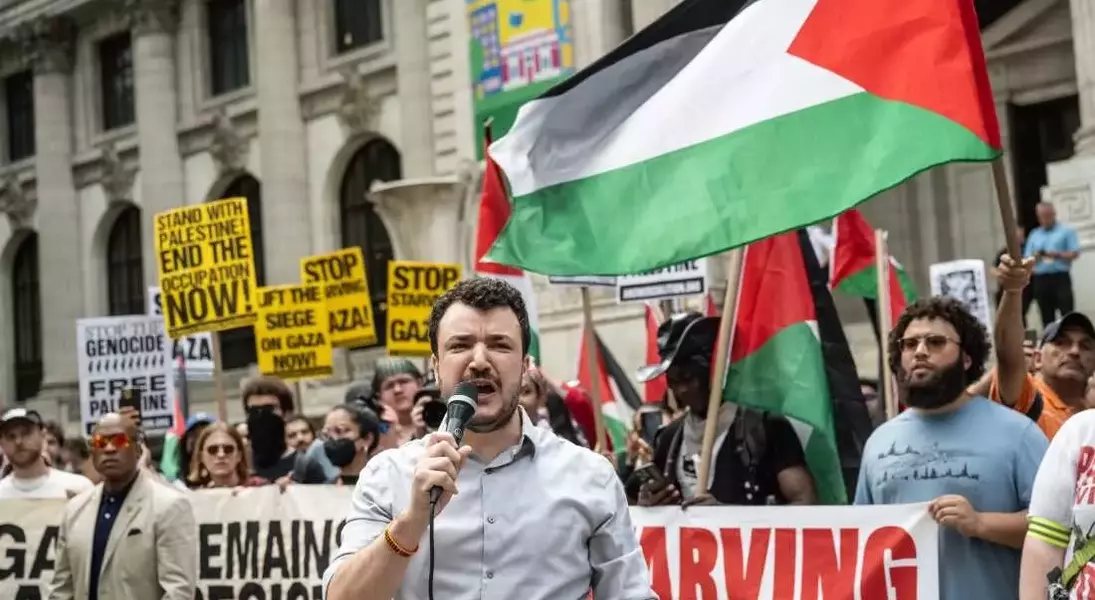
A year has passed since Mahmoud Khalil, a former Columbia University graduate student, was subjected to immigration detention, marking the beginning of an ongoing legal struggle. His situation has evolved into a pivotal case, challenging the Trump administration's stringent deportation policies and their broader implications for immigrants' civil liberties and due process rights. Despite facing significant personal and legal hurdles, Khalil remains resolute in his determination to contest the efforts to deport him, asserting that his detention is a direct consequence of his activism in pro-Palestinian demonstrations. This narrative underscores the precarious position of non-citizens whose political expressions lead to governmental scrutiny and potential removal from the country.
The ordeal began when Khalil was taken into custody outside his New York residence, just as his wife was preparing for the birth of their child. For over three months, he was held in immigration detention, grappling with the uncertainty of his future: whether he would be permitted to remain in the United States with his newborn son, whose arrival he tragically missed, or be expelled to a nation unfamiliar to him. His lawyers contend that the administration's actions represent a targeted response to his involvement in the 2024 Columbia University pro-Palestinian protests. Khalil himself believes he was singled out for his role in a student movement critical of U.S. support for Israel, highlighting a contentious intersection of political activism and immigration enforcement.
Initially, the administration utilized a seldom-invoked statute to justify Khalil's detention, with then-Secretary of State Marco Rubio asserting that Khalil's presence posed "potentially serious adverse foreign policy consequences." However, Khalil's legal team swiftly challenged this basis, arguing that the proper procedural steps for employing such a statute were not followed. A federal judge in New Jersey later supported Khalil's position, indicating that the administration's actions likely infringed upon his constitutionally protected right to political speech. This judicial stance affirmed the notion that the government's attempts to deport Khalil might be an unconstitutional penalization of his activism.
Following this setback, the administration altered its approach, attempting to revoke Khalil's permanent resident status by alleging he had misrepresented information on his green card application. Specifically, they claimed he omitted details about past employment with the British Embassy and a U.N. agency assisting Palestinian refugees. Khalil and his legal representatives vehemently deny these accusations, clarifying that his work with the U.N. was an internship supervised by Columbia University. They have since lodged an appeal with the immigration court appeals board, emphasizing that these claims are unfounded and represent a continued effort to target him.
The legal fight has consumed Khalil's life, forcing him to become intimately familiar with the complexities of immigration law and the specific tactics employed by the Trump administration to challenge his residency. He is supported by a large team of over 20 attorneys, navigating both the federal court system and immigration courts. Khalil articulated that the government's decision to pursue immigration proceedings against him, rather than other avenues, effectively weaponizes the immigration system to deny him due process. Despite a recent Third Circuit Court of Appeals ruling that limited federal court review until immigration proceedings are concluded, Khalil's legal team plans to appeal, wary that this could lead to his re-detention.
This case holds significant implications for the future of immigration law and free speech in the United States. Immigration attorneys closely monitoring the situation view Khalil's case as potentially precedent-setting, especially concerning the First Amendment rights of immigrants. As Eric Lee, an immigration attorney, noted, "The First Amendment is not a dial. It's either on or it's off." He argues that restricting the speech rights of any immigrant undermines the fundamental principle that the First Amendment applies to all individuals within the country. While some similar cases involving pro-Palestinian activists have seen favorable outcomes, others remain unresolved, with individuals like Khalil still facing an uncertain future. Khalil is prepared for a prolonged battle, stating that his fight transcends his personal circumstances, advocating for a principle where no one should endure such hardships merely for expressing their views against injustice.
