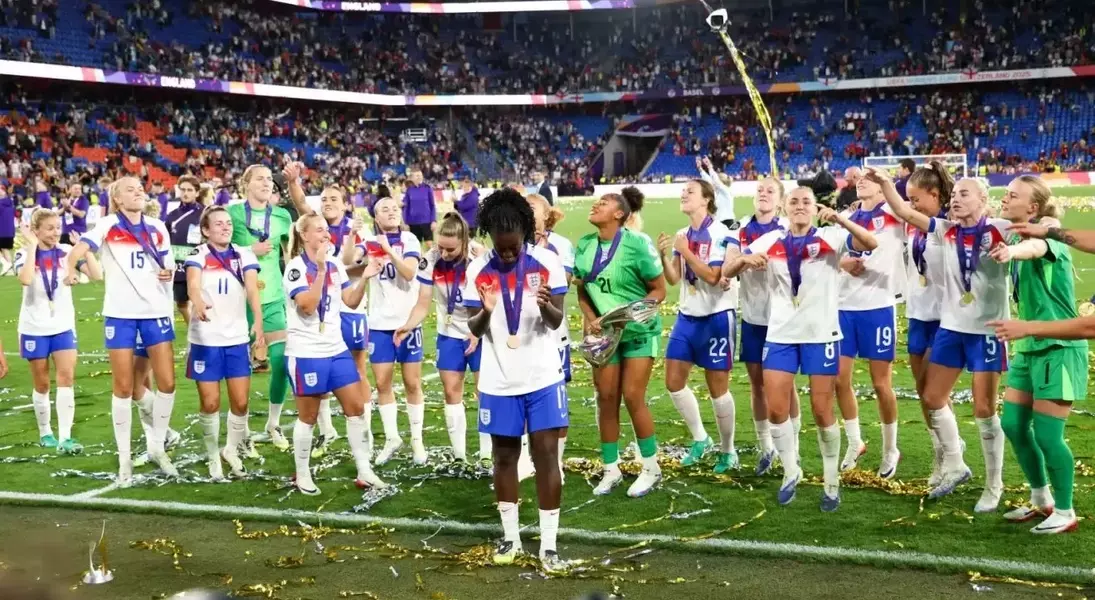
The recent triumph of the England women's football team, the Lionesses, securing consecutive European Championship titles, marks a remarkable achievement that transcends mere sporting success. Their journey to glory underscores an extraordinary blend of technical prowess, unwavering determination, and profound collective spirit. This victory stands as a powerful testament to their unique development pathway, one characterized by overcoming systemic challenges and forging their own identity. The Lionesses' success story is not a mere replication of traditional football models but a distinctly female narrative of excellence and inspiration.
This historic accomplishment by the Lionesses highlights a new era for women's football, showcasing how a team's inherent strength and unity can lead to unparalleled heights. Their triumph is a powerful symbol of national pride, reflecting the diverse backgrounds and shared aspirations of a group of athletes who have consistently defied expectations. Their resilience, evident in navigating demanding matches and emerging victorious, speaks volumes about their character and commitment. This extraordinary achievement firmly establishes the Lionesses as a benchmark of sporting excellence, distinct in its origin and impact.
The Lionesses' Unparalleled Rise to Prominence
The England women's football team, known as the Lionesses, has carved out an extraordinary legacy, achieving successive European Championship victories. This remarkable success, epitomized by Chloe Kelly's decisive penalty, propelled the team to unprecedented levels of acclaim, a scenario largely unimaginable for earlier generations of women's football. Their ascent from determined contenders to dominant champions signifies a profound shift in the landscape of the sport. For passionate English supporters, years of collective anticipation have been replaced by the joyous realization of consistent deep runs and ultimate triumphs in major tournaments.
The current Lionesses squad stands as a beacon of developmental achievement. While national football federations often attempt to replicate successful models from other teams, the Lionesses' journey has been uniquely effective, albeit not always as initially envisioned. Despite possessing exceptional technical abilities, this England team does not rely on a Spanish-style possession-based game. Instead, their success is more akin to the German approach, prioritizing winning through a combination of technical skill and an unyielding will. Their path to the second Euro title, marked by an initial defeat, extra time in every knockout match, and two penalty shootouts, vividly illustrates their immense talent, squad depth, and indomitable resilience. This characteristic grit likely stems from the numerous obstacles these athletes have overcome simply to participate in the sport.
Cultivating Success: Beyond Conventional Paradigms
The evolution of coaching standards at youth levels within women's football has seen exponential improvements over the past decade, providing players in academies with superior technical instruction and more structured development. However, women's football continues to grapple with significant underfunding at the youth level when compared to its male counterpart, disproportionately affecting inner-city girls who often lack access to the predominantly suburban-based academies and established scouting networks. Thus, the tenacity and unwavering determination that have characterized England's recent international achievements can largely be attributed to the inherent challenges these women have consistently surmounted throughout their careers in the sport.
A significant factor in their development has been the players' willingness to seek opportunities abroad, enriching their tactical understanding and technical abilities. While the Women's Super League (WSL) has emerged as a premier club competition globally, the remuneration for even top players does not parallel the financial gains enjoyed by male Premier League counterparts. With only a dozen teams in the top flight, playing opportunities are limited within England. Consequently, many Lionesses have opted to play overseas, with notable figures like Lucy Bronze and Keira Walsh featuring for Barcelona, and others experiencing stints in France, the United States, and Germany. These international experiences have undoubtedly pushed them beyond their comfort zones, introducing fresh tactical insights and further honing their skills, both as athletes and individuals. Additionally, their guidance under Sarina Wiegman, a coach with a proven track record of three consecutive European Championship wins, has been pivotal. Her ability to transform the team into world-beaters after her 2021 appointment has been instrumental in their success. The profound sense of English pride expressed by players like Chloe Kelly following their victory resonates deeply, representing a nation at its finest—a diverse group united by a common goal, demonstrating an unyielding commitment that defines their unique, inspiring triumph.
