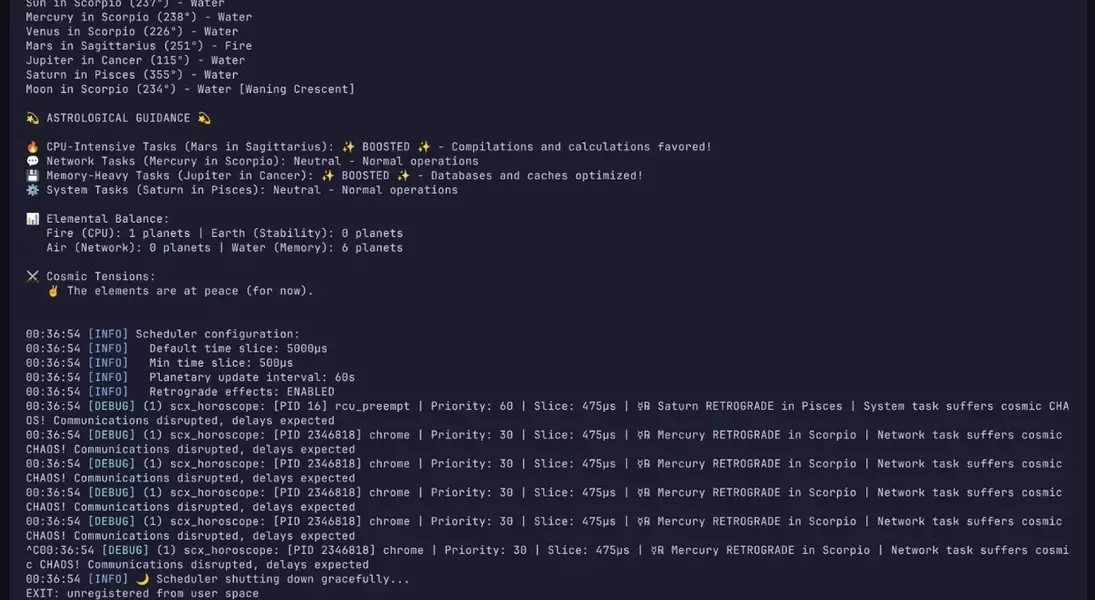
A novel Linux CPU scheduler, playfully named "scx_horoscope," has emerged as a truly unconventional project, integrating celestial mechanics and astrological tenets to govern processor operations. This endeavor, born from the creativity of software engineer Zampierilucas, assigns task priorities based on real-time planetary alignments and zodiac classifications, transforming mundane computing into a cosmic dance of data. Despite its highly speculative scientific foundation, the scheduler is fully functional, highlighting an imaginative intersection of technology and ancient beliefs, primarily intended for educational exploration and amusement within the developer community.
The creator, Zampierilucas, explicitly states that the project's intent is purely for educational and entertainment value. Emphasizing its "scientifically dubious" nature for practical application, he describes it as "cosmically hilarious" and perfect for engaging audiences at conferences or hackathons. The scheduler's core functionality relies on accurate geocentric planetary calculations, incorporating a diverse range of astrological influences.
Among its more peculiar features is lunar phase scheduling, which purportedly grants a 1.4x performance boost to tasks during a full moon. More notably, it introduces a zodiac-based task classification system. Here, different celestial bodies are assigned dominion over specific system operations. For instance, the Sun, symbolizing life force, manages critical system processes (such as PID 1 and init), while the Moon, reflecting emotions, oversees interactive tasks like shell commands and text editors. Jupiter, representing expansion, is delegated to handle memory-intensive applications like databases and web browsers.
Further adding to its intricate logic, the scheduler factors in the elemental affinities and oppositions derived from zodiac signs. Tasks governed by fire signs such as Aries, Leo, or Sagittarius receive a 1.5x performance multiplier, whereas water signs dampen this to 0.6x, reflecting the astrological concept of water extinguishing fire. Moreover, during planetary retrogrades—periods when planets appear to move backward through the zodiac—all tasks under the influence of that particular planet incur a 50% time slice penalty, adding another layer of complexity to this celestial algorithm.
While the amalgamation of complex CPU scheduling with astrological principles might initially seem overwhelming, the sheer ingenuity behind this project is undeniable. It serves as a fascinating example of how creative thinking can push the boundaries of conventional technical implementations. Though its practical utility beyond a demonstration of what is theoretically possible is questionable, it certainly sparks a conversation about alternative approaches to problem-solving and the playful side of engineering. As Zampierilucas himself queries, "If the universe can influence our lives, why not our CPU scheduling too?" The answer, while likely rooted in scientific pragmatism, doesn't diminish the charm of this remarkably inventive endeavor.
