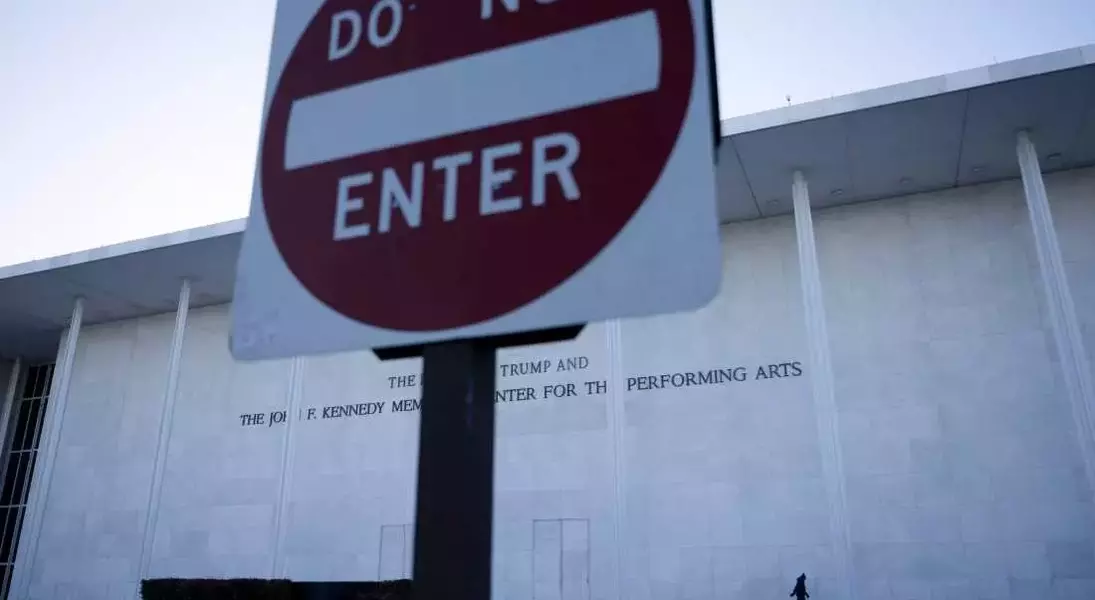
A coalition of architectural and cultural bodies has filed a lawsuit against President Trump and the governing board of the Kennedy Center. This legal action seeks to prevent forthcoming renovations at the renowned arts complex, contending that current plans disregard established historic preservation regulations and circumvent the requisite congressional endorsement. The petitioners emphasize the Kennedy Center's status as a vital historical and cultural monument, arguing that any significant alterations demand meticulous adherence to legal frameworks designed to safeguard such national treasures. This case brings to the forefront debates surrounding executive authority, institutional governance, and the preservation of national heritage sites in the face of proposed modernization.
The litigation against President Trump and the Kennedy Center board by a collective of eight prominent architectural and cultural organizations underscores a critical conflict regarding the future of a pivotal national arts institution. This consortium, representing over a million members, contends that the planned renovations, scheduled to commence in approximately three months, fail to adhere to critical historic preservation statutes and have not secured the necessary congressional approval. Their legal submission to the U.S. District Court in Washington, D.C., names the American Institute of Architects, the American Society of Landscape Architects, the Committee of 100 on the Federal City, the Cultural Landscape Foundation, the DC Preservation League, Docomomo US, and the National Trust for Historic Preservation as plaintiffs. This group's unified stance highlights a profound concern over maintaining the structural and symbolic integrity of the Kennedy Center, arguing that its historical significance warrants a more rigorous and legally compliant approach to any proposed changes. The lawsuit challenges the authority and methodology employed by the current administration and the center's leadership in advancing these renovations, bringing into question the transparency and legality of the decision-making process.
Legal Battle Over Kennedy Center's Future
A collection of eight significant architectural and cultural bodies has launched a federal lawsuit against President Trump and the Kennedy Center's governing board. The core of their argument revolves around ensuring that the planned renovations for the arts facility comply with existing historic preservation statutes and receive proper congressional consent before proceeding. This legal challenge, initiated in Washington, D.C., by a broad alliance of organizations including the American Institute of Architects and the National Trust for Historic Preservation, reflects a deep concern for the iconic structure's historical and cultural integrity. The groups collectively stress the need for adherence to established protocols for modifying national landmarks, particularly given the center's role as a living memorial and a significant cultural hub. They advocate for a process that respects the center's heritage and involves all necessary legislative oversight, emphasizing the principle that such profound changes to a public institution should not occur without thorough legal and procedural scrutiny.
The lawsuit explicitly aims to prevent the Kennedy Center's board and the White House from proceeding with renovations without first satisfying critical legal requirements. The plaintiffs contend that the center, established in 1971, represents an "irreplaceable legacy of history, architecture and civic purpose," symbolizing a national gathering point for the arts and a tribute to a former president. They argue that under President Trump's chairmanship, the board and his appointees are attempting to fundamentally alter this property without observing federal historic preservation and environmental laws, or obtaining congressional authorization. Citing past actions, such as the demolition of the White House East Wing, the organizations express apprehension that the proposed "complete rebuilding" of the Kennedy Center signifies a broader pattern of disregarding historical preservation. The absence of publicly released architectural plans, alongside the Kennedy Center's silence on inquiries regarding the project's details, funding, and expert involvement, further fuels the plaintiffs' concerns about transparency and proper governance. This legal confrontation is therefore not merely about a building, but about the integrity of the process by which national cultural assets are managed and transformed.
Preservation Concerns and Procedural Integrity
The essence of the legal dispute against President Trump and the Kennedy Center board lies in the profound concerns raised by architectural and cultural organizations regarding the preservation of a national landmark. These groups assert that any proposed renovations must strictly adhere to historic preservation laws and obtain explicit approval from Congress, highlighting a perceived bypass of established legal and oversight mechanisms. The plaintiffs contend that the actions of the current administration and the center's leadership signify a disregard for the historical and cultural value of the Kennedy Center, treating a significant national memorial as a property that can be unilaterally redeveloped. Their lawsuit serves as a critical effort to uphold the principles of careful stewardship for national heritage, ensuring that alterations to such iconic structures are undertaken with maximum transparency, public consultation, and legal compliance, rather than through executive decree or expedited processes.
The detailed complaints outlined in the lawsuit paint a picture of a presidency and a board intent on remaking the Kennedy Center without the customary checks and balances. The groups emphasize the center's historical significance as a "living memorial" and a "defining landmark" of the nation's capital, whose Modernist design and public spaces form a crucial part of its legacy. They specifically accuse President Trump, in his capacity as chairman, and his appointed trustees, of wishing to "fundamentally alter this iconic property" without complying with "bedrock federal historic preservation and environmental laws" and without obtaining "the necessary Congressional authorization." The plaintiffs further buttress their argument by referencing previous controversial actions, such as the demolition of the East Wing of the White House, and President Trump's repeated statements about a "complete rebuilding" of the Kennedy Center. The lack of public disclosure regarding the architectural plans, funding, and the experts involved in the renovation project, despite repeated requests, underscores the organizations' argument that the process lacks transparency and accountability. This judicial challenge seeks not only to protect the physical structure but also to reinforce the procedural integrity and democratic oversight expected for projects involving national monuments.
