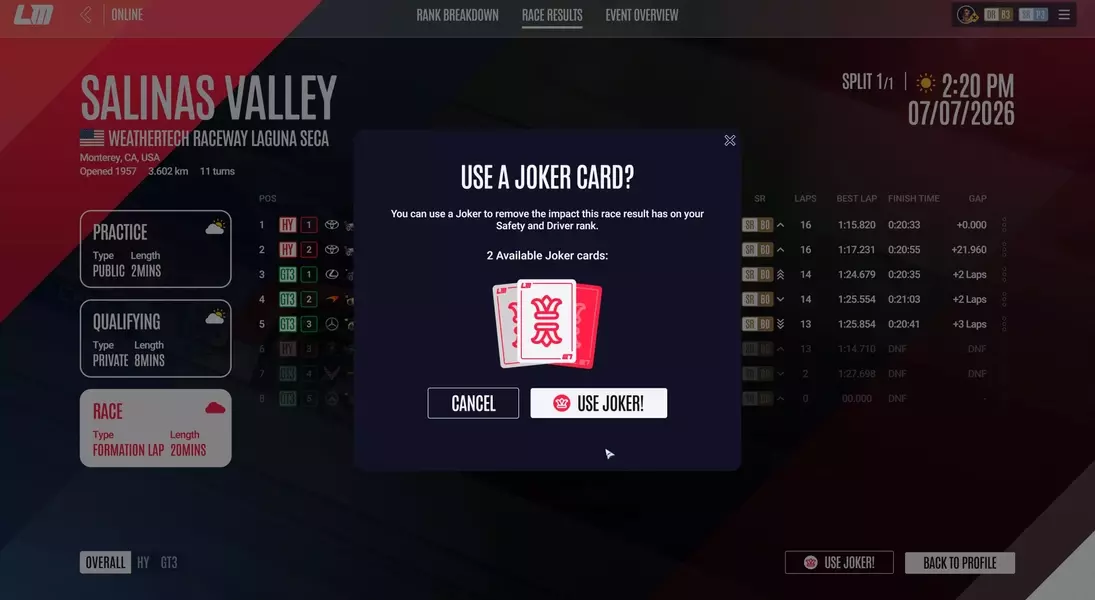
A recent development in the virtual racing sphere has stirred considerable controversy among players. The simulation racing title, Le Mans Ultimate, has unveiled an unusual subscription-based feature that has drawn sharp criticism. Instead of a conventional "pay-to-win" model, this new system offers subscribers a "pay-not-to-lose" advantage, allowing them to nullify undesirable race outcomes. Whether a player finished last, crashed their vehicle, or was responsible for another driver's mishap, a monthly fee promises to erase these incidents from their record.
Le Mans Ultimate, a highly competitive online racing game, employs a "driver rank" and a "safety rank" to evaluate player skill and penalize aggressive driving. A high driver rank combined with a low safety rank indicates a skilled but reckless player. These metrics influence matchmaking and serve as markers of achievement. Developer Studio 397 announced the "Event Joker" system, set to launch on July 28, as a solution for unforeseen incidents like crashes, internet disconnections, or even a pet-induced distraction. Players would earn one Joker after every 10 races, up to a maximum of three, to negate a single race result. While the outcome would still count for championships, it wouldn't impact the player's driver or safety rank.
Despite the apparent reasonableness of the Joker system, it has ignited a firestorm within the Le Mans Ultimate community. Social media platforms are awash with condemnation, with many posts labeling the system as "the worst idea ever" and a clear "P2W" (pay-to-win) mechanic. The core of the dissatisfaction lies in the fact that Jokers are exclusively available to those with a paid monthly "Pro" or "Pro+" membership. This means that subscribers can effectively remove their worst performance from every ten races, gaining an unfair ranking advantage over non-subscribers, even if their poor results weren't due to accidents. Critics argue that this undermines the integrity of the ranking system, where gains would no longer solely reflect driving performance but also strategic Joker usage, disproportionately rewarding inconsistency.
Beyond the pay-to-win debate, the Joker system has raised concerns about player conduct and safety. The safety rank is designed to foster fair play and ensure that drivers of similar caliber compete against each other. With a Joker in hand, a player could theoretically engage in reckless driving without suffering the typical penalties, as they could simply erase the negative impact. While deliberate dangerous driving should ideally lead to temporary bans, a loss of safety rank is currently the primary deterrent when intent is unclear. To quell the dissent, the developers could either make Jokers accessible to all players or abandon the system entirely, opting instead to reduce the impact of "did not finish" (DNF) results for everyone, regardless of subscription status. The current Joker system adds a new dimension to the ongoing discussion about what game features should legitimately reside behind paywalls in the gaming industry.
