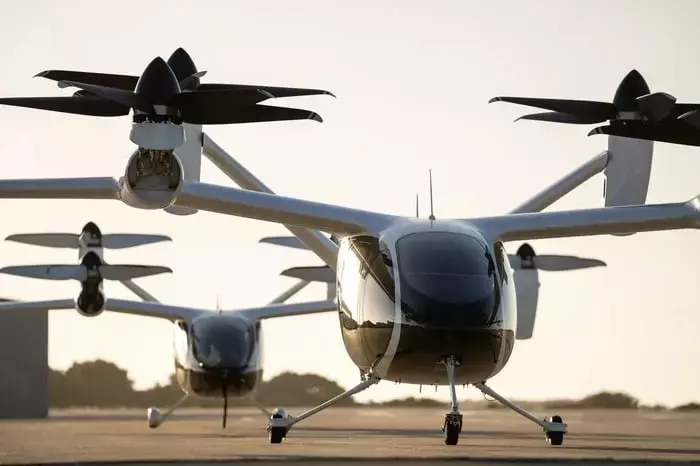
Joby Aviation is rapidly advancing in the electric vertical takeoff and landing (eVTOL) aircraft market, a sector projected to transform urban transportation with immense economic potential. The company's strategic progress, including advanced FAA certification and international test flights, positions it as a key player. Despite significant capital expenditure and a high market valuation, Joby's innovative approach aims to deliver commercial air taxi services by 2026, challenging traditional travel paradigms and offering lucrative opportunities for forward-thinking investors.
Joby Aviation's Journey Towards Commercial Skyward Journeys
In a groundbreaking period for aerial transportation, Joby Aviation is steering the future of urban mobility with its pioneering electric vertical takeoff and landing (eVTOL) aircraft. As of early September 2025, the company has seen its stock soar, reflecting strong investor confidence in its transformative potential. This enthusiasm stems from the belief that eVTOLs, by significantly reducing travel times, will become an invaluable asset in our time-constrained world.
Joby's cutting-edge aircraft are specifically designed for efficient urban commutes, offering a quieter and more environmentally friendly alternative to traditional helicopters, capable of transporting passengers over distances of approximately one hundred miles on a single charge. This innovation holds profound implications for public transportation, from easing airport congestion to facilitating rapid emergency responses and even revolutionizing package delivery. Esteemed financial institutions like Morgan Stanley foresee the eVTOL market expanding into a staggering $9 trillion industry by 2050, underscoring the monumental opportunity at hand.
A critical milestone for Joby is securing regulatory approval. The company is currently in the advanced stages of the Federal Aviation Administration (FAA) certification process, having completed roughly 70% of stage four, the penultimate phase before full clearance. While a production certificate and final stage five approval are still pending, the substantial progress indicates a clear path towards commercial operation. Successful navigation through these regulatory hurdles would allow Joby to transition from a development-focused entity to a revenue-generating air service provider.
Internationally, Joby has showcased its capabilities with an impressive series of 21 piloted test flights conducted during the summer in the challenging, high-temperature conditions of Dubai, United Arab Emirates. This successful demonstration reinforces the company's commitment to launching commercial passenger services in Dubai by early 2026, coinciding with the anticipated completion of its 'vertiport' at the Dubai International Airport. Domestically, Joby has also forged a strategic alliance with aerospace and defense leader L3Harris Technologies. This partnership is geared towards developing a gas turbine hybrid aircraft for defense applications, with initial test flights slated for the upcoming autumn and full demonstrations planned for 2026. These collective efforts are meticulously laying the groundwork for what promises to be a pivotal year for Joby Aviation in 2026, potentially marking its transition to a fully operational commercial air travel provider.
However, despite these promising developments, Joby faces considerable financial challenges. With approximately $991 million in cash reserves and a burn rate of about $500 million over the past year, the company has less than two years before it will necessitate additional funding. Furthermore, its current market capitalization of roughly $11 billion and a projected full-year revenue of merely $232,000 result in an extremely high price-to-sales ratio. This inflated valuation suggests that future growth expectations are already largely factored into the stock price, making it susceptible to significant volatility based on upcoming news.
A Sky Full of Potential: Reflecting on the Future of Flight
From a journalist's perspective, Joby Aviation's narrative is a compelling saga of innovation meeting reality. It’s a vivid illustration of how visionary technology, backed by strategic partnerships and relentless testing, can push the boundaries of what's possible in transportation. The company's journey highlights the intricate balance between pioneering new frontiers and navigating the pragmatic demands of regulatory approval and financial sustainability. For investors, Joby represents a high-stakes, high-reward proposition: the chance to be part of the next major industrial disruption, akin to the early days of ride-sharing giants like Uber. However, it also serves as a cautionary tale, reminding us that even the most revolutionary ideas must overcome significant operational and financial hurdles to achieve widespread adoption and profitability. The path to a sky filled with commercial eVTOLs is still being charted, and Joby Aviation is undoubtedly at the forefront of this exhilarating aerial revolution, shaping not just how we travel, but how we perceive time and distance in our increasingly connected world.
