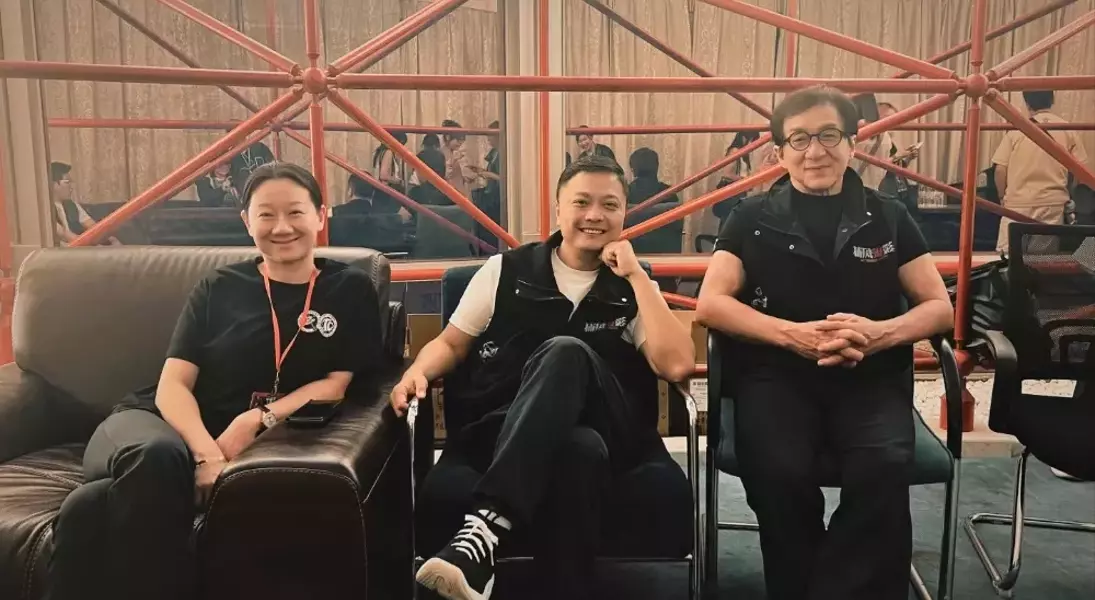
The film \"Shadow's Edge,\" featuring Jackie Chan, is gaining significant attention at the Busan International Film Festival, with discussions already underway for a potential sequel. This action thriller has successfully reinterpreted a classic Hong Kong film for contemporary viewers, achieving notable box office success in China. The creative minds behind the project share their vision and the collaborative efforts that brought this compelling narrative to life.
\"Shadow's Edge\": A Reimagined Thriller's Global Ascent and Future Horizons
Considering a Follow-Up for a Box Office Hit
Director Larry Yang and producer Victoria Hon are exploring the possibility of a continuation for Jackie Chan's film, \"The Shadow's Edge.\" The action-packed movie premiered globally at the Busan International Film Festival's Open Cinema segment, drawing considerable interest.
Modernizing a Classic: Crafting a New Cinematic Experience
This crime thriller has held the top spot at the Chinese box office for an impressive four weeks. It serves as a fresh take on the iconic Hong Kong movie \"Eye in the Sky,\" tailored for today's viewers. Director Larry Yang, known for his debut feature \"Mountain Cry\" which closed the 20th Busan festival, reunites with Chan after their successful collaboration on \"Ride On\" in 2023.
Director's Vision: Adapting to Evolving Audience Preferences
Yang noted that the primary hurdle wasn't updating the plot with modern technology, but rather aligning it with current audience tastes. He expressed a willingness to retell the same narrative if it resonated with today's audiences, though he acknowledged that might not always be the case. Yang emphasized that establishing the correct tone—encompassing character development, pacing, and emotional progression—is more crucial than merely finding suitable story backdrops.
A Creative Remake: Balancing Originality and Inspiration
The film incorporates a substantial amount of new material, roughly 85-90%, while still drawing inspiration from the original concept. Yang clarified that his respect for the source material stemmed from his desire to secure remake rights, even if for just a small fraction, because that core idea is the essence of any film. He believes a powerful idea always precedes a story, and there are countless ways to articulate such an idea.
Reimagining Characters: A Fresh Take on Familiar Roles
Yang's approach to the remake prioritized artistic freedom over strict adherence to the original narrative. He viewed a remake not as a scene-by-scene replication but as a fresh evolution of the same underlying concept. Consequently, his focus remained on what would best serve his interpretation and the mood he aimed to create around the central idea, rather than strictly balancing old and new elements.
Jackie Chan's Role: A Veteran Surveillance Expert's Return
In \"The Shadow's Edge,\" Jackie Chan portrays a seasoned surveillance specialist who is called back from retirement to investigate a high-stakes robbery in Macau. Tony Leung Ka-fai reprises his villainous role from the original \"Eye in the Sky,\" though Yang reimagined the character for the contemporary setting.
Evolving Narratives: The Villain's Hypothetical Journey
Yang pondered Leung's character as a speculative \"what if\" scenario, imagining a parallel reality. He questioned what would transpire if the character had survived, been rescued by children, raised and trained them, and then collaborated with them two decades later. He explored how spending years with these young individuals might instill a sense of affection in the ruthless character, and what if a misunderstanding led to a betrayal of that affection.
Technology and Wit: Driving the Narrative Forward
The movie seamlessly blends advanced surveillance technology with action sequences propelled by character development. Yang explained that the concept of a covert surveillance team tracking a hidden target originated from the initial story. Technology acts as both an impediment and an advantage for both sides, introducing fresh complexities to the plot. He ensured that this technological aspect never overshadowed the intense energy of the storytelling, maintaining that it remains a \"human story,\" driven by intellect rather than solely by tech.
Action with Purpose: Beyond Mere Spectacle
Yang stressed that the action sequences serve a deeper narrative function beyond mere visual excitement. He described action as an extension of dialogue, a continuation of a quiet, clandestine surveillance mission, and a means to combat evil that technology alone could not address. The team crafted sequences that \"spoke\" through the characters, consistently anchoring them in human elements.
Jackie Chan's Enduring Prowess: Still a Force in Action
Regarding Jackie Chan's capabilities, Yang confidently stated that the legendary actor can still perform fight scenes, and this film is far from pushing his limits.
Generational Themes: Old Meets New
Producer Victoria Hon highlighted the film's exploration of generational themes. She mentioned that the remake rights for \"Eye in the Sky\" were acquired years ago, and the story underwent extensive development. The challenge lay in making the narrative resonate with today's audiences, especially considering the growing influence of AI in modern society. This led to the incorporation of AI elements, with the interplay of old and new becoming a central theme.
Overcoming Challenges: Securing Investment in a Niche Genre
The production faced the significant challenge of convincing investors that action films could succeed in the current Chinese market. Hon explained that action movies had not been performing well at the box office recently. To gain investor confidence, the team dedicated considerable effort to refining the script and developing compelling characters.
The Power of the Script: Attracting Top Talent
Hon attributed the film's ability to attract renowned talent to its strong screenplay. She believed the script was the initial milestone, enabling them to engage masters like Jackie Chan and Tony Leung and persuade them of the unique and distinct qualities of their characters. The production also benefited from young actors with extensive wushu training and a creative, energetic crew.
Synergy of Experience and Youth: A Recipe for Success
The production strategy involved balancing industry veterans with emerging talent, reflecting the film's theme of old and new. Hon emphasized that this blend was a key to success, allowing them to learn from experienced masters while infusing the film with youthful energy and creativity.
Collaborative Action: Jackie Chan's Insightful Contributions
Hon described the collaborative process with Chan, noting that director Larry and action director Su Hang had many innovative ideas for action sequences. They created action demos for Chan, who, with his vast experience, offered advice on enhancing tension or mitigating risks. Chan's trust in the team was invaluable, allowing them to explore new ideas.
Intensive Preparation: Crafting Complex Action Scenes
The intricate action sequences demanded extensive preparation and a significant budget. Hon explained that despite the high cost and time commitment, action scenes were filmed by a single crew to maintain consistency in action and performance. Pre-production spanned about five months, and filming took 84 days, with most action scenes storyboarded and demos filmed beforehand.
Macau's Unique Charm: A Perfect Setting
Macau's distinctive cultural landscape played a crucial role in shaping the film's atmosphere. Hon described Macau as a city where luxurious hotels stand alongside historic old towns, creating a mixed cultural environment. This unique backdrop perfectly complemented the story and characters.
Organic Location Scouting: Discovering the City's Potential
The production team spent eight months scouting locations, with some sequences naturally arising from the geography. Hon mentioned that script locations were chosen based on real-world routes they explored, such as how the robbers' landing platform after flying from Macau Tower was identified by standing at the tower's edge and spotting the Wynn Macau platform, leading to collaboration with the hotel.
Global Reach: Optimism for International Sales
With Golden Network Asia managing international sales, Hon expressed confidence in the film's overseas performance. She noted that many sales were finalized at Cannes earlier in the year, with buyers expressing enthusiasm after seeing demos and reels. She looks forward to strong box office results globally.
Future Endeavors: Sequels and Genre Exploration
Looking ahead, Yang confirmed ongoing discussions for a sequel and his plans for additional action projects. He expressed a desire to avoid repetition, indicating he would likely pursue a fresh approach for any follow-up. He remains open to exploring new genres, including sci-fi or historical narratives.
Expanding Horizons: Asian Cinema's Global Appeal
Hon foresees continued opportunities for Asian cinema in international markets. She believes commercial genres like action and thrillers are most effective for reaching global audiences. The team intends to continue working within the action genre and hopes to engage in more co-productions that appeal to both local and international viewers.
